
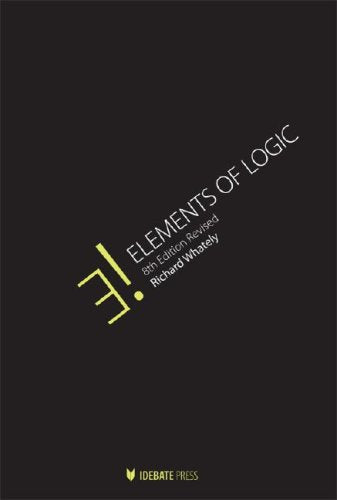
Title
Elements of Logic (Key Titles in Rhetoric, Argumentation, and Debate),Used
Sold by Ergodebooks, an authorized reseller.
Returns accepted within 30 days | support@ergodebooks.com
Shipping Information
- Free Standard Shipping — United States only
- Processing Time: 3–5 business days
- Estimated Delivery: 6–10 business days after dispatch
- Double-boxed, fully insured & discreetly packaged
- Tracking number sent via email once dispatched
Returns & Refund
Returns accepted within 30 days of delivery.
Damaged or Defective Item
Free return shipping + replacement or full refund
Wrong Item Received
Free return shipping + replacement or full refund
Change of Mind
Return shipping at customer's expense · 25% restocking fee applies
Payment Option

This classical text was once dismissed as a mere reaffirmation of Aristotle's doctrine of syllogistic reasoning, standing in opposition to the new logic of scientific induction that dominated the modern era of logic and rhetoric. Yet today Elements of Logic again offers a number of useful principles for teaching reasoning and critical thinking to undergraduates, helping them to understand that common reasoning patterns are a constant across subjects and contexts. As the linear reasoning patterns of the inductive scientific method are fading, students are constantly exposed to, and seek out, information that comes in short bursts and is dominated by visual and aural stimuli. Those who must create new models of reasoning to fit everevolving forms of electronic media may find guidance and inspiration in Whately's work.
⚠️ WARNING (California Proposition 65):
This product may contain chemicals known to the State of California to cause cancer, birth defects, or other reproductive harm.
For more information, please visit www.P65Warnings.ca.gov.
- Q: What is the main focus of 'Elements of Logic' by Richard Whately? A: The book primarily focuses on teaching reasoning and critical thinking, emphasizing common reasoning patterns across various subjects and contexts.
- Q: Who is the author of 'Elements of Logic'? A: The author of 'Elements of Logic' is Richard Whately.
- Q: What is the publication date of this book? A: The book was published on September 30, 2008.
- Q: What is the binding type of 'Elements of Logic'? A: The binding type of 'Elements of Logic' is paperback.
- Q: How many pages does 'Elements of Logic' have? A: The book contains 402 pages.
- Q: Is 'Elements of Logic' suitable for undergraduate students? A: Yes, the book is designed to help undergraduate students understand reasoning and critical thinking.
- Q: What condition is the used book in? A: This is a used book in good condition.
- Q: What topics are covered in 'Elements of Logic'? A: The book covers topics related to syllogistic reasoning, critical thinking, and reasoning patterns relevant to various disciplines.
- Q: Is there a specific edition of 'Elements of Logic' available? A: Yes, the book is available in a revised edition.
- Q: Can 'Elements of Logic' help with modern reasoning challenges? A: Yes, the book provides guidance for creating new models of reasoning suitable for contemporary forms of electronic media.