
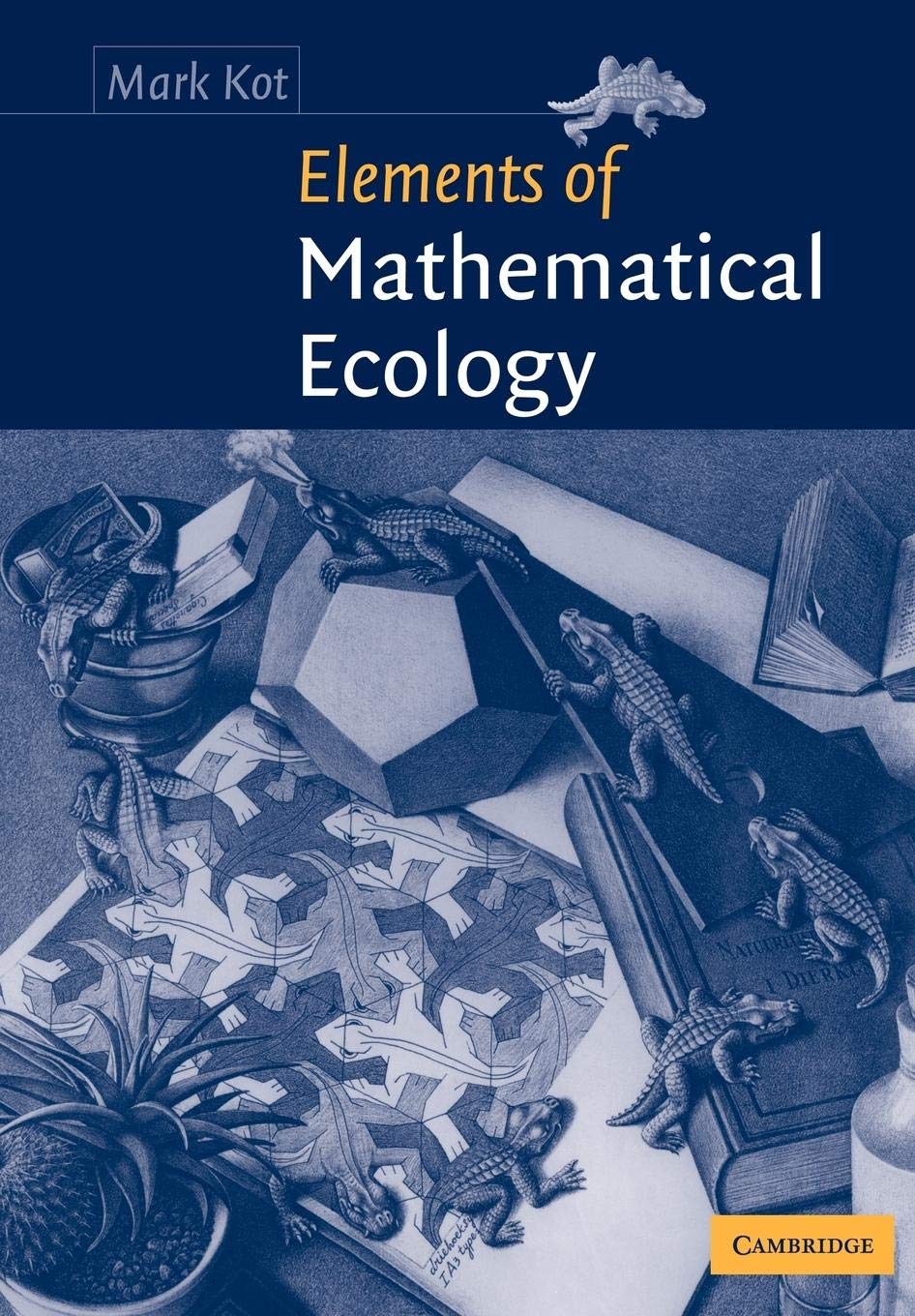
Title
Elements of Mathematical Ecology,Used
Sold by Ergodebooks, an authorized reseller.
Returns accepted within 30 days | support@ergodebooks.com
Shipping Information
- Free Standard Shipping — United States only
- Processing Time: 3–5 business days
- Estimated Delivery: 6–10 business days after dispatch
- Double-boxed, fully insured & discreetly packaged
- Tracking number sent via email once dispatched
Returns & Refund
Returns accepted within 30 days of delivery.
Damaged or Defective Item
Free return shipping + replacement or full refund
Wrong Item Received
Free return shipping + replacement or full refund
Change of Mind
Return shipping at customer's expense · 25% restocking fee applies
Payment Option

Elements of Mathematical Ecology provides an introduction to classical and modern mathematical models, methods, and issues in population ecology. The first part of the book is devoted to simple, unstructured population models that ignore much of the variability found in natural populations for the sake of tractability. Topics covered include density dependence, bifurcations, demographic stochasticity, time delays, population interactions (predation, competition, and mutualism), and the application of optimal control theory to the management of renewable resources. The second part of this book is devoted to structured population models, covering spatiallystructured population models (with a focus on reactiondiffusion models), agestructured models, and twosex models. Suitable for upper level students and beginning researchers in ecology, mathematical biology, and applied mathematics, the volume includes numerous clear line diagrams that clarify the mathematics, relevant problems throughout the text that aid understanding, and supplementary mathematical and historical material that enrich the main text.
⚠️ WARNING (California Proposition 65):
This product may contain chemicals known to the State of California to cause cancer, birth defects, or other reproductive harm.
For more information, please visit www.P65Warnings.ca.gov.
- Q: What is the main focus of 'Elements of Mathematical Ecology'? A: The book provides an introduction to classical and modern mathematical models and methods used in population ecology, covering both simple and structured population models.
- Q: Who is the intended audience for this book? A: This book is suitable for upper-level students and beginning researchers in ecology, mathematical biology, and applied mathematics.
- Q: What topics are covered in the book? A: Topics include density dependence, bifurcations, demographic stochasticity, time delays, and population interactions such as predation, competition, and mutualism.
- Q: Does the book include illustrations or diagrams? A: Yes, the book contains numerous clear line diagrams that help clarify the mathematical concepts discussed.
- Q: What type of models does the second part of the book focus on? A: The second part focuses on structured population models, including spatially-structured models, age-structured models, and two-sex models.
- Q: When was 'Elements of Mathematical Ecology' published? A: The book was published on August 6, 2001.
- Q: What is the binding type of this book? A: The book is available in paperback binding.
- Q: How many pages does the book have? A: The book contains a total of 464 pages.
- Q: Who is the author of 'Elements of Mathematical Ecology'? A: The author of the book is Mark Kot.
- Q: Is the book in new condition? A: Yes, the item condition is listed as new.