
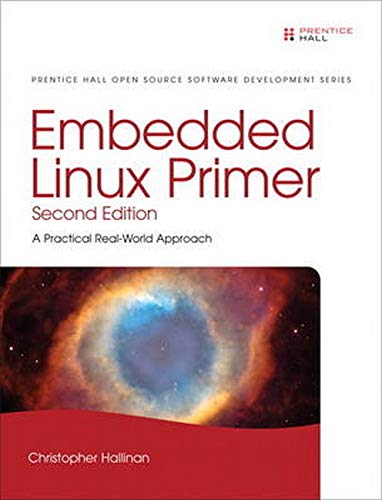
Title
Embedded Linux Primer: A Practical, Realworld Approach,Used
Sold by Ergodebooks, an authorized reseller.
Returns accepted within 30 days | support@ergodebooks.com
Shipping Information
- Free Standard Shipping — United States only
- Processing Time: 3–5 business days
- Estimated Delivery: 6–10 business days after dispatch
- Double-boxed, fully insured & discreetly packaged
- Tracking number sent via email once dispatched
Returns & Refund
Returns accepted within 30 days of delivery.
Damaged or Defective Item
Free return shipping + replacement or full refund
Wrong Item Received
Free return shipping + replacement or full refund
Change of Mind
Return shipping at customer's expense · 25% restocking fee applies
Payment Option

Uptotheminute, Complete Guidance For Developing Embedded Solutions With Linuxlinux Has Emerged As Today&;S #1 Operating System For Embedded Products. Christopher Hallinan&;S Embedded Linux Primer Has Proven Itself As The Definitive Realworld Guide To Building Efficient, Highvalue, Embedded Systems With Linux. Now, Hallinan Has Thoroughly Updated This Highly Praised Book For The Newest Linux Kernels, Capabilities, Tools, And Hardware Support, Including Advanced Multicore Processors.Drawing On More Than A Decade Of Embedded Linux Experience, Hallinan Helps You Rapidly Climb The Learning Curve, Whether You&;Re Moving From Legacy Environments Or You&;Re New To Embedded Programming. Hallinan Addresses Today&;S Most Important Development Challenges And Demonstrates How To Solve The Problems You&;Re Most Likely To Encounter.You&;Ll Learn How To Build A Modern, Efficient Embedded Linux Development Environment, And Then Utilize It As Productively As Possible. Hallinan Offers Uptodate Guidance On Everything From Kernel Configuration And Initialization To Bootloaders, Device Drivers To File Systems, And Busybox Utilities To Realtime Configuration And System Analysis. This Edition Adds Entirely New Chapters On Udev, Usb, And Open Source Build Systems.Tour The Typical Embedded System And Development Environment And Understand Its Concepts And Components. Understand The Linux Kernel And Userspace Initialization Processes. Preview Bootloaders, With Specific Emphasis On Uboot. Configure The Memory Technology Devices (Mtd) Subsystem To Interface With Flash (And Other) Memory Devices. Make The Most Of Busybox And Latest Open Source Development Tools. Learn From Expanded And Updated Coverage Of Kernel Debugging. Build And Analyze Realtime Systems With Linux. Learn To Configure Device Files And Driver Loading With Udev. Walk Through Detailed Coverage Of The Usb Subsystem. Introduces The Latest Open Source Embedded Linux Build Systems. Reference Appendices Include Uboot And Busybox Commands.
⚠️ WARNING (California Proposition 65):
This product may contain chemicals known to the State of California to cause cancer, birth defects, or other reproductive harm.
For more information, please visit www.P65Warnings.ca.gov.
- Q: How many pages does this book have? A: This book contains six hundred sixteen pages. It provides comprehensive guidance on developing embedded solutions with Linux.
- Q: What are the dimensions of the book? A: The book measures seven point twenty-five inches in length, nine point zero two inches in height, and zero point seventy-five inches in width. These dimensions make it a convenient size for reading and reference.
- Q: What type of binding does this book have? A: This book is bound in hardcover. This durable binding ensures longevity and protection for the content.
- Q: Who is the author of this book? A: The author is Christopher Hallinan. He has extensive experience in embedded Linux development, which informs the content of this book.
- Q: What topics does this book cover? A: The book covers various topics, including kernel configuration, bootloaders, device drivers, and file systems. It also includes new chapters on UDEV, USB, and open source build systems.
- Q: How can I use this book for learning? A: You can use this book to build an embedded Linux development environment. It provides practical guidance for both beginners and those transitioning from legacy systems.
- Q: Is this book suitable for beginners? A: Yes, this book is suitable for beginners. It helps newcomers to embedded programming quickly understand key concepts and challenges.
- Q: What are the prerequisites for reading this book? A: There are no strict prerequisites, but a basic understanding of Linux and programming concepts can enhance comprehension. The content is designed to be accessible to various experience levels.
- Q: How can I keep this book in good condition? A: To keep this book in good condition, store it in a cool, dry place and avoid exposing it to direct sunlight. Handle it carefully to prevent wear.
- Q: Is this book easy to clean? A: Yes, it is easy to clean. You can dust the cover with a soft, dry cloth to maintain its appearance.
- Q: What if I find a mistake in the book? A: If you find a mistake, you can contact the publisher for corrections or updates. Feedback is often appreciated to enhance future editions.
- Q: Can I return this book if I'm not satisfied? A: Yes, you can return the book if you're not satisfied. Check the retailer's return policy for specific details on timeframes and conditions.
- Q: Does this book come with any supplementary materials? A: No, this book does not come with supplementary materials. It is a standalone resource for learning embedded Linux.
- Q: How does this book compare to others in the field? A: This book is often regarded as a definitive guide due to its practical approach and thorough coverage of embedded Linux topics. It stands out for its real-world applications.
- Q: Is this book relevant for modern embedded systems? A: Yes, this book is highly relevant for modern embedded systems. It covers the latest Linux kernels and tools necessary for current development practices.
- Q: What type of reader would benefit the most from this book? A: Developers, engineers, and students interested in embedded systems will benefit the most. Its comprehensive content is useful for anyone looking to deepen their understanding of embedded Linux.