
Title

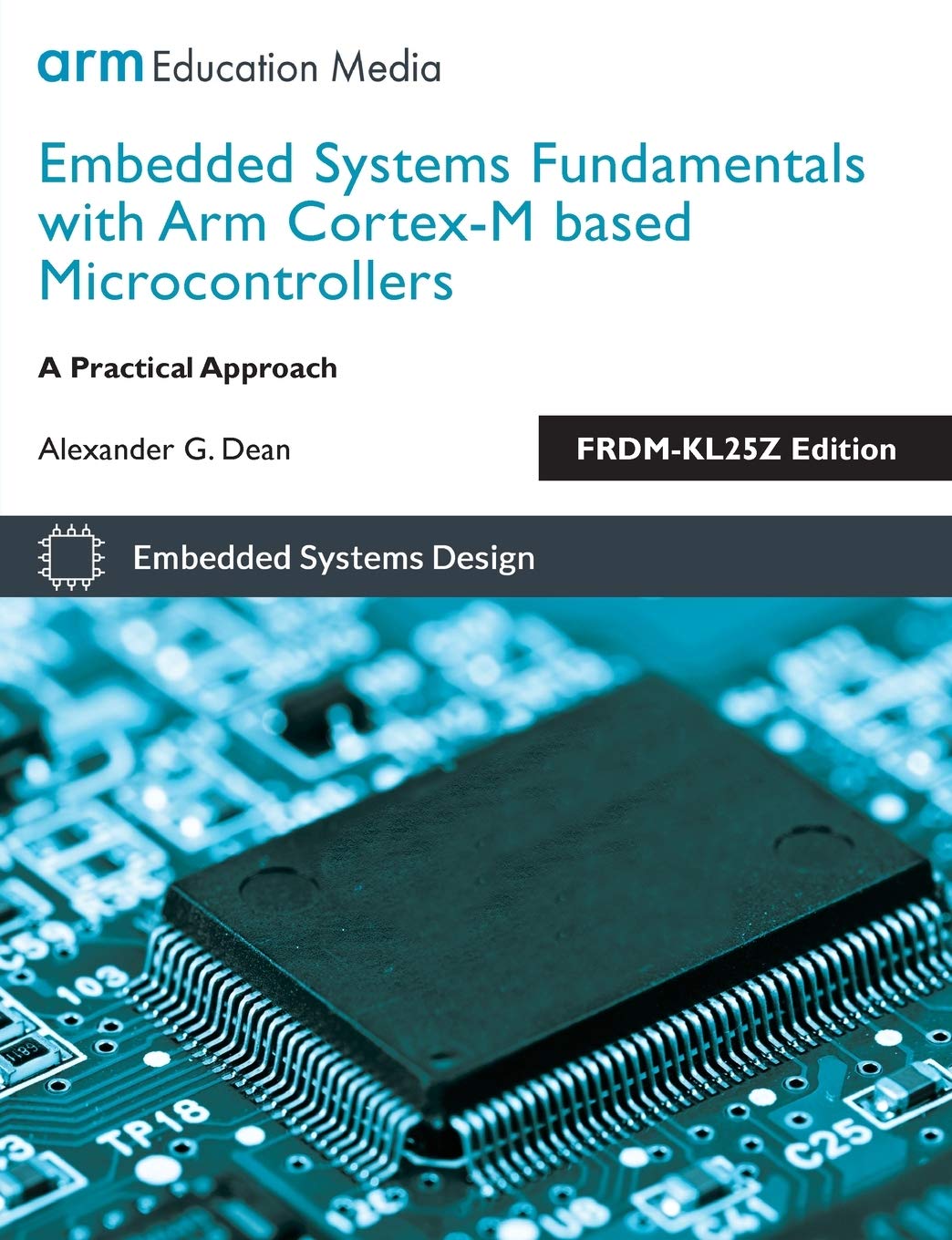
Embedded Systems Fundamentals with ARM CortexM based Microcontrollers: A Practical Approach FRDMKL25Z Edition,Used
Sold by Ergodebooks, an authorized reseller.
Returns accepted within 30 days | support@ergodebooks.com
Shipping Information
- Free Standard Shipping — United States only
- Processing Time: 3–5 business days
- Estimated Delivery: 6–10 business days after dispatch
- Double-boxed, fully insured & discreetly packaged
- Tracking number sent via email once dispatched
Returns & Refund
Returns accepted within 30 days of delivery.
Damaged or Defective Item
Free return shipping + replacement or full refund
Wrong Item Received
Free return shipping + replacement or full refund
Change of Mind
Return shipping at customer's expense · 25% restocking fee applies
Payment Option

Microcontrollers are embedded into larger systems to provide benefits such as better performance, more features, better efficiency, lower costs and better dependability. This textbook introduces students to creating microcontrollerbased embedded systems featuring an ARM CortexM CPU core. All source code is available on Github at alexandergdean/ESF.Chapter 1 introduces students to the concepts of MCUbased embedded systems, and how they differ from generalpurpose computers. It then introduces the ARM CortexM0+ CPU, the Kinetis KL25Z MCU, and the low cost FRDMKL25Z MCU development board.Chapter 2 presents the general purpose I/O peripheral to provide an early, handson experience with reading switches and lighting LEDs using C code. It also introduces the CMSIS hardware abstraction layer, which simplifies software access to peripherals.Chapter 3 introduces multitasking on the CPU, with the goals of improving responsiveness and software modularity while reducing CPU overhead. The interplay of interrupts, peripherals and schedulers (both cooperative and preemptive) is examined.Chapter 4 presents the ARM CortexM0+ processor core, including organization, registers, memory, and instruction set. It then discusses interrupts and exceptions, including CPU response and hardware configuration. Designing software for a system with interrupts is discussed, including program design (including partitioning work), interrupt configuration, writing handlers in C, and sharing data safely given preemption.Chapter 5 first gives an overview of toolchain which translates a program from C source code to executable object code. It then shows sidebyside the source code and the object code the toolchain has generated to implement it. Topics covered include functions, arguments, return values, activation records, exception handlers, control flow constructs for loops and selection, memory allocation and use, and accessing data in memory.Chapter 6 presents analog interfacing, starting with theory and ending with practical implementations. Quantization and sampling are presented as a foundation for digital to analog conversion, and analog to digital conversion. The DAC, ADC and analog comparator peripherals are presented and used.Chapter 7 presents timer peripherals and their use for generating a periodic interrupt or a pulsewidth modulated signal, or for measuring elapsed time or a signal's frequency. Watchdog timers, used to detect and reset an outofcontrol program, are also discussed. The SysTick, PIT, TPM and COP timers are examined.Chapter 8 discusses serial communications, starting with the fundamentals of data serialization, framing, error detection, media access control and addressing. Software queues are introduced to show how to buffer data between communication ISRs and other parts of the program. Three protocols and their supporting peripherals are investigated next: SPI, asynchronous serial (UART) and I2C. UART communication is demonstrated using the FRDMKL25Z's debug MCU as a serial port bridge over USB to the PC. I2C communication is demonstrated using the FRDMKL25Z's builtin 3 axis accelerometer with I2C interface.Chapter 9 introduces the direct memory access peripheral and its ability to transfer data autonomously, offloading work from the CPU and offering dramatically improved performance. Examples include using DMA for bulk data copying, and for DACbased analog waveform generation with precise timing.An appendix covers how to measure the power and energy use on the FRDMKL25Z board, including disconnecting the debug MCU to reduce power. Energy measurement using an ultracapacitor is also presented.For use in ECE, EE, and CS departments.
⚠️ WARNING (California Proposition 65):
This product may contain chemicals known to the State of California to cause cancer, birth defects, or other reproductive harm.
For more information, please visit www.P65Warnings.ca.gov.