
Title
Emigre 65,Used
Sold by Ergodebooks, an authorized reseller.
Returns accepted within 30 days | support@ergodebooks.com
Shipping Information
- Free Standard Shipping — United States only
- Processing Time: 3–5 business days
- Estimated Delivery: 6–10 business days after dispatch
- Double-boxed, fully insured & discreetly packaged
- Tracking number sent via email once dispatched
Returns & Refund
Returns accepted within 30 days of delivery.
Damaged or Defective Item
Free return shipping + replacement or full refund
Wrong Item Received
Free return shipping + replacement or full refund
Change of Mind
Return shipping at customer's expense · 25% restocking fee applies
Payment Option

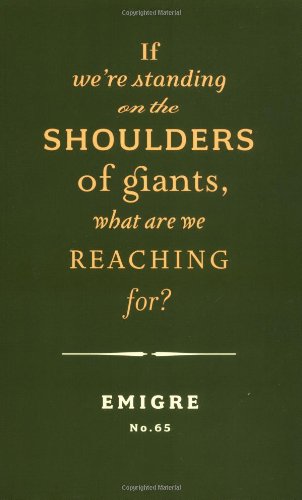
In this second issue of Emigre presented in our new book format we return to some topics that are close to our hearts.We look at the phenomenon of Helvetica, and the fact that this nearly 50 yearold sans serif is currently one of the three best selling fonts at many of the world's largest font distributors. But, as ten different designers tell us, not everybody is using it for the same reasons. Featuring interviews with Experimental Jetset, Michael Bierut, Ian Anderson, Michael Cina and others.We are reprinting the article "Legible?" which was published in Emigre No. 23 and written by the wellknown Dutch type designer Gerard Unger. This is the first reprint from a previous issue ever. Rudy VanderLans explains why. Elliott Earls, who is not your gardenvariety type designer and has some very specific ideas about how to draw type, gives us his unique outlook on what matters most when designing a typeface.We interviewed Rob Giampietro, who has coined the term "Default Systems Design" to describe a particular type of design that is rapidly spreading and is begging to be put under a microscope.Meanwhile Cranbrook design graduate Joshua Ray Stephens suggests that design styles are not where the action is.Also, we are featuring four short essays written in reply to our previous issue: Mike Kippenhan addresses graphic design's aversion to criticism and suggests we look at "American Idol" as a model to kickstart the comatose state of design inquiry; Patrick Fox tells us how pro bono work can keep an outofwork graphic designer from committing desperate acts; Anthony Inciong ponders the responsibilities of graphic design education in an age defined by style and technology; and, finally, Armin Vit fires off a short essay in reply to the challenge put forth by the "old cranks" in "Rant." He may not be speaking for an entire generation of young and upcoming graphic designers, but we have a suspicion many of his contemporaries will agree with what he has to say.
⚠️ WARNING (California Proposition 65):
This product may contain chemicals known to the State of California to cause cancer, birth defects, or other reproductive harm.
For more information, please visit www.P65Warnings.ca.gov.