
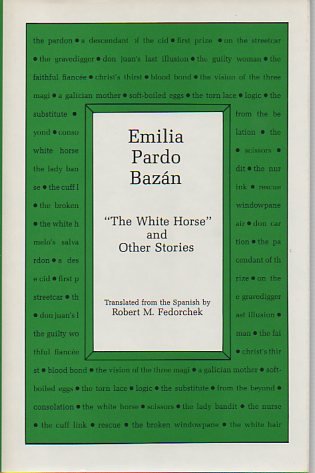
Title
Emilia Pardo Bazan: The White Horse and Other Stories,Used
Sold by Ergodebooks, an authorized reseller.
Returns accepted within 30 days | support@ergodebooks.com
Shipping Information
- Free Standard Shipping — United States only
- Processing Time: 3–5 business days
- Estimated Delivery: 6–10 business days after dispatch
- Double-boxed, fully insured & discreetly packaged
- Tracking number sent via email once dispatched
Returns & Refund
Returns accepted within 30 days of delivery.
Damaged or Defective Item
Free return shipping + replacement or full refund
Wrong Item Received
Free return shipping + replacement or full refund
Change of Mind
Return shipping at customer's expense · 25% restocking fee applies
Payment Option

This is a collection of stories by Emilia Pardo Bazan (18511921), a Spanish author who often found the subject matter of her stories in the mysteries and vicissitudes of life. Some of her tales are fictional accounts of actual occurrences or people ("The Pardon," "A Galician Mother," and "The Lady Bandit"); others are a defense of women subjugated by a double standard ("The Guilty Woman" and "The Faithful Fiancee"); a number focus on the figure of the rural priest ("A Descendant of the Cid" and "Don Carmelo's Salvation," for example). One highly symbolic story "The White Horse" qualifies Pardo Bazan as the godmother of the Generation of 98, the group of writers who exhorted Spain to begin anew, ridding itself of inertia, apathy, and fixation on past glories. Several of the collected tales are like contemporary suspense thrillers (such as "The Cuff Link" and "The White Hair"), while many others reveal a keen psychological insight ("The Torn Lace," "The Substitute," "Scissors," "The Nurse," and "Rescue"). Pardo Bazan's themes are fear, love, hatred, forgiveness, cruelty, poverty, necrophilia, repentance, homesickness, and madness that is, naked reality, bitter reality, and often an ugly, vicious reality.One of the indisputable giants of the nineteenthcentury short story is Guy de Maupassant. Pardo Bazan met him (along with Daudet and Zola) in France and considered him author of "The Horla" to be the master of short story writers. However, although Maupassant influenced her (most notably in psychological inquiry and careful attention to realistic detail), Pardo Bazan put her own stamp on her stories and developed a style sui generis, the most striking feature of which is brevity.The essence of Pardo Bazan's approach is to engage the reader as quickly as possible, certainly in the first paragraph, frequently in the first few sentences. Some aspect of a character or an episode is brought to light and the story unfolds rapidly. There are thirdperson narratives in which the author occasionally injects herself or her point of view. Other narratives are presented wholly in the first person some by an omniscient narrator, some by the "players"; and, from time to time, Pardo Bazan has someone else tell the story to her, and then as narrator she becomes the audience.It is entirely plausible that some of her graphic descriptions were intended to blunt accusations of softness (i.e., femininity) that in her era would foolishly, but automatically have been associated with a woman writer. Still, when the time came to represent the plight of women in terms of natural, understandable sexual needs and intellectual acceptance Pardo Bazan captured the anguish and inferior status of her Spanish sisters.
⚠️ WARNING (California Proposition 65):
This product may contain chemicals known to the State of California to cause cancer, birth defects, or other reproductive harm.
For more information, please visit www.P65Warnings.ca.gov.
- Q: What is the page count of the book? A: This book contains one hundred sixty-three pages. It's a concise collection of stories that explores complex themes.
- Q: What are the dimensions of this book? A: The book measures six point seventy-five inches in length, one point one inches in width, and nine point seventy-five inches in height.
- Q: What is the binding type of this book? A: The book is bound in hardcover. This type of binding provides durability and a premium feel.
- Q: Who is the author of this collection? A: The author of this collection is Emilia Pardo Bazan. She is known for her impactful storytelling and exploration of social themes.
- Q: What genre does this book belong to? A: This book belongs to the genre of fiction. It contains various stories that delve into the intricacies of human emotions.
- Q: How do I read this book? A: You can read this book by simply opening it and starting from the first page. The stories can be read in any order.
- Q: Is this book suitable for young readers? A: No, this book is not specifically designed for young readers. It contains mature themes that may not be appropriate for all ages.
- Q: What themes are explored in this book? A: The book explores themes such as love, fear, and social injustice. These stories reflect the complexities of human experiences.
- Q: How should I store this book? A: You should store this book in a cool, dry place. Keeping it away from direct sunlight will help preserve its condition.
- Q: Can I clean the book if it gets dirty? A: Yes, you can gently wipe the cover with a soft, dry cloth. Avoid using water or cleaners that could damage the pages.
- Q: What if the book arrives damaged? A: If the book arrives damaged, you should contact the seller for a return or replacement. Most sellers have policies for such situations.
- Q: How do I contact customer support for this book? A: You can contact customer support through the retailer's website or customer service number. They will assist you with any inquiries.
- Q: Is this book a good choice for book clubs? A: Yes, this book is a great choice for book clubs. Its rich themes and engaging stories provide ample material for discussion.
- Q: Are there other works by Emilia Pardo Bazan? A: Yes, Emilia Pardo Bazan has written several other works. She is known for her contributions to literature in the late nineteenth century.
- Q: Does this book include illustrations? A: No, this book does not include illustrations. It focuses on text to convey its narratives and themes.
- Q: What makes this book unique? A: This book is unique due to its exploration of complex female characters and social issues in a historical context, showcasing Bazan's literary style.