
Title
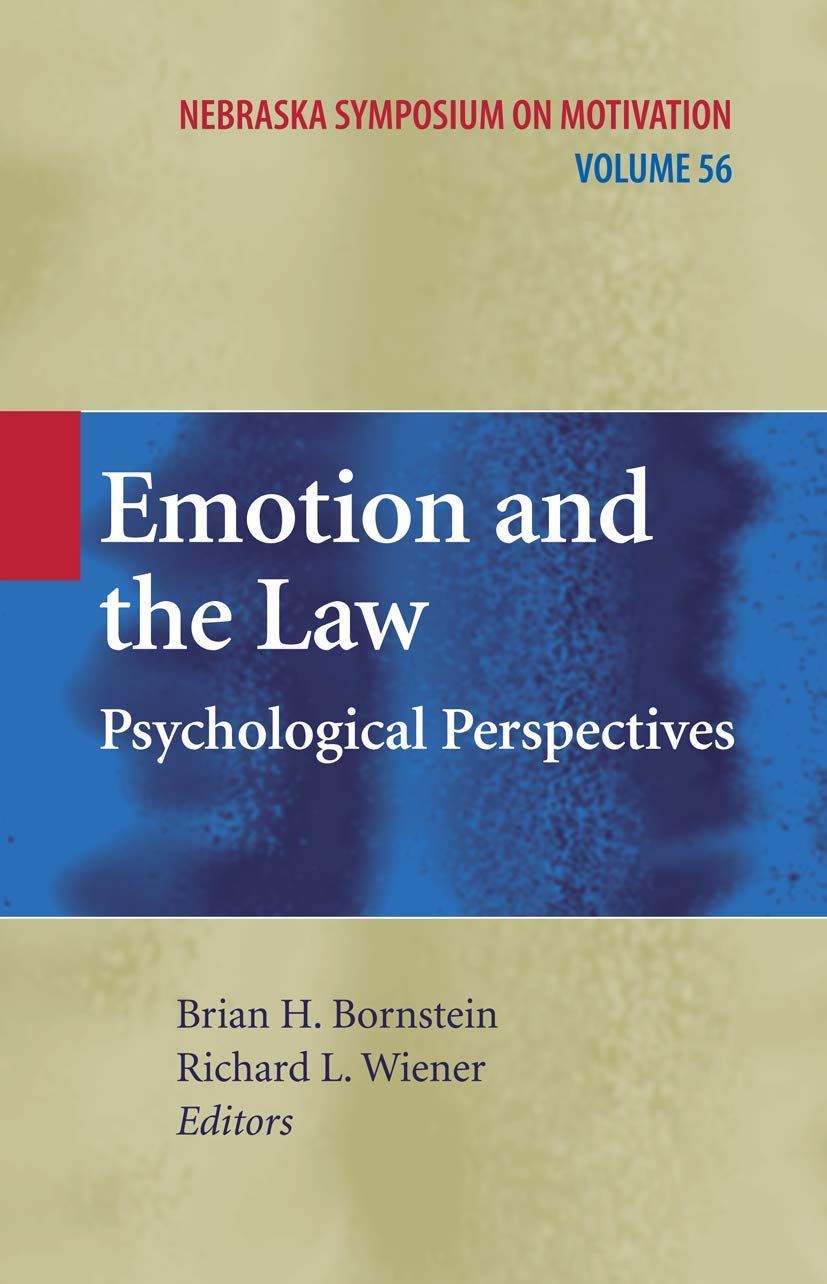
Emotion and the Law: Psychological Perspectives (Nebraska Symposium on Motivation, 56),Used
Sold by Ergodebooks, an authorized reseller.
Returns accepted within 30 days | support@ergodebooks.com
Shipping Information
- Free Standard Shipping — United States only
- Processing Time: 3–5 business days
- Estimated Delivery: 6–10 business days after dispatch
- Double-boxed, fully insured & discreetly packaged
- Tracking number sent via email once dispatched
Returns & Refund
Returns accepted within 30 days of delivery.
Damaged or Defective Item
Free return shipping + replacement or full refund
Wrong Item Received
Free return shipping + replacement or full refund
Change of Mind
Return shipping at customer's expense · 25% restocking fee applies
Payment Option

From questions surrounding motives to the concept of crimes of passion, the intersection of emotional states and legal practice has long interested professionals as well as the publicrecent cases involving extensive pretrial publicity, highly charged evidence, and instances of jury nullification continue to make the subject particularly timely. With these trends in mind, Emotion and the Law brings a rich tradition in social psychology into sharp forensic focus in a unique interdisciplinary volume. Emotion, mood and affective states, plus patterns of conduct that tend to arise from them in legal contexts, are analyzed in theoretical and practical terms, using reallife examples from criminal and civil cases. From these complex situations, contributors provide answers to bedrock questionswhat roles affect plays in legal decision making, when these roles are appropriate, and what can be done so that emotion is not misused or exploited in legal proceduresand offer complementary legal and social/cognitive perspectives on these and other salient issues: Positive versus negative affect in legal decision making, emotion, eyewitness memory, and false memory, the influence of emotions on juror decisions, and legal approaches to its control, a terror management theory approach to the understanding of hate crimes, policy recommendations for managing affect in legal proceedings, additional legal areas that can benefit from the study of emotion.Emotion and the Law clarifies theoretical grey areas, revisits current practice, and suggests possibilities for both new scholarship and procedural guidelines, making it a valuable reference for psycho legal researchers, forensic psychologists, and policymakers.
⚠️ WARNING (California Proposition 65):
This product may contain chemicals known to the State of California to cause cancer, birth defects, or other reproductive harm.
For more information, please visit www.P65Warnings.ca.gov.
- Q: What is the main focus of the book 'Emotion and the Law'? A: The book explores the intersection of emotional states and legal practice, analyzing how emotions influence legal decision-making and the implications for both criminal and civil cases.
- Q: Who is the author of 'Emotion and the Law'? A: The author of 'Emotion and the Law' is Brian H. Bornstein.
- Q: What are some key topics covered in this book? A: Key topics include the role of affect in legal decisions, the influence of emotions on juror decisions, eyewitness memory, hate crimes, and policy recommendations for managing emotions in legal contexts.
- Q: What is the publication date of 'Emotion and the Law'? A: The book was published on November 16, 2010.
- Q: How many pages does 'Emotion and the Law' have? A: The book contains 225 pages.
- Q: What type of binding does 'Emotion and the Law' have? A: This edition of 'Emotion and the Law' is a paperback.
- Q: Is 'Emotion and the Law' suitable for legal professionals? A: Yes, the book is a valuable reference for psycho-legal researchers, forensic psychologists, and policymakers interested in the psychological aspects of legal practice.
- Q: Can this book help in understanding jury decision-making? A: Yes, it provides insights into how emotions affect juror decisions and offers theoretical and practical perspectives on managing these influences.
- Q: What is the edition of this book? A: This is the 2010 edition of 'Emotion and the Law'.
- Q: Are there real-life examples used in 'Emotion and the Law'? A: Yes, the book includes real-life examples from both criminal and civil cases to illustrate its concepts.