
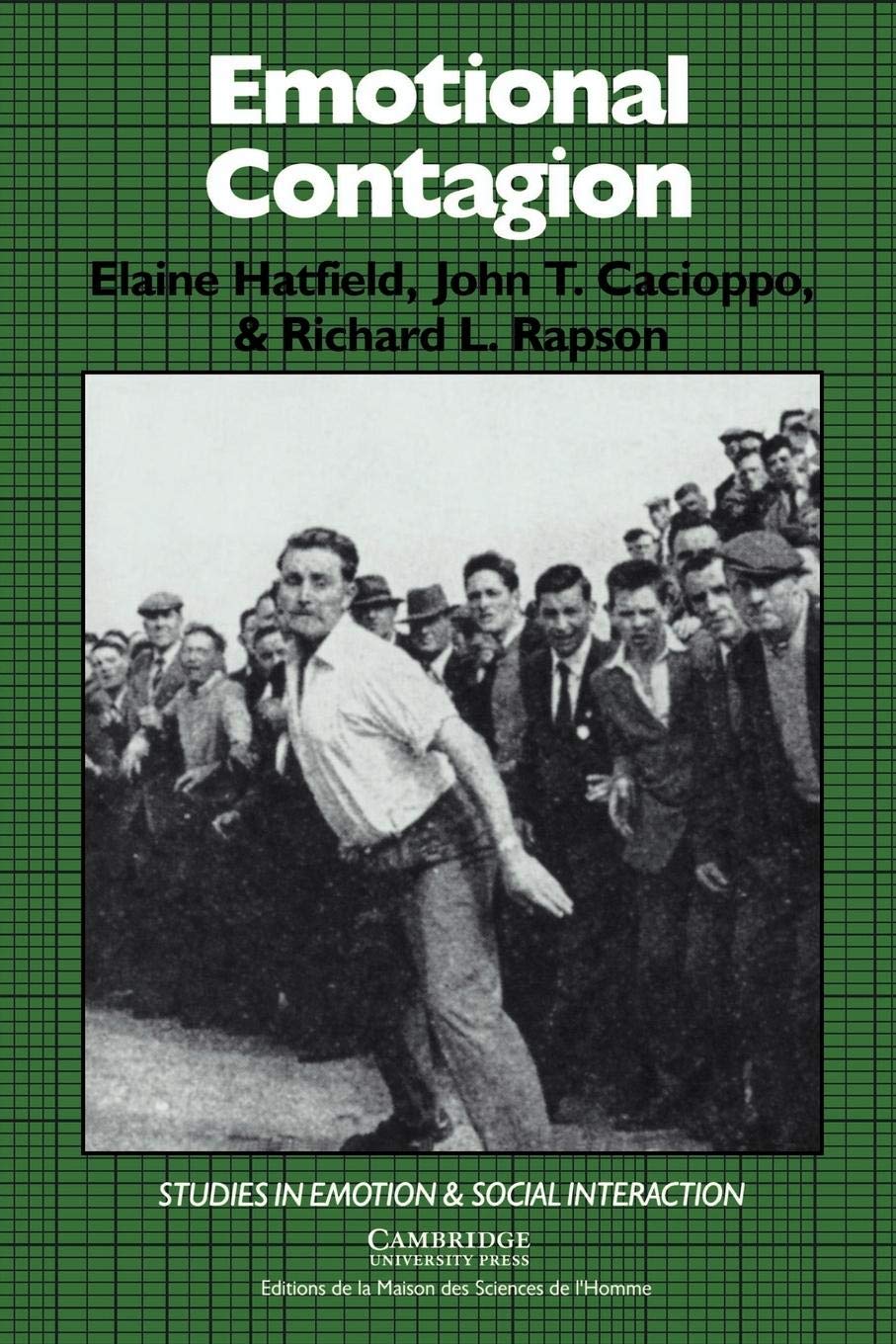
Title
Emotional Contagion (Studies in Emotion and Social Interaction),New
Sold by Ergodebooks, an authorized reseller.
Returns accepted within 30 days | support@ergodebooks.com
Shipping Information
- Free Standard Shipping — United States only
- Processing Time: 3–5 business days
- Estimated Delivery: 6–10 business days after dispatch
- Double-boxed, fully insured & discreetly packaged
- Tracking number sent via email once dispatched
Returns & Refund
Returns accepted within 30 days of delivery.
Damaged or Defective Item
Free return shipping + replacement or full refund
Wrong Item Received
Free return shipping + replacement or full refund
Change of Mind
Return shipping at customer's expense · 25% restocking fee applies
Payment Option

When people are in a certain mood, whether elated or depressed, that mood is often communicated to others. When we are talking to someone who is depressed it may make us feel depressed, whereas if we talk to someone who is feeling selfconfident and buoyant we are likely to feel good about ourselves. This phenomenon, known as emotional contagion, is identified here, and compelling evidence for its effects is offered from a variety of disciplinessocial and developmental psychology, history, crosscultural psychology, experimental psychology, and psychopathology. The authors propose a simple mechanism to account for the process of contagion. They argue that people, in their everyday encounters, tend automatically and continuously to synchronize with the facial expressions, voices, postures, movements, and instrumental emotional behaviors of others. Emotional experiences are affected, momenttomoment, by the feedback from such mimicry. In a series of orderly chapters, the authors provide observational and laboratory evidence to support their propositions. They then offer practical suggestions for clinical psychologists, physicians, husbands and wives, parents, and professionals who wish to become better at shaping the emotional tone of social encounters.
⚠️ WARNING (California Proposition 65):
This product may contain chemicals known to the State of California to cause cancer, birth defects, or other reproductive harm.
For more information, please visit www.P65Warnings.ca.gov.
- Q: What is the main topic of 'Emotional Contagion'? A: 'Emotional Contagion' explores how people's moods can influence one another, demonstrating that emotions can be communicated through various forms of nonverbal communication.
- Q: Who is the author of this book? A: The book is authored by Elaine Hatfield, a prominent figure in the study of emotions and social interactions.
- Q: How many pages does this book have? A: This book contains a total of 252 pages.
- Q: When was 'Emotional Contagion' published? A: 'Emotional Contagion' was published on September 24, 1993.
- Q: What type of binding does this book have? A: The book is available in paperback binding.
- Q: What is the condition of the book? A: The book is in new condition.
- Q: What disciplines does the book draw evidence from? A: 'Emotional Contagion' draws evidence from social psychology, developmental psychology, history, cross-cultural psychology, experimental psychology, and psychopathology.
- Q: Are there practical suggestions provided in the book? A: Yes, the authors offer practical suggestions for various professionals and individuals to better shape the emotional tone of social encounters.
- Q: Is this book suitable for professionals in psychology? A: Yes, the book is suitable for clinical psychologists, physicians, and other professionals looking to understand emotional interactions.
- Q: What is the significance of emotional contagion according to the authors? A: The authors argue that emotional contagion significantly affects people's emotional experiences through continuous mimicry of others' emotional expressions.