
Title
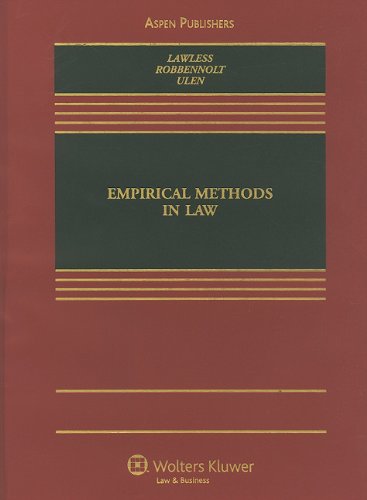
Empirical Methods in Law,Used
Sold by Ergodebooks, an authorized reseller.
Returns accepted within 30 days | support@ergodebooks.com
Shipping Information
- Free Standard Shipping — United States only
- Processing Time: 3–5 business days
- Estimated Delivery: 6–10 business days after dispatch
- Double-boxed, fully insured & discreetly packaged
- Tracking number sent via email once dispatched
Returns & Refund
Returns accepted within 30 days of delivery.
Damaged or Defective Item
Free return shipping + replacement or full refund
Wrong Item Received
Free return shipping + replacement or full refund
Change of Mind
Return shipping at customer's expense · 25% restocking fee applies
Payment Option

Today's legal profession demands that lawyers understand and engage in dialogue about basic empirical research techniques. Empirical Methods in Law teaches law students to recognize when empirical research needs to be applied in legal practice. It provides the vocabulary with which to communicate with scientific experts, and an awareness of the type of questions to ask about empirical findings.Hailing from diverse backgrounds, authors Lawless, Robbennolt, and Ulen bring practical experience and insight to this accessible research methods text that features: A consistent focus on basic principles and concepts, explained in an intuitive style requiring no prerequisite knowledge of math or statistics; Clear explanations geared to students new to empirical techniques; Optional problem sets and footnotes that will challenge more experienced students who are eager to explore specific topics in depth; Generous use of examples that show how empirical techniques are applied in a range of substantive areas; Coverage of different stages of empirical research, from formulating research questions and testable hypotheses, to data collection, sampling, coding, statistical analysis, and presenting data; Discussion of the connections among the different stages of empirical research; Sidebars with indepth views of particular topics that provide flexible options for teaching; Learningbydoing exercises at the end of each chapter.Combining expertise and an exceptionally studentfriendly approach, Empirical Methods in Law is suited for a standalone course on empirical methods in law or as a supplement for a course or seminar that includes an empirical component.
⚠️ WARNING (California Proposition 65):
This product may contain chemicals known to the State of California to cause cancer, birth defects, or other reproductive harm.
For more information, please visit www.P65Warnings.ca.gov.
- Q: What are the dimensions of 'Empirical Methods in Law'? A: The book measures seven point five two inches by nine point seven six inches and is zero point seven five inches thick.
- Q: How many pages does 'Empirical Methods in Law' have? A: The book contains four hundred forty-six pages, providing comprehensive coverage of empirical research methods in legal practice.
- Q: What type of binding does 'Empirical Methods in Law' have? A: This book is bound in hardcover, ensuring durability and a professional appearance for academic use.
- Q: Who is the author of 'Empirical Methods in Law'? A: The book is authored by Robert M. Lawless, along with co-authors who contribute to its insights in empirical methods.
- Q: What is the primary focus of 'Empirical Methods in Law'? A: The book focuses on teaching law students the basics of empirical research techniques relevant to legal practice.
- Q: How do I use 'Empirical Methods in Law' for my studies? A: This book can be used as a stand-alone course text on empirical methods or as a supplemental resource in seminars.
- Q: Is 'Empirical Methods in Law' suitable for beginners? A: Yes, the book is designed for students new to empirical techniques, with clear explanations and intuitive concepts.
- Q: What exercises are included in 'Empirical Methods in Law'? A: The book features learning-by-doing exercises at the end of each chapter to reinforce the understanding of empirical methods.
- Q: Can experienced students benefit from 'Empirical Methods in Law'? A: Yes, it includes optional problem sets that challenge more experienced students to explore specific topics in depth.
- Q: How should I care for 'Empirical Methods in Law'? A: To keep the book in good condition, store it upright in a dry place and avoid exposing it to excessive moisture.
- Q: Is 'Empirical Methods in Law' safe for all readers? A: Yes, the content is academic and appropriate for students and professionals in legal and related fields.
- Q: What if 'Empirical Methods in Law' arrives damaged? A: If the book arrives damaged, you can follow the return policy provided by the seller for a replacement or refund.
- Q: Is there a warranty for 'Empirical Methods in Law'? A: Typically, there is no warranty for books, but you should check with the retailer for their specific policies.
- Q: How does 'Empirical Methods in Law' compare to other research method texts? A: This book is unique in its focus on legal applications of empirical methods, distinguishing it from general research texts.
- Q: What topics are covered in 'Empirical Methods in Law'? A: The book covers various stages of empirical research, including formulating questions, data collection, and statistical analysis.