
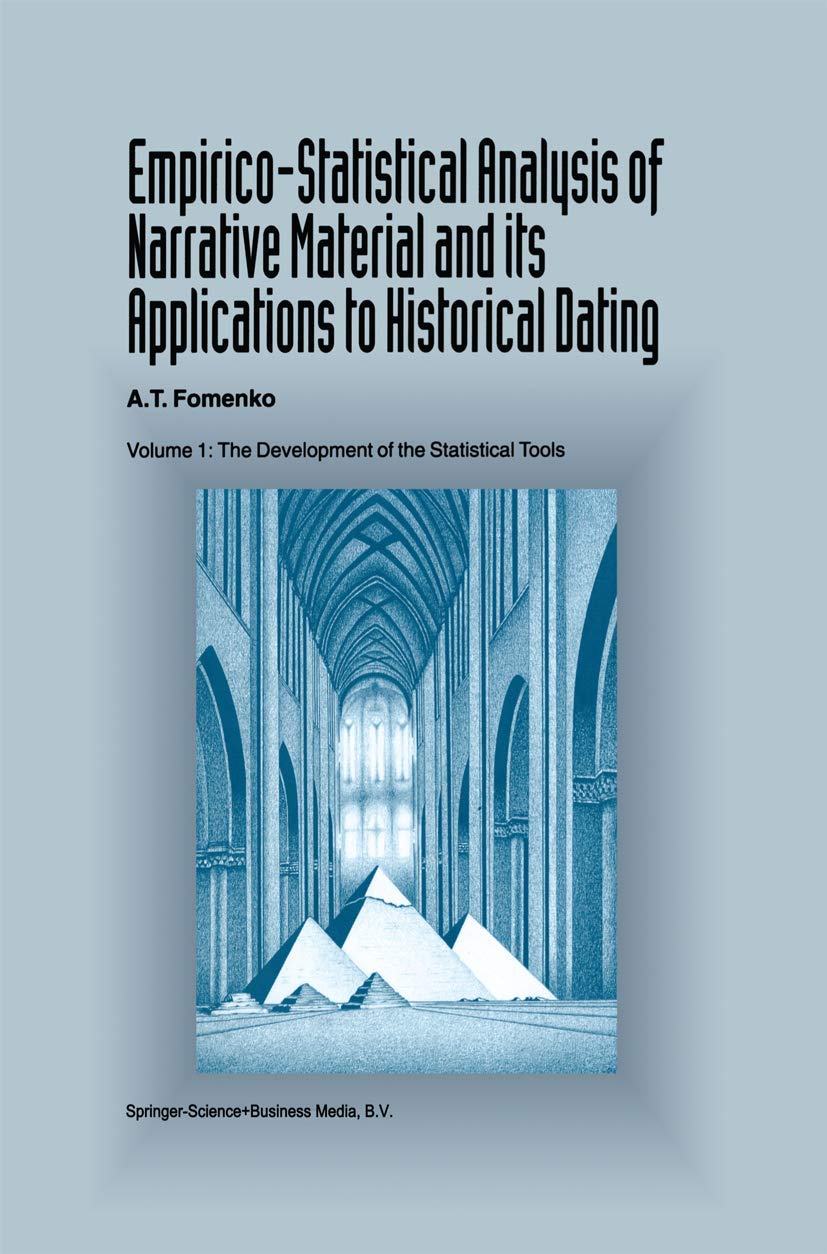
Title
EmpiricoStatistical Analysis of Narrative Material and its Applications to Historical Dating: Volume I: The Development of the ,Used
Sold by Ergodebooks, an authorized reseller.
Returns accepted within 30 days | support@ergodebooks.com
Shipping Information
- Free Standard Shipping — United States only
- Processing Time: 3–5 business days
- Estimated Delivery: 6–10 business days after dispatch
- Double-boxed, fully insured & discreetly packaged
- Tracking number sent via email once dispatched
Returns & Refund
Returns accepted within 30 days of delivery.
Damaged or Defective Item
Free return shipping + replacement or full refund
Wrong Item Received
Free return shipping + replacement or full refund
Change of Mind
Return shipping at customer's expense · 25% restocking fee applies
Payment Option

Today the methods of applied statistics have penetrated very different fields of knowledge, including the investigation oftexts ofvarious origins. These "texts" may be considered as signal sequences of different kinds, long genetic codes, graphic representations (which may be coded and represented by a "text"), as well as actual narrative texts (for example, historical chronicles, originals, documents, etc. ). One ofthe most important problems arising here is to recognize dependent text, i. e. , texts which have a measure of "resemblance", arising from some kind of "common origin". For instance, in patternrecognition problems, it is essential to identify from a large set of "patterns" a pattern that is "closest" to a given one; in studying long signal sequences, it is important to recognize "homogeneous subsequences" and the places of their junction. This includes, in particular, the wellknown changepoint prob lern, which is given considerable attention in mathematical statistics and the theory of stochastic processes. As applied to the study of narrative texts, the problern of recognizing depen dent and independent texts ( e . g. , chronicles) Ieads to the problern offinding texts having a common source, i. e. , the sameoriginal (such texts are naturally called dependent), or, on the contrary, having different sources (such texts are natu rally called independent). Clearly, such problems are exceedingly complicated, and therefore the appearance of new empiricostatistical recognition methods which, along with the classical approaches, may prove useful in concrete studies (e. g. , source determination) is welcome.
⚠️ WARNING (California Proposition 65):
This product may contain chemicals known to the State of California to cause cancer, birth defects, or other reproductive harm.
For more information, please visit www.P65Warnings.ca.gov.