
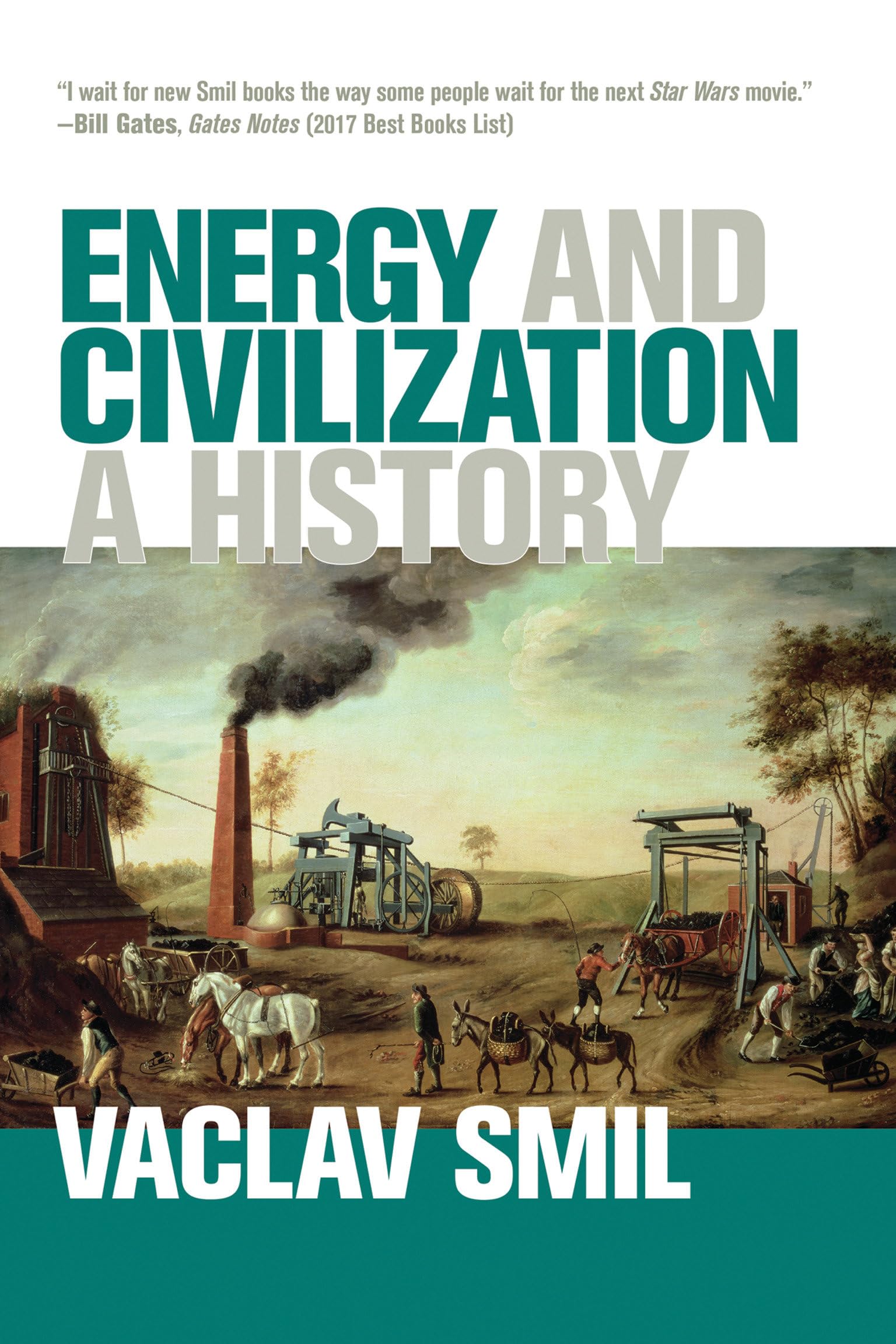
Title
Energy And Civilization: A History (Mit Press),Used
Sold by Ergodebooks, an authorized reseller.
Returns accepted within 30 days | support@ergodebooks.com
Shipping Information
- Free Standard Shipping — United States only
- Processing Time: 1–3 business days
- Estimated Delivery: 3–5 business days after dispatch
- Double-boxed, fully insured & discreetly packaged
- Tracking number sent via email once dispatched
- Orders over $250 require signature upon delivery. Taxes calculated at checkout.
Returns & Refund
Returns accepted within 30 days of delivery.
Damaged or Defective Item
Free return shipping + replacement or full refund
Wrong Item Received
Free return shipping + replacement or full refund
Change of Mind
Return shipping at customer's expense · 25% restocking fee applies
Payment Option

A Comprehensive Account Of How Energy Has Shaped Society Throughout History, From Preagricultural Foraging Societies Through Today'S Fossil Fueldriven Civilization.'I Wait For New Smil Books The Way Some People Wait For The Next 'Star Wars' Movie. In His Latest Book, Energy And Civilization: A History, He Goes Deep And Broad To Explain How Innovations In Humans' Ability To Turn Energy Into Heat, Light, And Motion Have Been A Driving Force Behind Our Cultural And Economic Progress Over The Past 10,000 Years.Bill Gates, Gates Notes, Best Books Of The Yearenergy Is The Only Universal Currency; It Is Necessary For Getting Anything Done. The Conversion Of Energy On Earth Ranges From Terraforming Forces Of Plate Tectonics To Cumulative Erosive Effects Of Raindrops. Life On Earth Depends On The Photosynthetic Conversion Of Solar Energy Into Plant Biomass. Humans Have Come To Rely On Many More Energy Flowsranging From Fossil Fuels To Photovoltaic Generation Of Electricityfor Their Civilized Existence. In This Monumental History, Vaclav Smil Provides A Comprehensive Account Of How Energy Has Shaped Society, From Preagricultural Foraging Societies Through Today'S Fossil Fueldriven Civilization.Humans Are The Only Species That Can Systematically Harness Energies Outside Their Bodies, Using The Power Of Their Intellect And An Enormous Variety Of Artifactsfrom The Simplest Tools To Internal Combustion Engines And Nuclear Reactors. The Epochal Transition To Fossil Fuels Affected Everything: Agriculture, Industry, Transportation, Weapons, Communication, Economics, Urbanization, Quality Of Life, Politics, And The Environment. Smil Describes Humanity'S Energy Eras In Panoramic And Interdisciplinary Fashion, Offering Readers A Magisterial Overview. This Book Is An Extensively Updated And Expanded Version Of Smil'S Energy In World History (1994). Smil Has Incorporated An Enormous Amount Of New Material, Reflecting The Dramatic Developments In Energy Studies Over The Last Two Decades And His Own Research Over That Time.
⚠️ WARNING (California Proposition 65):
This product may contain chemicals known to the State of California to cause cancer, birth defects, or other reproductive harm.
For more information, please visit www.P65Warnings.ca.gov.
- Q: What is the page count of 'Energy and Civilization: A History'? A: This book has five hundred sixty-two pages. It offers an in-depth exploration of how energy has influenced human civilization throughout history.
- Q: What are the dimensions of this book? A: The dimensions are six inches in length, one point four six inches in width, and nine point zero two inches in height. These measurements make it a standard size for a paperback.
- Q: What type of binding does this book have? A: The book is available in paperback binding. This makes it lightweight and easy to handle for reading.
- Q: Who is the author of this book? A: The author is Vaclav Smil. He is renowned for his interdisciplinary approach to energy studies and history.
- Q: What is the primary focus of this book? A: The book focuses on how energy has shaped society from pre-agricultural times to the present. It emphasizes the role of energy in cultural and economic progress.
- Q: Is this book suitable for academic use? A: Yes, this book is suitable for academic use. It provides a comprehensive historical overview, making it a valuable resource for students and researchers.
- Q: How can I best utilize this book for research? A: To utilize this book effectively, read it as a chronological account of energy’s influence. It’s beneficial for understanding historical contexts and energy transitions.
- Q: What audience would find this book most relevant? A: This book is relevant for historians, students, and anyone interested in energy studies. It caters to readers seeking a deeper understanding of energy's societal impact.
- Q: Is there any specific age recommendation for readers? A: This book is recommended for adults and advanced students. Its complex themes and historical analysis may not be suitable for younger audiences.
- Q: How should I care for this paperback book? A: To care for this paperback, store it in a cool, dry place and avoid direct sunlight. Handling it gently will help maintain its condition.
- Q: Can I return this book if I’m not satisfied? A: Yes, you can return the book if you are not satisfied. Be sure to check the specific return policy of the retailer from which you purchase it.
- Q: What if the book arrives damaged? A: If the book arrives damaged, contact the retailer immediately for a replacement or refund. Most retailers have policies in place for such issues.
- Q: Is there a warranty for this book? A: No, books typically do not come with a warranty. However, you can inquire about return policies for defective copies.
- Q: Does this book include illustrations or graphs? A: No, this book does not primarily focus on illustrations or graphs. It is a text-heavy work that emphasizes detailed historical analysis.
- Q: How does this book compare to other works on energy? A: This book offers a unique interdisciplinary perspective compared to others. It combines historical narrative with scientific analysis, providing a holistic view of energy.
- Q: What makes this edition different from previous ones? A: This edition is extensively updated and expanded compared to earlier versions. It reflects significant developments in energy studies over the past two decades.