
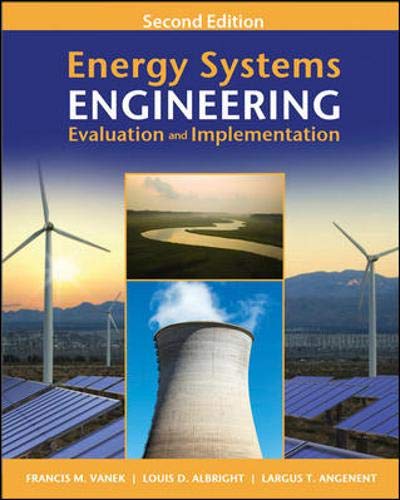
Title
Energy Systems Engineering: Evaluation And Implementation, Second Edition,Used
Sold by Ergodebooks, an authorized reseller.
Returns accepted within 30 days | support@ergodebooks.com
Shipping Information
- Free Standard Shipping — United States only
- Processing Time: 3–5 business days
- Estimated Delivery: 6–10 business days after dispatch
- Double-boxed, fully insured & discreetly packaged
- Tracking number sent via email once dispatched
Returns & Refund
Returns accepted within 30 days of delivery.
Damaged or Defective Item
Free return shipping + replacement or full refund
Wrong Item Received
Free return shipping + replacement or full refund
Change of Mind
Return shipping at customer's expense · 25% restocking fee applies
Payment Option

The Defining Guide To Energy Systems Engineeringupdated For The Latest Technologies'Broad In Scope, With Focused Instructional Detail, This Text Offers A Uniquely Excellent, Studentaccessible Educational Resource For Integrating Thermodynamic, Alternative, And Renewable Energy Conversion Processes.' Professor Randy L. Vander Wal, Department Of Materials Science And Engineering, Penn State University'A Carefully Written Book, Providing Good Breadth As Well As Depth On Major Conventional And Sustainable Energy Systems.' Professor David Dillard, Department Of Engineering Science & Mechanics, Virginia Techfully Revised Throughout, Energy Systems Engineering, Second Edition Discusses Fossil, Nuclear, And Renewable Energy Sources, Emphasizing A Technologyneutral, Portfolio Approach To Energy Systems Options. The Book Covers Major Energy Technologies, Describing How They Work, How They Are Quantitatively Evaluated, Their Cost, And Their Benefit Or Impact On The Natural Environment.Evaluating Project Scope, Cost, Energy Consumption, And Technical Efficiency Is Clearly Addressed. Example Problems Help You To Quantify The Performance Of Each Technology And Better Assess Its Potential. Hundreds Of Illustrations And Endofchapter Exercises Aid In Your Understanding Of The Concepts Presented In This Practical Guide.Coverage Includes: Systems And Economic Tools For Energy Systems Climate Change And Climate Modeling Fossil Fuel Resources Stationary Combustion Systems Carbon Sequestration Nuclear Energy Systems Solar Resource Evaluation Solar Photovoltaic Technologies Active And Passive Solar Thermal Systems Wind Energy Systems New Chapter On Energy From Biological Sources Transportation Energy Technologies Systems Perspective On Transportation Engineering
⚠️ WARNING (California Proposition 65):
This product may contain chemicals known to the State of California to cause cancer, birth defects, or other reproductive harm.
For more information, please visit www.P65Warnings.ca.gov.
- Q: What is the binding type of this book? A: This book has a hardcover binding. Hardcover books are durable and provide good protection for the pages.
- Q: How many pages does this book contain? A: This book contains six hundred seventy-two pages. It offers extensive information on energy systems and technologies.
- Q: What are the dimensions of this book? A: The dimensions of this book are seven point five two inches in length, one point five inches in width, and nine point five inches in height. These dimensions make it a standard size for textbooks.
- Q: Who is the author of this book? A: The author of this book is Francis Vanek. He is known for his expertise in energy systems engineering.
- Q: What category does this book fall under? A: This book falls under the Nuclear category. It covers various energy technologies, including nuclear energy systems.
- Q: What key topics are covered in this book? A: The book covers topics like fossil fuel resources, renewable energy sources, climate change modeling, and energy technologies. It provides a comprehensive overview of energy systems.
- Q: How should I use this book for studying? A: You can use this book as a primary resource for learning about energy systems engineering. It includes example problems and end-of-chapter exercises for practical understanding.
- Q: Is this book suitable for beginners? A: Yes, this book is suitable for beginners in energy systems engineering. It provides clear explanations and covers fundamental concepts.
- Q: What level of education is this book appropriate for? A: This book is appropriate for undergraduate and graduate students studying engineering. It serves as an educational resource for various energy systems.
- Q: How do I care for this hardcover book? A: To care for this hardcover book, store it in a cool, dry place and avoid exposing it to direct sunlight. This will help preserve its condition.
- Q: What should I do if the book gets damaged? A: If the book gets damaged, check the return policy from the seller. Most sellers offer a return or replacement policy for damaged items.
- Q: Can I clean the book's cover? A: Yes, you can clean the book's cover gently with a damp cloth. Avoid using harsh chemicals that could damage the material.
- Q: What if I need to return the book? A: If you need to return the book, follow the seller's return instructions. Ensure you keep the original packaging for a smoother return process.
- Q: How does this book compare to others in the field? A: This book is highly regarded for its breadth and depth on energy systems. It provides a comprehensive, technology-neutral approach compared to other texts.
- Q: Is this book a good choice for professionals in the field? A: Yes, this book is a valuable resource for professionals seeking to update their knowledge on energy systems and technologies.
- Q: What makes this book stand out among other energy engineering books? A: This book stands out due to its comprehensive coverage of both conventional and sustainable energy systems, along with practical examples and exercises.