
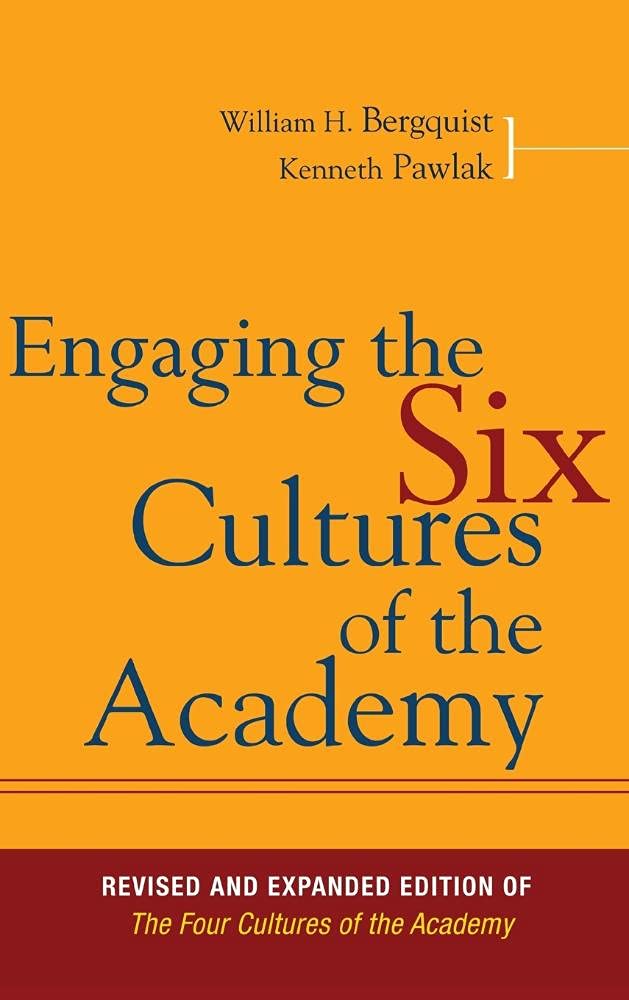
Title
Engaging the Six Cultures of the Academy,New
Sold by Ergodebooks, an authorized reseller.
Returns accepted within 30 days | support@ergodebooks.com
Shipping Information
- Free Standard Shipping — United States only
- Processing Time: 3–5 business days
- Estimated Delivery: 6–10 business days after dispatch
- Double-boxed, fully insured & discreetly packaged
- Tracking number sent via email once dispatched
Returns & Refund
Returns accepted within 30 days of delivery.
Damaged or Defective Item
Free return shipping + replacement or full refund
Wrong Item Received
Free return shipping + replacement or full refund
Change of Mind
Return shipping at customer's expense · 25% restocking fee applies
Payment Option

In The Four Cultures of the Academy, William H. Bergquist identified four different, yet interrelated, cultures found in North American higher education: collegial, managerial, developmental, and advocacy. In this new and expanded edition of that classic work, Bergquist and coauthor Kenneth Pawlak propose that there are additional external influences in our global culture that are pressing upon the academic institution, forcing it to alter the way it goes about its business. Two new cultures are now emerging in the academic institution as a result of these global, external forces: the virtual culture, prompted by the technological and social forces that have emerged over the past twenty years, and the tangible culture, which values its roots, community, and physical location and has only recently been evident as a separate culture partly in response to emergence of the virtual culture. These two cultures interact with the previous four, creating new dynamics.
⚠️ WARNING (California Proposition 65):
This product may contain chemicals known to the State of California to cause cancer, birth defects, or other reproductive harm.
For more information, please visit www.P65Warnings.ca.gov.
- Q: What is the page count of the book? A: The book contains three hundred four pages. This length provides a comprehensive exploration of the six cultures in academia.
- Q: What is the binding type of this book? A: This book is hardcover. The hardcover binding ensures durability and longevity for frequent use.
- Q: What are the dimensions of the book? A: The book measures six point three inches in length, one point one inches in width, and nine point three inches in height. These dimensions make it a standard-sized academic volume.
- Q: Who is the author of 'Engaging the Six Cultures of the Academy'? A: The book is authored by William H. Bergquist and Kenneth Pawlak. They provide insights into the evolving academic landscape.
- Q: What category does this book belong to? A: This book falls under the category of Higher & Continuing Education. It addresses cultural dynamics within academic institutions.
- Q: How do I apply the concepts from this book? A: You can apply the concepts by understanding the interaction of different academic cultures in your institution. This awareness can enhance collaboration and effectiveness in educational settings.
- Q: Is this book suitable for educators? A: Yes, this book is suitable for educators and academic leaders. It provides valuable insights into the cultures that influence higher education.
- Q: Can students benefit from reading this book? A: Yes, students can benefit from reading this book. It helps them understand the cultural context of their educational environment.
- Q: How do I keep this book in good condition? A: To keep this book in good condition, store it upright in a cool, dry place away from direct sunlight. Avoid exposing it to moisture.
- Q: Are there any specific care instructions for this hardcover book? A: No specific care instructions are required for this hardcover book. Regular handling should suffice to maintain its condition.
- Q: What if I receive a damaged copy of the book? A: If you receive a damaged copy, contact the seller for a return or replacement. Most sellers have policies to address such issues.
- Q: Can this book be used as a reference for academic research? A: Yes, this book can be used as a reference for academic research. It offers a detailed examination of cultural dynamics in academia.
- Q: Is there a warranty on this book? A: Typically, there is no warranty on books. However, check with the retailer for their specific return policy.
- Q: Is this book appropriate for a general audience? A: Yes, this book is appropriate for a general audience interested in education. It discusses broad cultural themes relevant to all academic stakeholders.
- Q: How does this book compare to other educational literature? A: This book provides a unique perspective by combining six cultures within academia, unlike many other educational texts that focus on fewer aspects.