If you have any questions, you are always welcome to contact us. We'll get back to you as soon as possible, withing 24 hours on weekdays.
Customer service
All questions about your order, return and delivery must be sent to our customer service team by e-mail at yourstore@yourdomain.com
Sale & Press
If you are interested in selling our products, need more information about our brand or wish to make a collaboration, please contact us at press@yourdomain.com
Help
If you have any questions, you are always welcome to contact us. We'll get back to you as soon as possible, withing 24 hours on weekdays.
Customer service
All questions about your order, return and delivery must be sent to our customer service team by e-mail at yourstore@yourdomain.com
Sale & Press
If you are interested in selling our products, need more information about our brand or wish to make a collaboration, please contact us at press@yourdomain.com
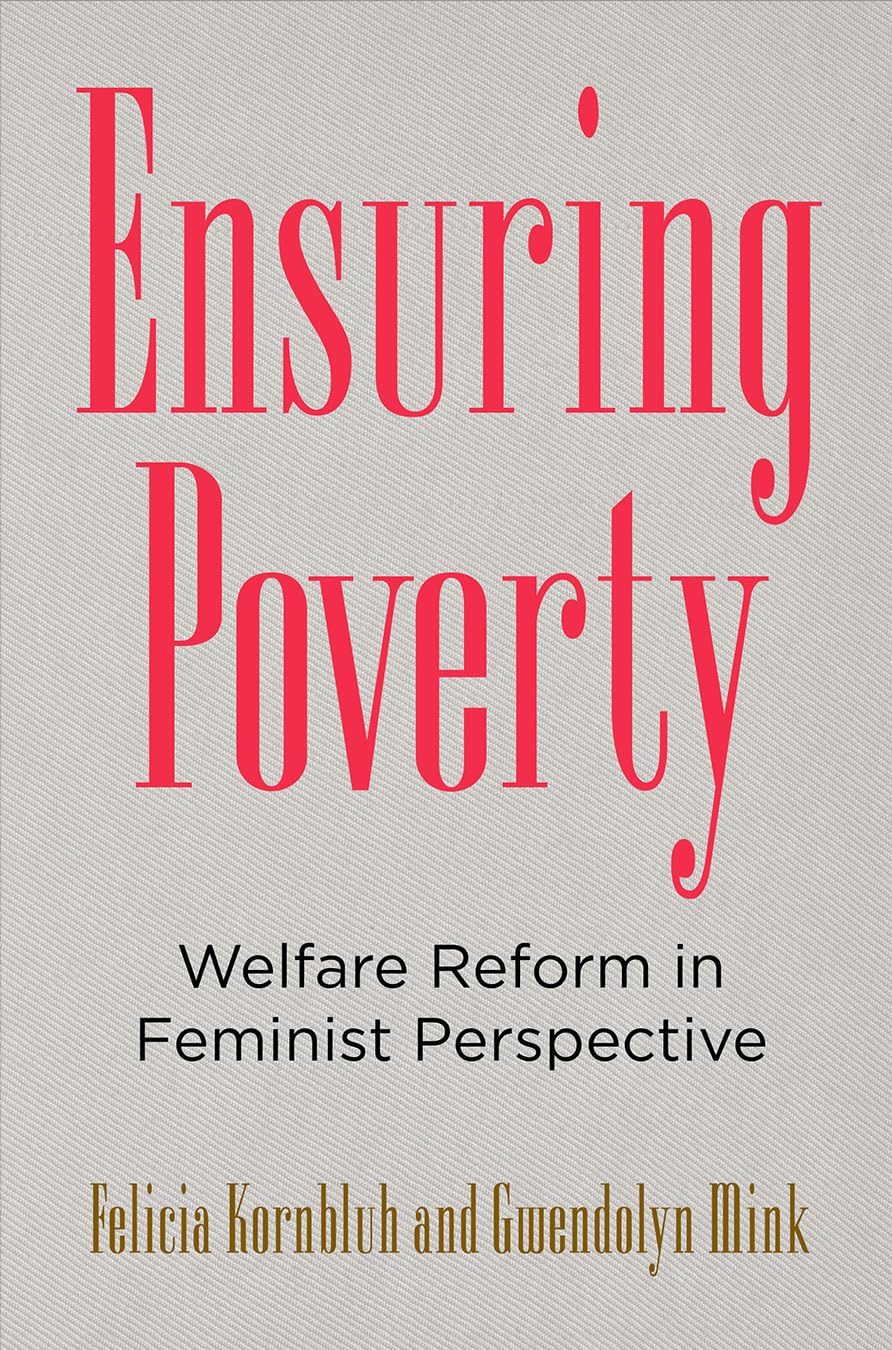
In Ensuring Poverty, Felicia Kornbluh and Gwendolyn Mink assess the gendered history of welfare reform. They foreground arguments advanced by feminists for a welfare policy that would respect single mothers' rights while advancing their opportunities and assuring economic security for their families. Kornbluh and Mink consider welfare policy in the broad intersectional context of gender, race, poverty, and inequality. They argue that the subject of welfare reform always has been single mothers, the animus always has been race, and the currency always has been inequality. Yet public conversations about poverty and welfare, even today, rarely acknowledge the nexus between racialized gender inequality and the economic vulnerability of singlemother families.Since passage of the Personal Responsibility and Work Opportunity Reconciliation Act (PRWORA) by a Republican Congress and the Clinton administration, the gendered dimensions of antipoverty policy have receded from debate. Mink and Kornbluh explore the narrowing of discussion that has occurred in recent decades and the path charted by social justice feminists in the 1990s and early 2000s, a course rejected by policy makers. They advocate a return to the social justice approach built on the equality of mothers, especially mothers of color, in policies aimed at poor families.
⚠️ WARNING (California Proposition 65):
This product may contain chemicals known to the State of California to cause cancer,
birth defects, or other reproductive harm.
For MAP (Minimum Advertised Price) violations and Intellectual Property (IP) or Trademark concerns, please contact:
support@ergodebooks.com
⚠️ California Proposition 65 Warning: Some products sold on this website may expose you to chemicals known to the State of California to cause cancer, birth defects, or other reproductive harm. For more information, visit www.P65Warnings.ca.gov.