If you have any questions, you are always welcome to contact us. We'll get back to you as soon as possible, withing 24 hours on weekdays.
Customer service
All questions about your order, return and delivery must be sent to our customer service team by e-mail at yourstore@yourdomain.com
Sale & Press
If you are interested in selling our products, need more information about our brand or wish to make a collaboration, please contact us at press@yourdomain.com
Help
If you have any questions, you are always welcome to contact us. We'll get back to you as soon as possible, withing 24 hours on weekdays.
Customer service
All questions about your order, return and delivery must be sent to our customer service team by e-mail at yourstore@yourdomain.com
Sale & Press
If you are interested in selling our products, need more information about our brand or wish to make a collaboration, please contact us at press@yourdomain.com
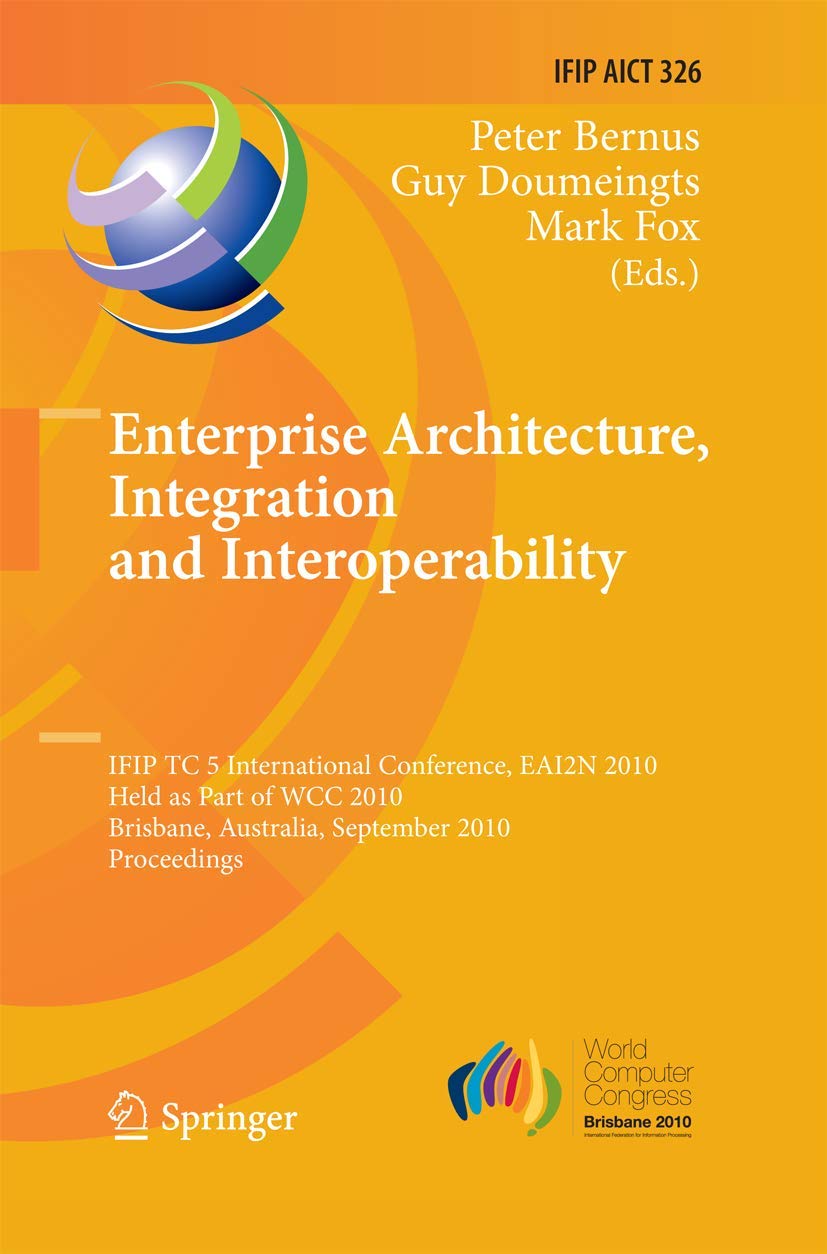
Enterprise Architecture, Integration, and Interoperability and the Networked enterprise have become the theme of many conferences in the past few years. These conferences were organised by IFIP TC5 with the support of its two working groups: WG 5. 12 (Architectures for Enterprise Integration) and WG 5. 8 (Enterprise Interoperability), both concerned with aspects of the topic: how is it possible to architect and implement businesses that are flexible and able to change, to interact, and use one anothers s vices in a dynamic manner for the purpose of (joint) value creation. The original qu tion of enterprise integration in the 1980s was: how can we achieve and integrate formation and material flow in the enterprise? Various methods and reference models were developed or proposed ranging from tightly integrated monolithic system chitectures, through cellbased manufacturing to ondemand interconnection of bu nesses to form virtual enterprises in response to market opportunities. Two camps have emerged in the endeavour to achieve the same goal, namely, to achieve interoperability between businesses (whereupon interoperability is the ability to exchange information in order to use one anothers services or to jointly implement a service). One school of researchers addresses the technical aspects of creating dynamic (and static) interconnections between disparate businesses (or parts thereof).
⚠️ WARNING (California Proposition 65):
This product may contain chemicals known to the State of California to cause cancer,
birth defects, or other reproductive harm.
For MAP (Minimum Advertised Price) violations and Intellectual Property (IP) or Trademark concerns, please contact:
support@ergodebooks.com
⚠️ California Proposition 65 Warning: Some products sold on this website may expose you to chemicals known to the State of California to cause cancer, birth defects, or other reproductive harm. For more information, visit www.P65Warnings.ca.gov.