
Title
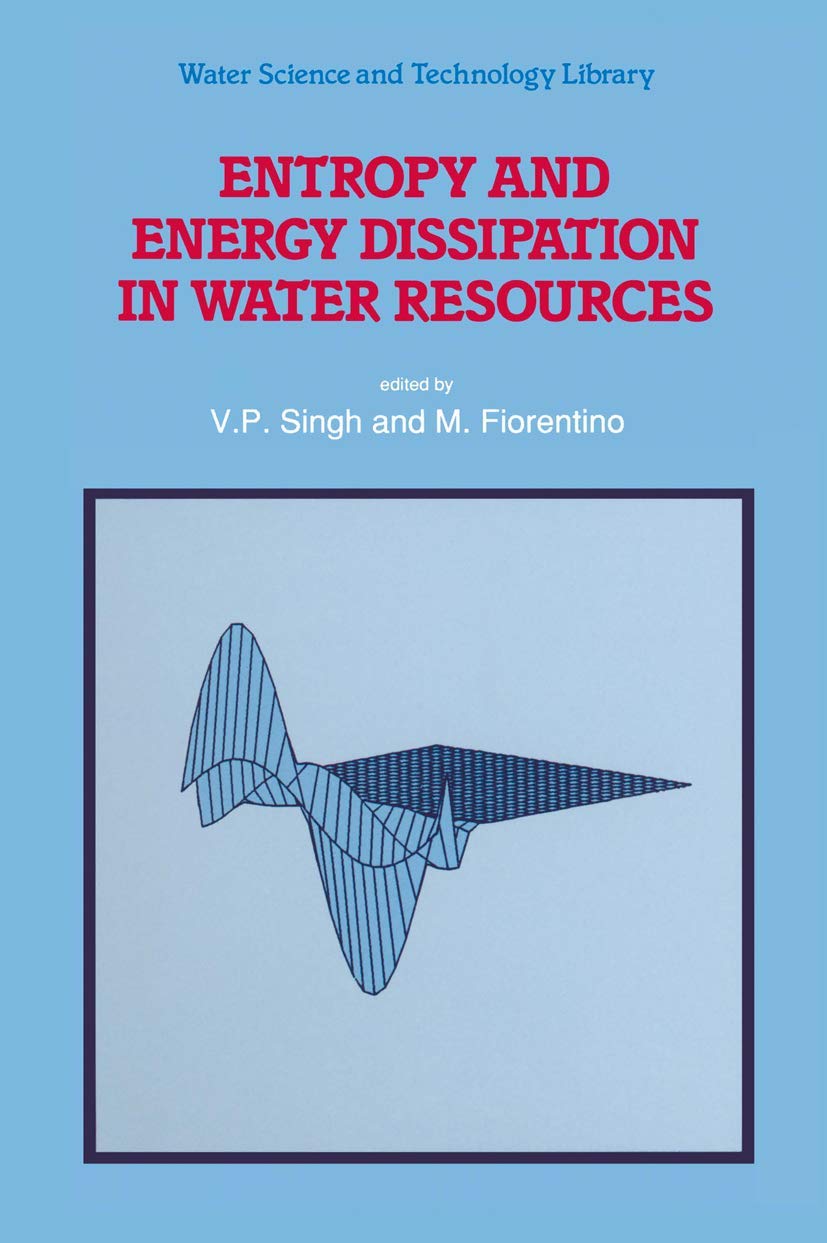
Entropy and Energy Dissipation in Water Resources (Water Science and Technology Library, 9),Used
Sold by Ergodebooks, an authorized reseller.
Returns accepted within 30 days | support@ergodebooks.com
Shipping Information
- Free Standard Shipping — United States only
- Processing Time: 3–5 business days
- Estimated Delivery: 6–10 business days after dispatch
- Double-boxed, fully insured & discreetly packaged
- Tracking number sent via email once dispatched
Returns & Refund
Returns accepted within 30 days of delivery.
Damaged or Defective Item
Free return shipping + replacement or full refund
Wrong Item Received
Free return shipping + replacement or full refund
Change of Mind
Return shipping at customer's expense · 25% restocking fee applies
Payment Option

Since the landmark contributions of C. E. Shannon in 1948, and those of E. T. Jaynes about a decade later, applications of the concept of entropy and the principle of maximum entropy have proliterated in science and engineering. Recent years have witnessed a broad range of new and exciting developments in hydrology and water resources using the entropy concept. These have encompassed innovative methods for hydrologic network design, transfer of information, flow forecasting, reliability assessment for water distribution systems, parameter estimation, derivation of probability distributions, drainagenetwork analysis, sediment yield modeling and pollutant loading, bridgescour analysis, construction of velocity profiles, comparative evaluation of hydrologic models, and so on. Some of these methods hold great promise for advancement of engineering practice, permitting rational alternatives to conventional approaches. On the other hand, the concepts of energy and energy dissipation are being increasingly applied to a wide spectrum of problems in environmental and water resources. Both entropy and energy dissipation have their origin in thermodynamics, and are related concepts. Yet, many of the developments using entropy seem to be based entirely on statistical interpretation and have seemingly little physical content. For example, most of the entropyrelated developments and applications in water resources have been based on the informationtheoretic interpretation of entropy. We believe if the power of the entropy concept is to be fully realized, then its physical basis has to be established.
⚠️ WARNING (California Proposition 65):
This product may contain chemicals known to the State of California to cause cancer, birth defects, or other reproductive harm.
For more information, please visit www.P65Warnings.ca.gov.