
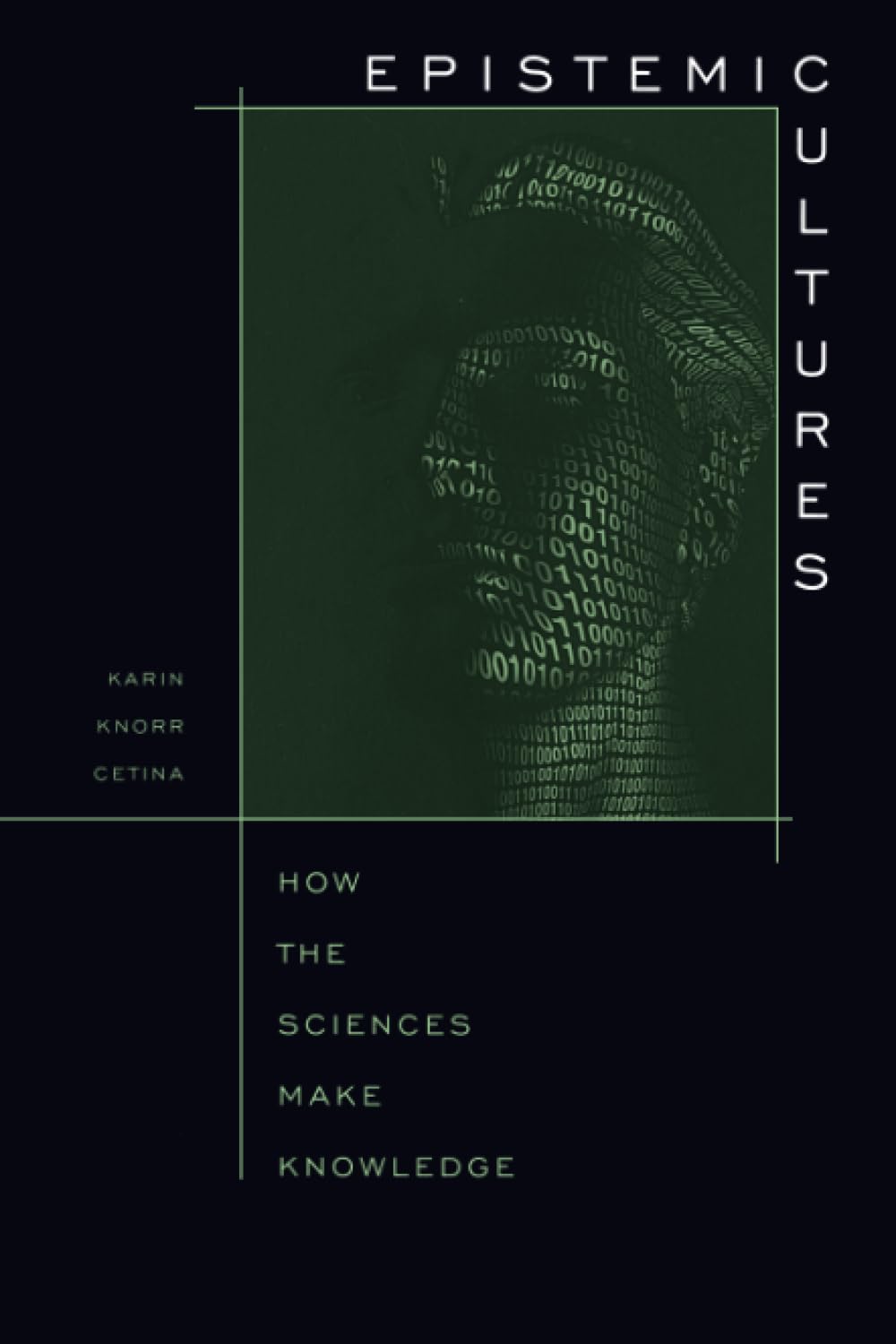
Title


Epistemic Cultures: How The Sciences Make Knowledge
Sold by Ergodebooks, an authorized reseller.
Returns accepted within 30 days | support@ergodebooks.com
Shipping Information
- Free Standard Shipping — United States only
- Processing Time: 3–5 business days
- Estimated Delivery: 6–10 business days after dispatch
- Double-boxed, fully insured & discreetly packaged
- Tracking number sent via email once dispatched
Returns & Refund
Returns accepted within 30 days of delivery.
Damaged or Defective Item
Free return shipping + replacement or full refund
Wrong Item Received
Free return shipping + replacement or full refund
Change of Mind
Return shipping at customer's expense · 25% restocking fee applies
Payment Option

How Does Science Create Knowledge? Epistemic Cultures, Shaped By Affinity, Necessity, And Historical Coincidence, Determine How We Know What We Know. In This Book, Karin Knorr Cetina Compares Two Of The Most Important And Intriguing Epistemic Cultures Of Our Day, Those In High Energy Physics And Molecular Biology. Her Work Highlights The Diversity Of These Cultures Of Knowing And, In Its Depiction Of Their Differencesin The Meaning Of The Empirical, The Enactment Of Object Relations, And The Fashioning Of Social Relationschallenges The Accepted View Of A Unified Science.By Many Accounts, Contemporary Western Societies Are Becoming Knowledge SocietiesWhich Run On Expert Processes And Expert Systems Epitomized By Science And Structured Into All Areas Of Social Life. By Looking At Epistemic Cultures In Two Sample Cases, This Book Addresses Pressing Questions About How Such Expert Systems And Processes Work, What Principles Inform Their Cognitive And Procedural Orientations, And Whether Their Organization, Structures, And Operations Can Be Extended To Other Forms Of Social Order.The First Ethnographic Study To Systematically Compare Two Different Scientific Laboratory Cultures, This Book Sharpens Our Focus On Epistemic Cultures As The Basis Of The Knowledge Society.
⚠️ WARNING (California Proposition 65):
This product may contain chemicals known to the State of California to cause cancer, birth defects, or other reproductive harm.
For more information, please visit www.P65Warnings.ca.gov.
- Q: How many pages does this book have? A: This book has three hundred fifty-two pages. It provides an in-depth exploration of epistemic cultures in scientific communities.
- Q: What is the binding type of this book? A: The book is paperback bound. This makes it lightweight and flexible for easy reading.
- Q: What are the dimensions of this book? A: The book measures six point fourteen inches in length, zero point eighty-eight inches in width, and nine point twenty-one inches in height.
- Q: Who is the author of this book? A: The author is Karin Knorr Cetina. She is well-known for her research on the sociology of science.
- Q: What genre does this book belong to? A: This book belongs to the History and Philosophy genre. It examines how scientific knowledge is constructed.
- Q: What is the main theme of the book? A: The main theme of the book is the analysis of epistemic cultures in science. It contrasts two significant areas: high energy physics and molecular biology.
- Q: Is this book suitable for beginners in philosophy? A: Yes, this book is suitable for beginners as it provides accessible insights into complex scientific cultures.
- Q: Can this book be used in academic settings? A: Yes, this book is ideal for academic settings. It serves as a resource for courses in science and philosophy.
- Q: What age group is this book suitable for? A: This book is suitable for adults and older teens interested in science and philosophy. It covers complex ideas that require critical thinking.
- Q: How do I care for this paperback book? A: To care for this paperback book, store it upright in a cool, dry place. Avoid exposing it to direct sunlight to prevent fading.
- Q: Is this book safe for children? A: No, this book is not specifically designed for children. It contains complex concepts better suited for mature readers.
- Q: What if my book arrives damaged? A: If your book arrives damaged, you should contact the seller for a replacement or refund. Most sellers have return policies in place.
- Q: Can I return this book if I don't like it? A: Yes, you can typically return this book if it is in new condition. Check the seller's return policy for specific details.
- Q: Does this book include any illustrations? A: No, this book does not include illustrations. It focuses on text to convey its ideas effectively.
- Q: What is the publisher of this book? A: The publisher of this book is Harvard University Press. They are known for their scholarly publications.