If you have any questions, you are always welcome to contact us. We'll get back to you as soon as possible, withing 24 hours on weekdays.
Customer service
All questions about your order, return and delivery must be sent to our customer service team by e-mail at yourstore@yourdomain.com
Sale & Press
If you are interested in selling our products, need more information about our brand or wish to make a collaboration, please contact us at press@yourdomain.com
Help
If you have any questions, you are always welcome to contact us. We'll get back to you as soon as possible, withing 24 hours on weekdays.
Customer service
All questions about your order, return and delivery must be sent to our customer service team by e-mail at yourstore@yourdomain.com
Sale & Press
If you are interested in selling our products, need more information about our brand or wish to make a collaboration, please contact us at press@yourdomain.com
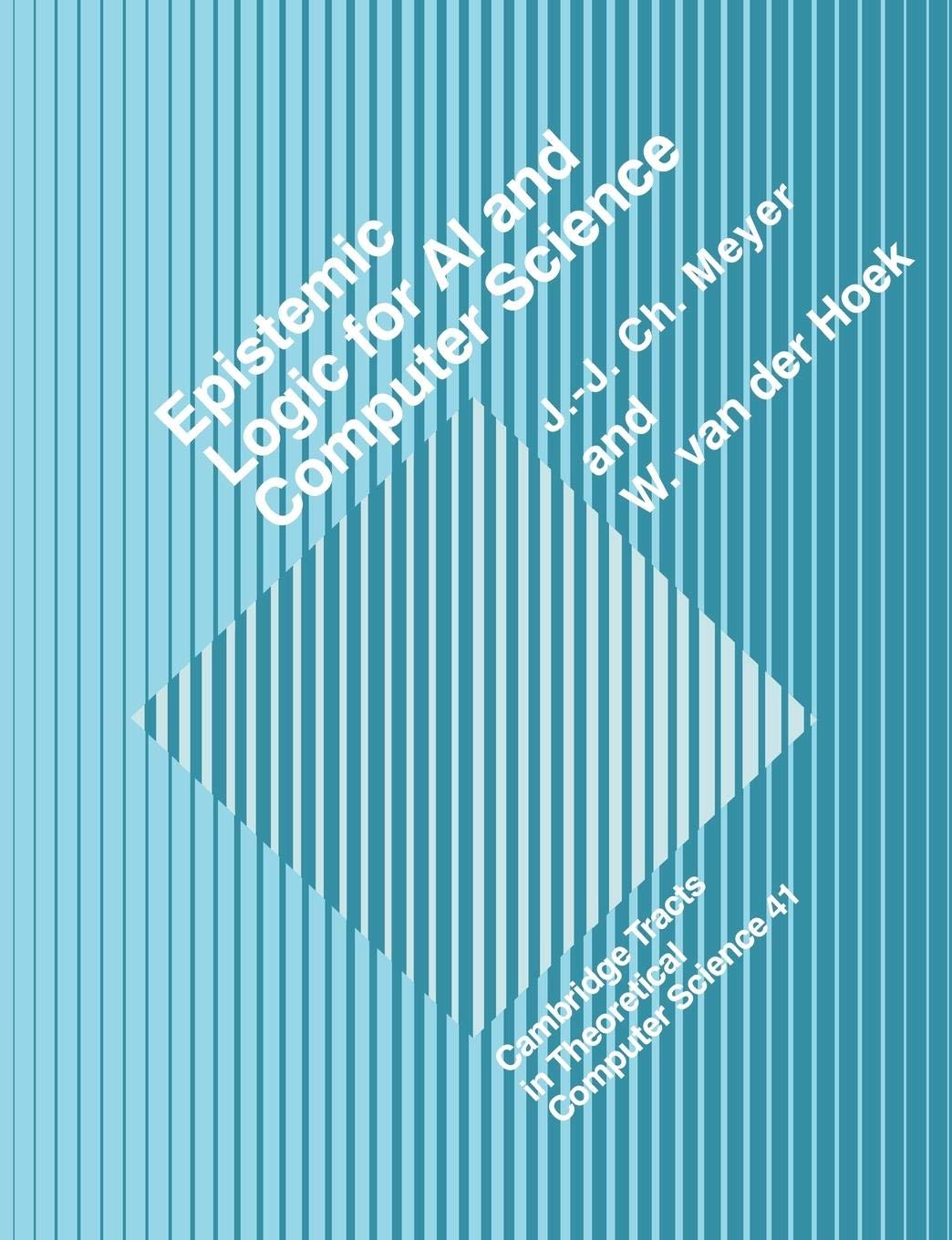
Epistemic logic has grown from its philosophical beginnings to find diverse applications in computer science as a means of reasoning about the knowledge and belief of agents. This book, based on courses taught at universities and summer schools, provides a broad introduction to the subject; many exercises are included together with their solutions. The authors begin by presenting the necessary apparatus from mathematics and logic, including Kripke semantics and the wellknown modal logics K, T, S4 and S5. Then they turn to applications in the contexts of distributed systems and artificial intelligence: topics that are addressed include the notions of common knowledge, distributed knowledge, explicit and implicit belief, the interplays between knowledge and time, and knowledge and action, as well as a graded (or numerical) variant of the epistemic operators. The problem of logical omniscience is also discussed extensively. Halpern and Moses' theory of honest formulae is covered, and a digression is made into the realm of nonmonotonic reasoning and preferential entailment. Moore's autoepistemic logic is discussed, together with Levesque's related logic of 'all I know'. Furthermore, it is shown how one can base default and counterfactual reasoning on epistemic logic.
⚠️ WARNING (California Proposition 65):
This product may contain chemicals known to the State of California to cause cancer,
birth defects, or other reproductive harm.
For MAP (Minimum Advertised Price) violations and Intellectual Property (IP) or Trademark concerns, please contact:
support@ergodebooks.com
⚠️ California Proposition 65 Warning: Some products sold on this website may expose you to chemicals known to the State of California to cause cancer, birth defects, or other reproductive harm. For more information, visit www.P65Warnings.ca.gov.