
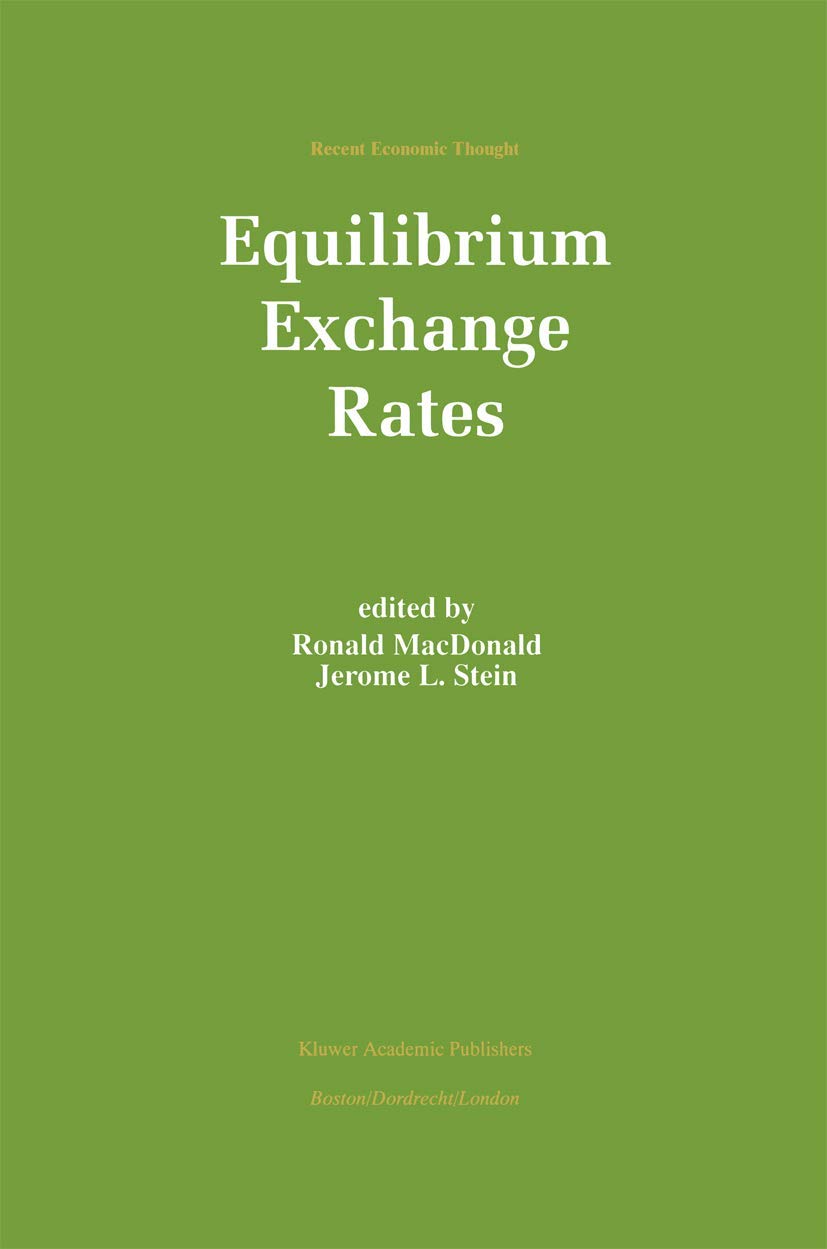
Title
Springer Equilibrium Exchange Rates - Recent Economic Thought, 69 Edition
Sold by Ergodebooks, an authorized reseller.
Returns accepted within 30 days | support@ergodebooks.com
Shipping Information
- Free Standard Shipping — United States only
- Processing Time: 3–5 business days
- Estimated Delivery: 6–10 business days after dispatch
- Double-boxed, fully insured & discreetly packaged
- Tracking number sent via email once dispatched
Returns & Refund
Returns accepted within 30 days of delivery.
Damaged or Defective Item
Free return shipping + replacement or full refund
Wrong Item Received
Free return shipping + replacement or full refund
Change of Mind
Return shipping at customer's expense · 25% restocking fee applies
Payment Option

The book titled "Equilibrium Exchange Rates: Theory and Evidence" is a comprehensive resource that delves into the complexities of equilibrium exchange rates. It addresses critical questions regarding the effectiveness of purchasing power parity (PPP) and its extension in determining the equilibrium exchange rate. This scholarly work is essential for academics, policymakers, international bankers, and investment fund managers seeking to enhance their understanding of currency valuation and its determinants.
This volume presents a robust empirical analysis of exchange rates, highlighting the various econometric and theoretical approaches utilized by different authors. It synthesizes competing views on exchange rate determination, from PPP to macroeconomic balance approaches, providing a nuanced understanding of the fundamental factors influencing exchange rates. The consistency of the findings across chapters reinforces confidence in the insights presented.
Key Features:- In-depth Analysis: Explores the determinants and dynamics of equilibrium real exchange rates.
- Empirical Focus: Emphasizes what is known about exchange rates through empirical evidence.
- Multiple Perspectives: Encompasses a diverse range of views on exchange rate determination.
- Policymaker Relevance: Provides valuable insights for policymakers and financial professionals.
- Quantitative Approaches: Utilizes various econometric techniques to analyze exchange rate behavior.
- Comprehensive Coverage: Addresses misalignments in exchange rates and their causes.
- Expert Contributions: Features contributions from leading scholars in the field of economics.
"Equilibrium Exchange Rates: Theory and Evidence" is an indispensable resource for those involved in international finance and economic policy. It is particularly beneficial for scholars and practitioners who require a deeper understanding of exchange rate mechanisms and their implications for global markets. This book not only enhances theoretical knowledge but also equips readers with practical insights relevant in today's volatile economic landscape.
⚠️ WARNING (California Proposition 65):
This product may contain chemicals known to the State of California to cause cancer, birth defects, or other reproductive harm.
For more information, please visit www.P65Warnings.ca.gov.
- Q: How many pages does this book have? A: This book has three hundred fifty-eight pages. It provides an in-depth exploration of equilibrium exchange rates and their determinants.
- Q: What is the binding type of this book? A: The binding type is hardcover. This ensures durability and provides a professional look for library or personal collections.
- Q: What are the dimensions of this book? A: The dimensions are six point fourteen inches in length, zero point eighty-three inches in width, and nine point twenty-one inches in height. These measurements make it a manageable size for reading.
- Q: Who is the author of this book? A: The author is Ronald MacDonald. He is known for his contributions to the field of econometrics and exchange rate theory.
- Q: What topics does this book cover? A: This book covers topics like purchasing power parity and the dynamics of equilibrium exchange rates. It also discusses policy effects on exchange rates.
- Q: Is this book suitable for beginners in economics? A: Yes, this book is suitable for readers with a basic understanding of economics. It presents various views of equilibrium exchange rate determination in an accessible manner.
- Q: How can I apply the concepts learned in this book? A: You can apply the concepts by analyzing real-world currency fluctuations and understanding the policies that affect exchange rates. This knowledge is valuable for policymakers and investors.
- Q: Is there a specific audience this book targets? A: Yes, the book targets academic theorists, policymakers, and investment fund managers. It provides insights that are useful for professionals in international finance.
- Q: How do I care for this hardcover book? A: To care for the book, keep it in a dry place and avoid direct sunlight. This will help preserve the binding and pages.
- Q: Can I store this book on a standard bookshelf? A: Yes, you can store this book on a standard bookshelf. Its dimensions are compatible with most shelves.
- Q: What if the book arrives damaged? A: If the book arrives damaged, you should contact the seller for a return or exchange. Most sellers will provide support for such issues.
- Q: Is there a warranty for this book? A: No, books typically do not come with a warranty. However, you can check the return policy with the seller.
- Q: How do I get help if I have questions about the content? A: If you have questions about the content, consider reaching out to economic forums or book clubs focused on econometrics. Engaging with others can provide additional insights.
- Q: What makes this book unique compared to others in its category? A: This book is unique because it encompasses various competing views of equilibrium exchange rates, providing a comprehensive understanding of the topic.
- Q: Is this book well-reviewed? A: Yes, this book has received positive reviews for its empirical approach and clarity in discussing complex economic concepts.
- Q: What is the main conclusion of this book? A: The main conclusion is that significant progress has been made in understanding the determinants of exchange rates and the forces that realign them.