
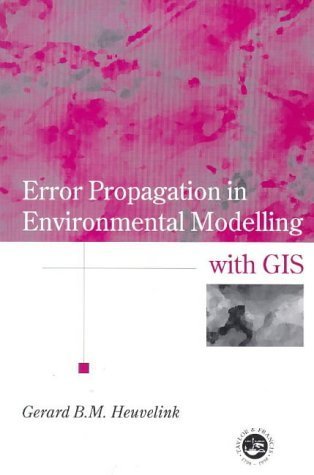
Title
Error Propagation in Environmental Modelling with GIS (Research Monographs in GIS),Used
Sold by Ergodebooks, an authorized reseller.
Returns accepted within 30 days | support@ergodebooks.com
Shipping Information
- Free Standard Shipping — United States only
- Processing Time: 3–5 business days
- Estimated Delivery: 6–10 business days after dispatch
- Double-boxed, fully insured & discreetly packaged
- Tracking number sent via email once dispatched
Returns & Refund
Returns accepted within 30 days of delivery.
Damaged or Defective Item
Free return shipping + replacement or full refund
Wrong Item Received
Free return shipping + replacement or full refund
Change of Mind
Return shipping at customer's expense · 25% restocking fee applies
Payment Option

GIS users and professionals are aware that the accuracy of GIS results cannot be naively based on the quality of the graphical output. Data stored in a GIS will have been collected or measured, classified, generalised, interpreted or estimated, and in all cases this allows the introduction of errors.; With the processing of translation of this data into the GIS itself further propagation or amplification or errors also occur. It is essential that GIS professionals understand these issues systematically if they are to build ever more accurate systems.; In this book the authors decade of study into these problems is brought into focus with an account of the development, application and implementation of error propagation techniques for use in environmental modelling with GIS. Its purpose is to provide a methodology for handling error and error propagation.
⚠️ WARNING (California Proposition 65):
This product may contain chemicals known to the State of California to cause cancer, birth defects, or other reproductive harm.
For more information, please visit www.P65Warnings.ca.gov.
- Q: What are the dimensions of this book? A: The book measures six and a half inches by nine and a quarter inches and has a thickness of zero point five one inches.
- Q: How many pages does this book have? A: This book contains one hundred forty-four pages, providing a comprehensive overview of error propagation in environmental modelling.
- Q: What type of binding does this book have? A: The book is available in paperback binding, making it lightweight and easy to handle.
- Q: Who is the author of this book? A: The book is authored by Gerard B.M. Heuvelink, an expert in GIS and environmental modelling.
- Q: What is the main topic of this book? A: The book focuses on error propagation techniques in environmental modelling using GIS, addressing the complexities of data accuracy.
- Q: Is this book suitable for beginners in GIS? A: Yes, the book systematically explains concepts and methodologies, making it accessible for beginners as well as professionals.
- Q: How can I apply the techniques from this book? A: You can apply the error propagation methodologies discussed in the book to improve the accuracy of your GIS projects.
- Q: What background knowledge is needed to understand this book? A: A basic understanding of GIS principles and environmental modelling will enhance your comprehension of the content.
- Q: How should I care for this book? A: To keep the book in good condition, store it in a dry place and avoid exposing it to direct sunlight.
- Q: Is there a warranty or return policy for this book? A: Yes, there is a standard return policy in place, allowing you to return the book if it arrives damaged.
- Q: What should I do if the book arrives damaged? A: If the book arrives damaged, contact customer support for assistance with the return process.
- Q: Can I find similar books in this genre? A: Yes, there are various other titles in the Remote Sensing and GIS category that explore similar topics and methodologies.
- Q: How does this book compare to other GIS textbooks? A: This book specifically focuses on error propagation, which may not be covered in other general GIS textbooks.
- Q: Is this book appropriate for academic use? A: Yes, the book is suitable for academic purposes, especially for students studying GIS and environmental sciences.
- Q: Will this book help me with my GIS project? A: Yes, the methodologies provided can significantly enhance the accuracy and reliability of your GIS projects.