
Title
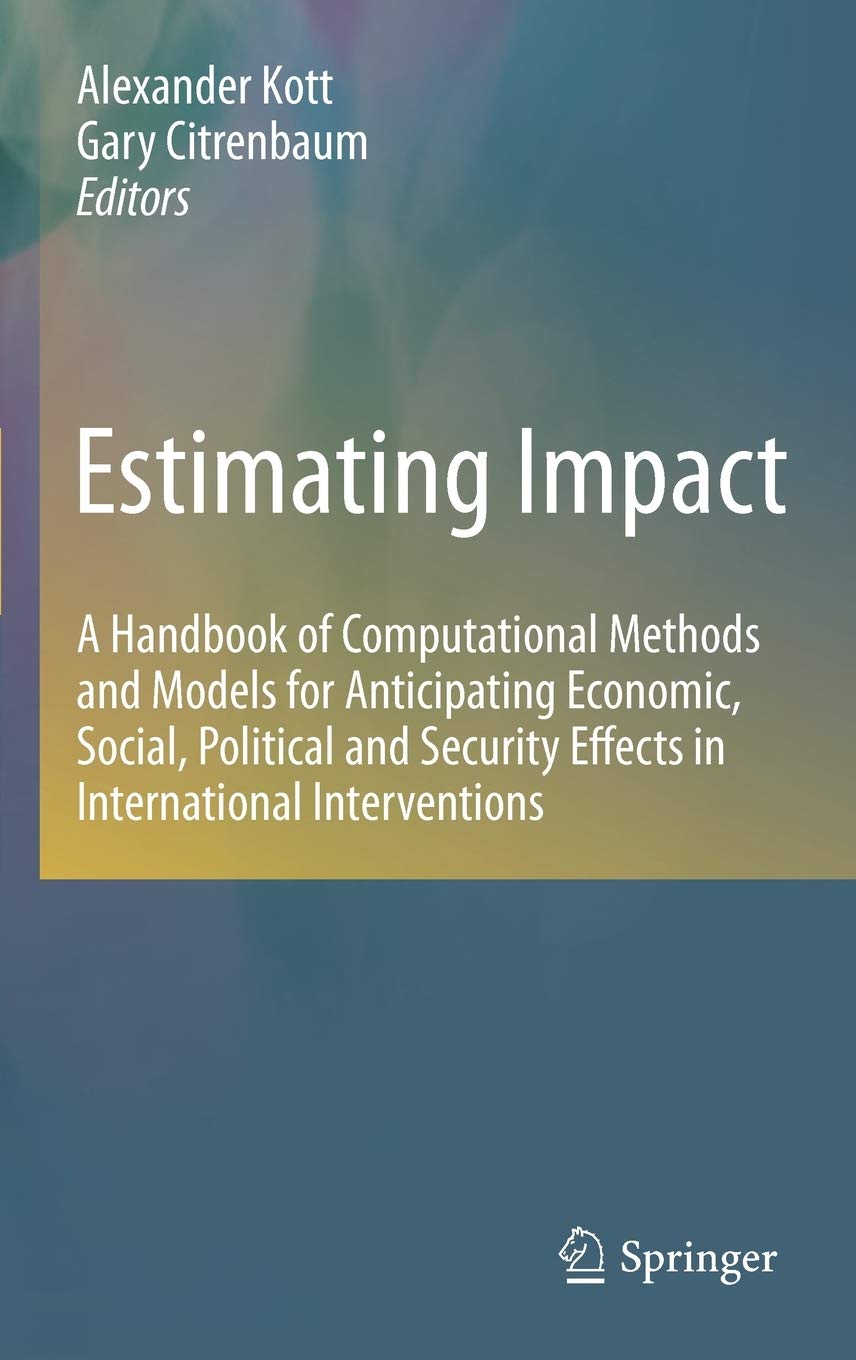
Estimating Impact: A Handbook of Computational Methods and Models for Anticipating Economic, Social, Political and Security Effe,Used
Sold by Ergodebooks, an authorized reseller.
Returns accepted within 30 days | support@ergodebooks.com
Shipping Information
- Free Standard Shipping — United States only
- Processing Time: 3–5 business days
- Estimated Delivery: 6–10 business days after dispatch
- Double-boxed, fully insured & discreetly packaged
- Tracking number sent via email once dispatched
Returns & Refund
Returns accepted within 30 days of delivery.
Damaged or Defective Item
Free return shipping + replacement or full refund
Wrong Item Received
Free return shipping + replacement or full refund
Change of Mind
Return shipping at customer's expense · 25% restocking fee applies
Payment Option

Sociological theories of crime include: theories of strain blame crime on personal stressors; theories of social learning blame crime on its social rewards, and see crime more as an institution in conflict with other institutions rather than as in vidual deviance; and theories of control look at crime as natural and rewarding, and explore the formation of institutions that control crime. Theorists of corruption generally agree that corruption is an expression of the PatronClient relationship in which a person with access to resources trades resources with kin and members of the community in exchange for loyalty. Some approaches to modeling crime and corruption do not involve an explicit simulation: rule based systems; Bayesian networks; game theoretic approaches, often based on rational choice theory; and Neoclassical Econometrics, a rational choicebased approach. Simulationbased approaches take into account greater complexities of interacting parts of social phenomena. These include fuzzy cognitive maps and fuzzy rule sets that may incorporate feedback; and agentbased simulation, which can go a step farther by computing new social structures not previously identified in theory. The latter include cognitive agent models, in which agents learn how to perceive their en ronment and act upon the perceptions of their individual experiences; and reactive agent simulation, which, while less capable than cognitiveagent simulation, is adequate for testing a policys effects with existing societal structures. For example, NNL is a cognitive agent model based on the REPAST Simphony toolkit.
⚠️ WARNING (California Proposition 65):
This product may contain chemicals known to the State of California to cause cancer, birth defects, or other reproductive harm.
For more information, please visit www.P65Warnings.ca.gov.