
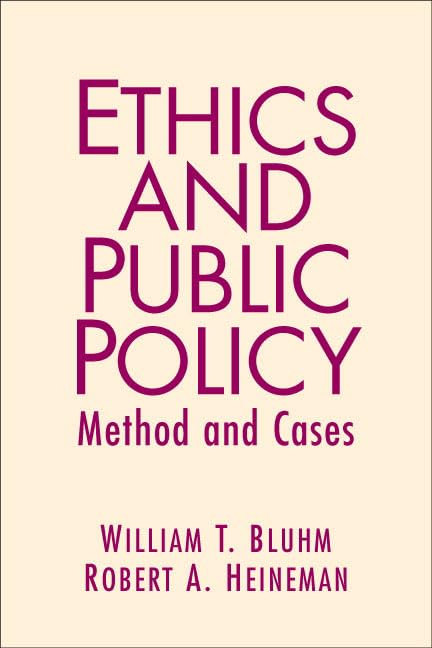
Title
Ethics and Public Policy: Method and Cases,Used
Sold by Ergodebooks, an authorized reseller.
Returns accepted within 30 days | support@ergodebooks.com
Shipping Information
- Free Standard Shipping — United States only
- Processing Time: 3–5 business days
- Estimated Delivery: 6–10 business days after dispatch
- Double-boxed, fully insured & discreetly packaged
- Tracking number sent via email once dispatched
Returns & Refund
Returns accepted within 30 days of delivery.
Damaged or Defective Item
Free return shipping + replacement or full refund
Wrong Item Received
Free return shipping + replacement or full refund
Change of Mind
Return shipping at customer's expense · 25% restocking fee applies
Payment Option

This book presents three systematic methods for analyzing public policy issues: utilitarianism, deontology, and prudent pragmatism. It argues for the superiority of prudent pragmatism to the other two approaches. These are described in Part One, together with substantive American values which form the assumptons of ethical analysis. Part Two contains an historical discussion of six public policy areas and presents two detailed case studies in each area. Each case is analysed from the standpoint of utilitarian, deontological, and prudent pragmatic ethics, and an effort is made to show why prudent pragmatism produces the most satisfying results
⚠️ WARNING (California Proposition 65):
This product may contain chemicals known to the State of California to cause cancer, birth defects, or other reproductive harm.
For more information, please visit www.P65Warnings.ca.gov.
- Q: What is the page count of the book? A: The book contains four hundred pages. This length allows for an in-depth exploration of ethics and public policy.
- Q: What are the dimensions of the book? A: The book measures six inches in length, zero point seventy-one inches in width, and nine point zero two inches in height.
- Q: Who is the author of this book? A: The author of the book is William Bluhm. He provides a comprehensive analysis of public policy issues.
- Q: What binding type does this book have? A: This book is available in paperback binding. This makes it lightweight and easy to handle.
- Q: What is the primary focus of the book? A: The book focuses on ethics and public policy. It presents methods like utilitarianism and prudent pragmatism for analysis.
- Q: Is this book suitable for beginners in public policy? A: Yes, the book is suitable for beginners. It systematically explains complex ethical theories in an accessible manner.
- Q: How does the book analyze public policy issues? A: The book analyzes public policy issues using three methods: utilitarianism, deontology, and prudent pragmatism.
- Q: Are there case studies included in the book? A: Yes, the book includes detailed case studies. Each case is analyzed through different ethical lenses.
- Q: What ethical theories are discussed in the book? A: The book discusses utilitarianism, deontology, and prudent pragmatism. It argues for the advantages of prudent pragmatism.
- Q: Does the book include historical discussions? A: Yes, the book contains historical discussions of six public policy areas. This context enhances the understanding of the case studies.
- Q: How can I best utilize this book for my studies? A: You can use this book as a foundational text for understanding ethical analysis in public policy. It is particularly useful for academic coursework.
- Q: Is this book appropriate for advanced studies in ethics? A: Yes, the book can serve as a supplementary resource for advanced studies. It provides various perspectives on ethical analysis.
- Q: What is the target audience for this book? A: The target audience includes students, policymakers, and anyone interested in ethics and public policy. It caters to diverse levels of expertise.
- Q: Does the book provide practical applications of its theories? A: Yes, the book offers practical applications through case studies. These examples illustrate how theories can be applied to real-world problems.
- Q: Can I expect to find a bibliography in the book? A: Yes, the book includes a bibliography. This provides additional resources for further reading and research.
- Q: What is the main argument presented in the book? A: The main argument is that prudent pragmatism is superior to other ethical approaches in analyzing public policy. It emphasizes practical outcomes.