
Title

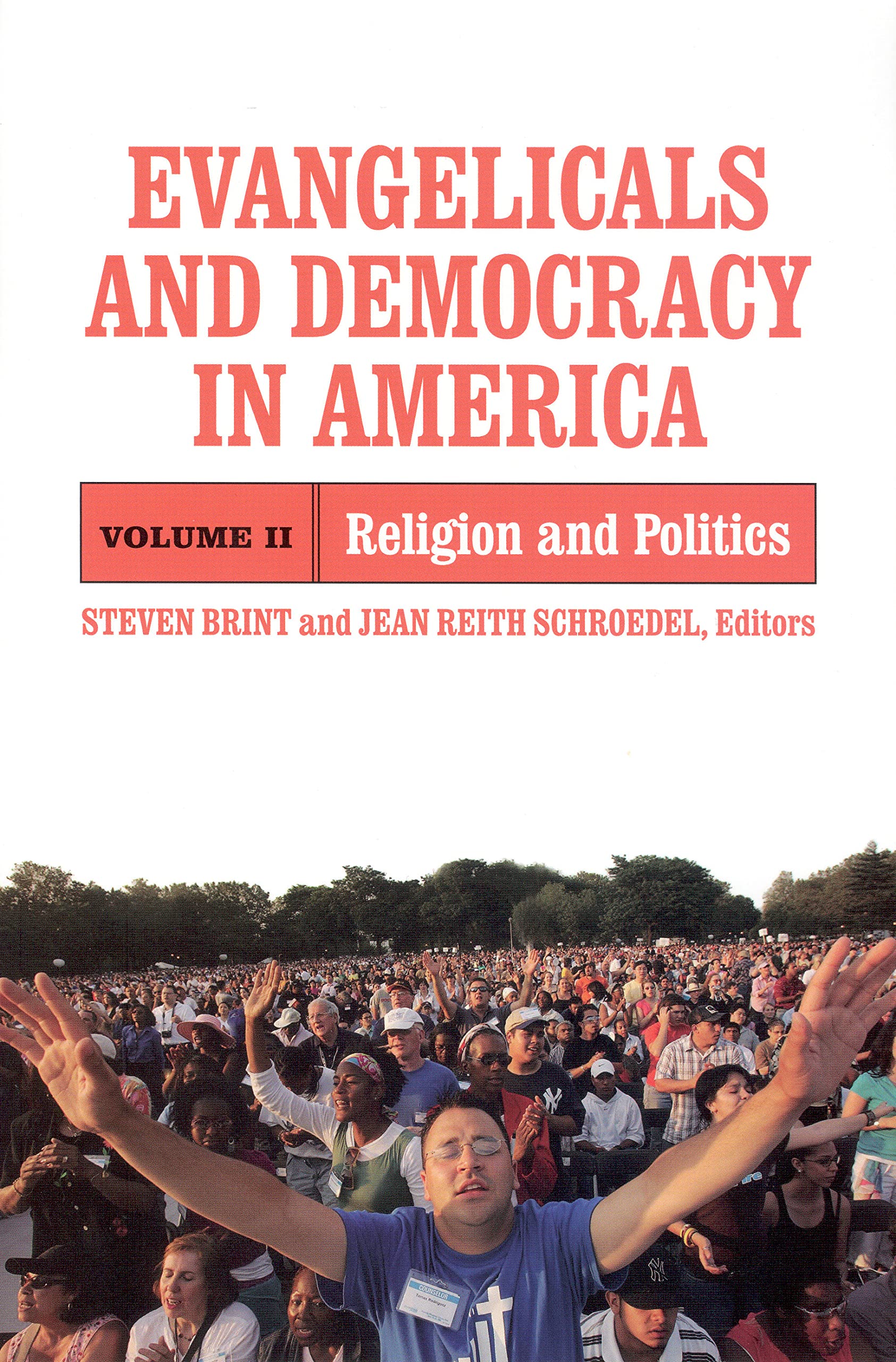
Evangelicals and Democracy in America: Religion and Politics (Volume 2),Used
Sold by Ergodebooks, an authorized reseller.
Returns accepted within 30 days | support@ergodebooks.com
Shipping Information
- Free Standard Shipping — United States only
- Processing Time: 3–5 business days
- Estimated Delivery: 6–10 business days after dispatch
- Double-boxed, fully insured & discreetly packaged
- Tracking number sent via email once dispatched
Returns & Refund
Returns accepted within 30 days of delivery.
Damaged or Defective Item
Free return shipping + replacement or full refund
Wrong Item Received
Free return shipping + replacement or full refund
Change of Mind
Return shipping at customer's expense · 25% restocking fee applies
Payment Option

Separation of church and state is a bedrock principal of American democracy, and so, too, is active citizen engagement. Since evangelicals comprise one of the largest and most vocal voting blocs in the United States, tensions and questions naturally arise. In the twovolume Evangelicals and Democracy in America, editors Steven Brint and Jean Reith Schroedel have assembled an authoritative collection of studies of the evangelical movement in America. Religion and Politics, the second volume of the set, focuses on the role of religious conservatives in party politics, the rhetoric evangelicals use to mobilize politically, and what the history of the evangelical movement reveals about where it may be going. Part I of Religion and Politics explores the role of evangelicals in electoral politics. Contributor Pippa Norris looks at evangelicals around the globe and finds that religiosity is a strong predictor of ideological leanings in industrialized countries. But the United States remains one of only a handful of postindustrial societies where religion plays a significant role in partisan politics. Other chapters look at voting trends, especially the growing number of higherincome evangelicals among Republican ranks, how voting is influenced both by "values" and race, and the management of the symbols and networks behind the electoral system of moralvalues politics. Part II of the volume focuses on the mobilizing rhetoric of the Christian Right. Nathaniel Klemp and Stephen Macedo show how the rhetorical strategies of the Christian Right create powerful mobilizing narratives, but frequently fail to build broad enough coalitions to prevail in the pluralistic marketplace of ideas. Part III analyzes the cycles and evolution of the Christian Right. Kimberly Conger looks at the specific circumstances that have allowed evangelicals to become dominant in some Republican state party committees but not in others. D. Michael Lindsay examines the "elastic orthodoxy" that has allowed evangelicals to evolve into a formidable social and political force. The final chapter by Clyde Wilcox presents a new framework for understanding the relationship between the Christian Right and the GOP based on the ecological metaphor of coevolution. With its companion volume on religion and society, this second volume of Evangelicals and Democracy in America offers the most complete examination yet of the social circumstances and political influence of the millions of Americans who are white evangelical Protestants. Understanding their history and prospects for the future is essential to forming a comprehensive picture of America today.
⚠️ WARNING (California Proposition 65):
This product may contain chemicals known to the State of California to cause cancer, birth defects, or other reproductive harm.
For more information, please visit www.P65Warnings.ca.gov.