If you have any questions, you are always welcome to contact us. We'll get back to you as soon as possible, withing 24 hours on weekdays.
Customer service
All questions about your order, return and delivery must be sent to our customer service team by e-mail at yourstore@yourdomain.com
Sale & Press
If you are interested in selling our products, need more information about our brand or wish to make a collaboration, please contact us at press@yourdomain.com
Help
If you have any questions, you are always welcome to contact us. We'll get back to you as soon as possible, withing 24 hours on weekdays.
Customer service
All questions about your order, return and delivery must be sent to our customer service team by e-mail at yourstore@yourdomain.com
Sale & Press
If you are interested in selling our products, need more information about our brand or wish to make a collaboration, please contact us at press@yourdomain.com
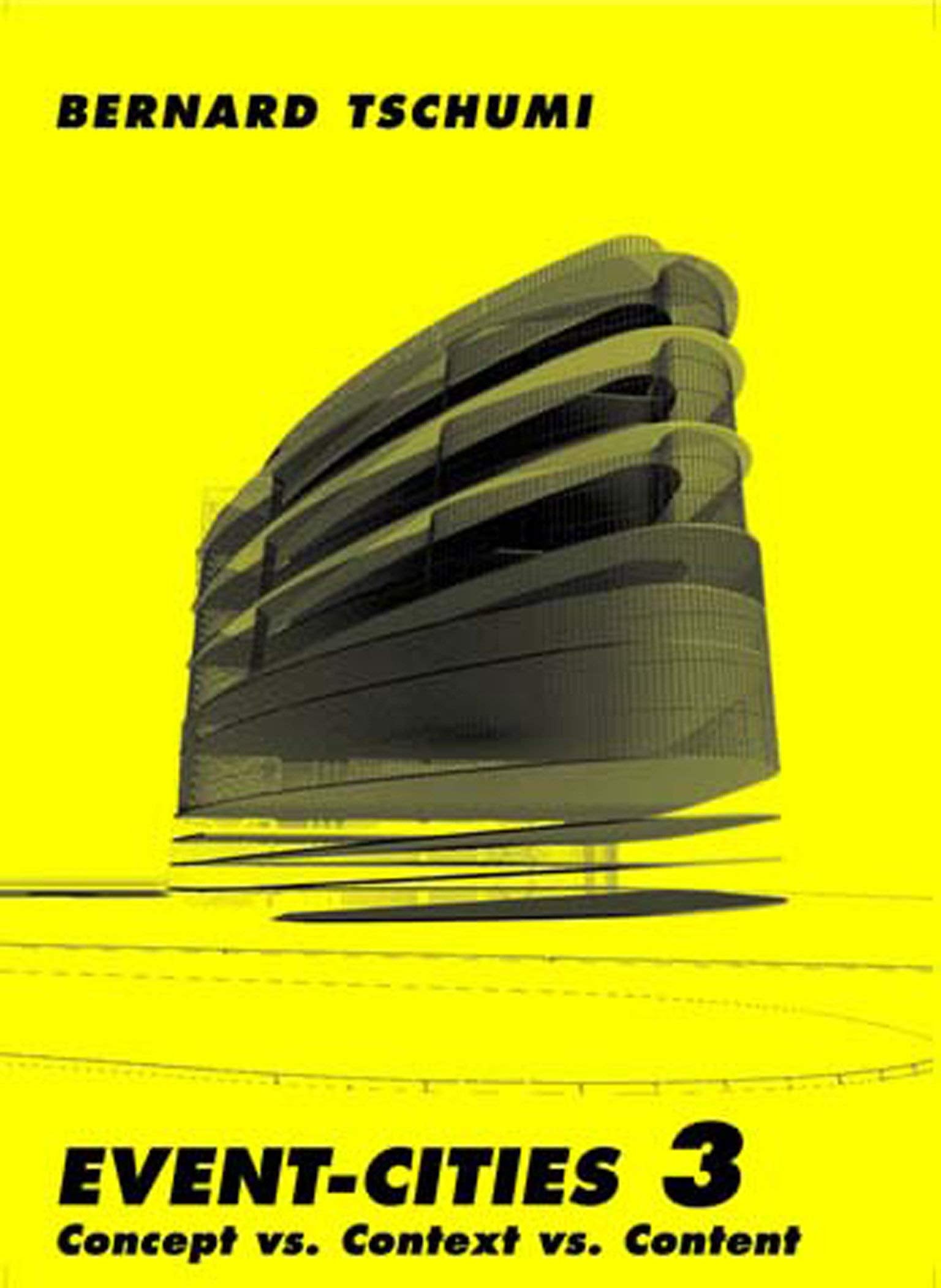
How concept, context, and content interact in architecture; provocative examples from recent projects by Bernard Tschumi.In EventCities 3, Bernard Tschumi explores the complex and productive triangulation of architectural concept, context, and content. There is no architecture without a concept, an overriding idea that gives coherence and identity to a building. But there is also no architecture without contexthistorical, geographical, culturalor content (what happens inside). Concept, context, and content may be in unison or purposely discordant. Against the contextualist movement of the 1980s and 1990s, which called for architecture to blend in with its surroundings, Tschumi argues that buildings may or may not conform to their settingsbut that the decision should always be strategic.Through documentation of recent projectsincluding the new Acropolis Museum in Athens, a campus athletic center in Cincinnati, museums in Sao Paolo, New York, and Antwerp, concert halls in France, and a speculative urban project in BeijingTschumi examines different ways that concept, context, and content relate to each other in his work. In the new Acropolis Museum, for example, Tschumi looks at the interaction of the concepta simple and precise museum with the clarity of ancient Greek buildingswith the context (its location at the base of the Acropolis, 800 feet from the Parthenon) and the content, which incorporates archaeological excavations on the building site into the fabric of the museum. Through provocative examples, Tschumi demonstrates that the relationship of concept, context, and content may be one of indifference, reciprocity, or conflictall of which, he argues, are valid architectural approaches. Above all, he suggests that the activity of architecture is less about the making of forms than the investigation and materialization of concepts.
⚠️ WARNING (California Proposition 65):
This product may contain chemicals known to the State of California to cause cancer,
birth defects, or other reproductive harm.
<div class="dynamic-checkout__content" id="dynamic-checkout-cart" data-shopify="dynamic-checkout-cart"> <shopify-accelerated-checkout-cart wallet-configs="[{"supports_subs":true,"supports_def_opts":false,"name":"shop_pay","wallet_params":{"shopId":73758048501,"merchantName":"Ergodebooks","personalized":true}},{"supports_subs":false,"supports_def_opts":false,"name":"amazon_pay","wallet_params":{"checkoutLanguage":"en_US","ledgerCurrency":"USD","placement":"Cart","sandbox":false,"merchantId":"A1G1ZY975O1T6J","productType":"PayAndShip","design":"C0002"}},{"supports_subs":true,"supports_def_opts":false,"name":"paypal","wallet_params":{"shopId":73758048501,"countryCode":"US","merchantName":"Ergodebooks","phoneRequired":true,"companyRequired":false,"shippingType":"shipping","shopifyPaymentsEnabled":true,"hasManagedSellingPlanState":false,"requiresBillingAgreement":false,"merchantId":"L873BZSC9NMQS","sdkUrl":"https://www.paypal.com/sdk/js?components=buttons\u0026commit=false\u0026currency=USD\u0026locale=en_US\u0026client-id=AbasDhzlU0HbpiStJiN1KRJ_cNJJ7xYBip7JJoMO0GQpLi8ePNgdbLXkC7_KMeyTg8tnAKW4WKrh9qmf\u0026merchant-id=L873BZSC9NMQS\u0026intent=authorize"}}]" access-token="c0f52a66b386e9fa5c0ab4c2febc737c" buyer-country="US" buyer-locale="en" buyer-currency="USD" shop-id="73758048501" cart-id="110f410d044de2dbcc01500328a829d7" enabled-flags="["ce346acf"]" > <div class="wallet-button-wrapper"> <ul class='wallet-cart-grid wallet-cart-grid--skeleton' role="list" data-shopify-buttoncontainer="true"> <li data-testid='grid-cell' class='wallet-cart-button-container'><div class='wallet-cart-button wallet-cart-button__skeleton' role='button' disabled aria-hidden='true'> </div></li><li data-testid='grid-cell' class='wallet-cart-button-container'><div class='wallet-cart-button wallet-cart-button__skeleton' role='button' disabled aria-hidden='true'> </div></li><li data-testid='grid-cell' class='wallet-cart-button-container'><div class='wallet-cart-button wallet-cart-button__skeleton' role='button' disabled aria-hidden='true'> </div></li> </ul> </div> </shopify-accelerated-checkout-cart> <small id="shopify-buyer-consent" class="hidden" aria-hidden="true" data-consent-type="subscription"> One or more of the items in your cart is a deferred, subscription, or recurring purchase. By continuing, I agree to the <span id="shopify-subscription-policy-button">cancellation policy</span> and authorize you to charge my payment method at the prices, frequency and dates listed on this page until my order is fulfilled or I cancel, if permitted. </small> </div>
Stay in the know
Subscribe to our newsletter and stay updated on latest offers, discounts and events near you.
For MAP (Minimum Advertised Price) violations and Intellectual Property (IP) or Trademark concerns, please contact:
support@ergodebooks.com
⚠️ California Proposition 65 Warning: Some products sold on this website may expose you to chemicals known to the State of California to cause cancer, birth defects, or other reproductive harm. For more information, visit www.P65Warnings.ca.gov.