
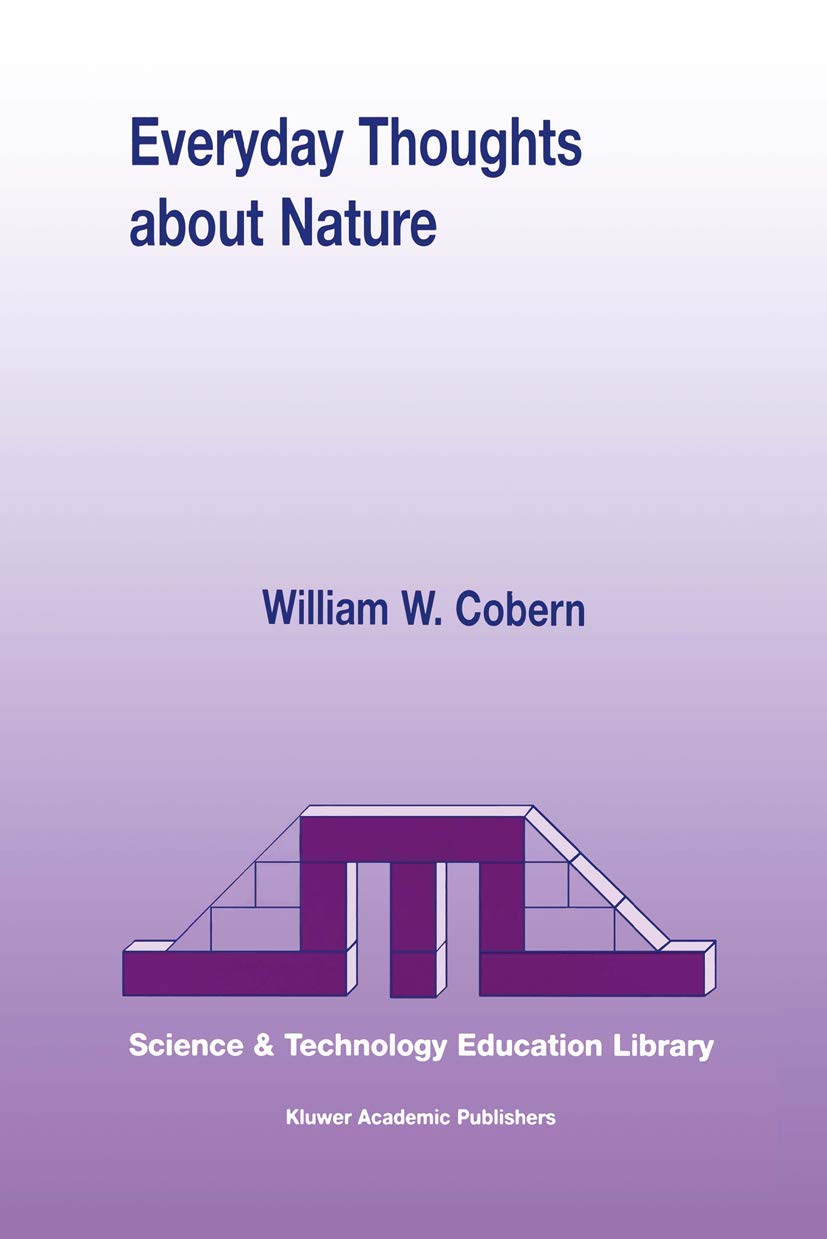
Title
Everyday Thoughts about Nature: A Worldview Investigation of Important Concepts Students Use to Make Sense of Nature with Specif,Used
Sold by Ergodebooks, an authorized reseller.
Returns accepted within 30 days | support@ergodebooks.com
Shipping Information
- Free Standard Shipping — United States only
- Processing Time: 3–5 business days
- Estimated Delivery: 6–10 business days after dispatch
- Double-boxed, fully insured & discreetly packaged
- Tracking number sent via email once dispatched
Returns & Refund
Returns accepted within 30 days of delivery.
Damaged or Defective Item
Free return shipping + replacement or full refund
Wrong Item Received
Free return shipping + replacement or full refund
Change of Mind
Return shipping at customer's expense · 25% restocking fee applies
Payment Option

Dr. Olcbee Lee SchoolofEducation, UniversityofMiami Coral Gables, Florida 33124 I remember my excitement and appreciation several years ago when I first read World View Theory and Science Education Research by Bill Cobern (1991). It was a comprehensive, theoretical discussion ofworldview theory in science education. I am delighted to see that Cobern has taken the next step to provide empirical accountsofworldview in Everyday Thoughts about Nature. . The primary goal of the book is to understand how typical ninth grade students and their science teachers think about Nature or the natural world, and how their thoughts are related to science. In pursuing this goal, the book raises a basicquestion about the purpose ofscienceeducationfor the public: Should science education seek to educate 'scientific thinkers' in the pattern of the science teachers? Or, should science education seek to foster sound science learning within the matrices ofvari ous cultural perspectives? (p. 3) The answer to this question becomes clear, thanks to Cobern's excellent research and persuasivearguments. First, this research takes a humanistic approach in understanding what students and teachers think about Nature 'through the language and ideas voluntarily expressed' (p. I). The research used multi directional prompts and encouraged students and teachers to speak freely and at length in any directions they wished. This humanistic approach is stated clearly: '[T]he research seeks to illuminate some of the various ways in which students think aboutNature withoutjudging eventhe most unorthodox perspectives' (p. 14).
⚠️ WARNING (California Proposition 65):
This product may contain chemicals known to the State of California to cause cancer, birth defects, or other reproductive harm.
For more information, please visit www.P65Warnings.ca.gov.