
Title
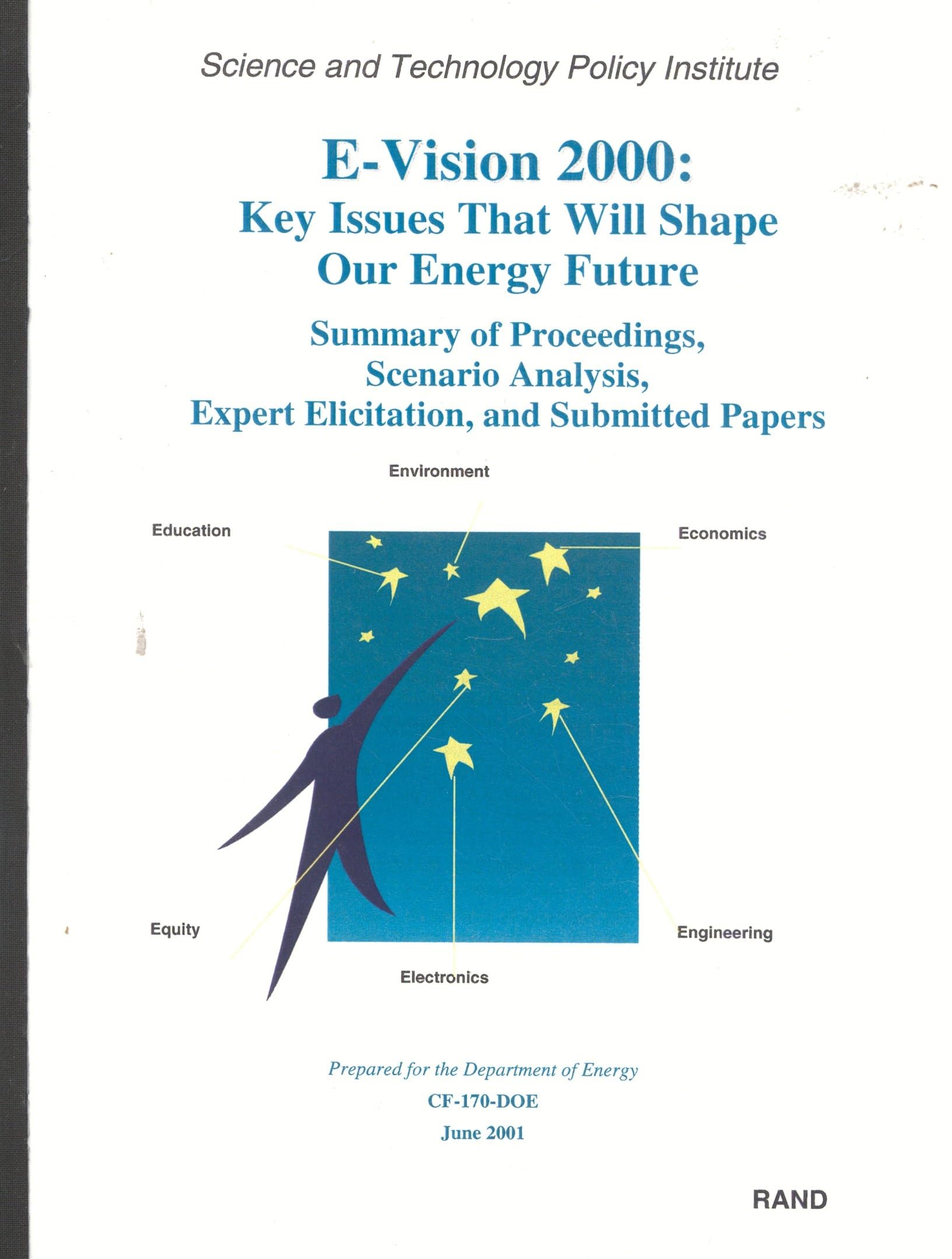
EVision 2000, Key Issues That Will Shape Our Energy Future: Summary of Proceedings, Scenario Analysis, Expert Elicitation, and ,Used
Delivery time: 8-12 business days (International)
This report documents an initiative by the Office of Energy Efficiency and Renewable Energy (EERE) of the U.S. Department of Energy to identify and assess a range of emerging issues that may affect future energy use and supply. The project had three parts: (1) a conference called EVision 2000, held October 11_13, 2000 in Washington, D.C., including presentation of invited papers; (2) an assessment of longrange planning scenarios currently used in the energy community; and (3) a structured process to identify a set of critical energy issues in 2020 to inform the EERE R&D portfolio, as viewed by a range of energy experts. This document summarizes the issues raised and suggestions made for future research by the participants in and attendees at the EVision conference and the key insights derived from RAND_s scenario analysis and expert elicitation. It also includes abstracts of papers submitted by some of the panelists. Conference participants explored the influence of information technologies on energy use; the implications of changing building designs to simultaneously improve both worker and energy productivity; how energy productivity can be improved through fundamental changes in transportation systems, landuse planning, and electricity grid design; and systems approaches to energy use.
By changing our most important processes and
products, we have already made a big leap forward. This ranges from the
increased use of more sustainable fibers to the use of more
environmentally friendly printing processes to the development of
efficient waste management in our value chain.
⚠️ WARNING (California Proposition 65):
This product may contain chemicals known to the State of California to cause cancer, birth defects, or other reproductive harm.
For more information, please visit www.P65Warnings.ca.gov.
Shipping & Returns
Shipping
We ship your order within 2–3 business days for USA deliveries and 5–8 business days for international shipments. Once your package has been dispatched from our warehouse, you'll receive an email confirmation with a tracking number, allowing you to track the status of your delivery.
Returns
To facilitate a smooth return process, a Return Authorization (RA) Number is required for all returns. Returns without a valid RA number will be declined and may incur additional fees. You can request an RA number within 15 days of the original delivery date. For more details, please refer to our Return & Refund Policy page.
Shipping & Returns
Shipping
We ship your order within 2–3 business days for USA deliveries and 5–8 business days for international shipments. Once your package has been dispatched from our warehouse, you'll receive an email confirmation with a tracking number, allowing you to track the status of your delivery.
Returns
To facilitate a smooth return process, a Return Authorization (RA) Number is required for all returns. Returns without a valid RA number will be declined and may incur additional fees. You can request an RA number within 15 days of the original delivery date. For more details, please refer to our Return & Refund Policy page.
Warranty
We provide a 2-year limited warranty, from the date of purchase for all our products.
If you believe you have received a defective product, or are experiencing any problems with your product, please contact us.
This warranty strictly does not cover damages that arose from negligence, misuse, wear and tear, or not in accordance with product instructions (dropping the product, etc.).
Warranty
We provide a 2-year limited warranty, from the date of purchase for all our products.
If you believe you have received a defective product, or are experiencing any problems with your product, please contact us.
This warranty strictly does not cover damages that arose from negligence, misuse, wear and tear, or not in accordance with product instructions (dropping the product, etc.).
Secure Payment
Your payment information is processed securely. We do not store credit card details nor have access to your credit card information.
We accept payments with :
Visa, MasterCard, American Express, Paypal, Shopify Payments, Shop Pay and more.
Secure Payment
Your payment information is processed securely. We do not store credit card details nor have access to your credit card information.
We accept payments with :
Visa, MasterCard, American Express, Paypal, Shopify Payments, Shop Pay and more.