If you have any questions, you are always welcome to contact us. We'll get back to you as soon as possible, withing 24 hours on weekdays.
Customer service
All questions about your order, return and delivery must be sent to our customer service team by e-mail at yourstore@yourdomain.com
Sale & Press
If you are interested in selling our products, need more information about our brand or wish to make a collaboration, please contact us at press@yourdomain.com
Help
If you have any questions, you are always welcome to contact us. We'll get back to you as soon as possible, withing 24 hours on weekdays.
Customer service
All questions about your order, return and delivery must be sent to our customer service team by e-mail at yourstore@yourdomain.com
Sale & Press
If you are interested in selling our products, need more information about our brand or wish to make a collaboration, please contact us at press@yourdomain.com
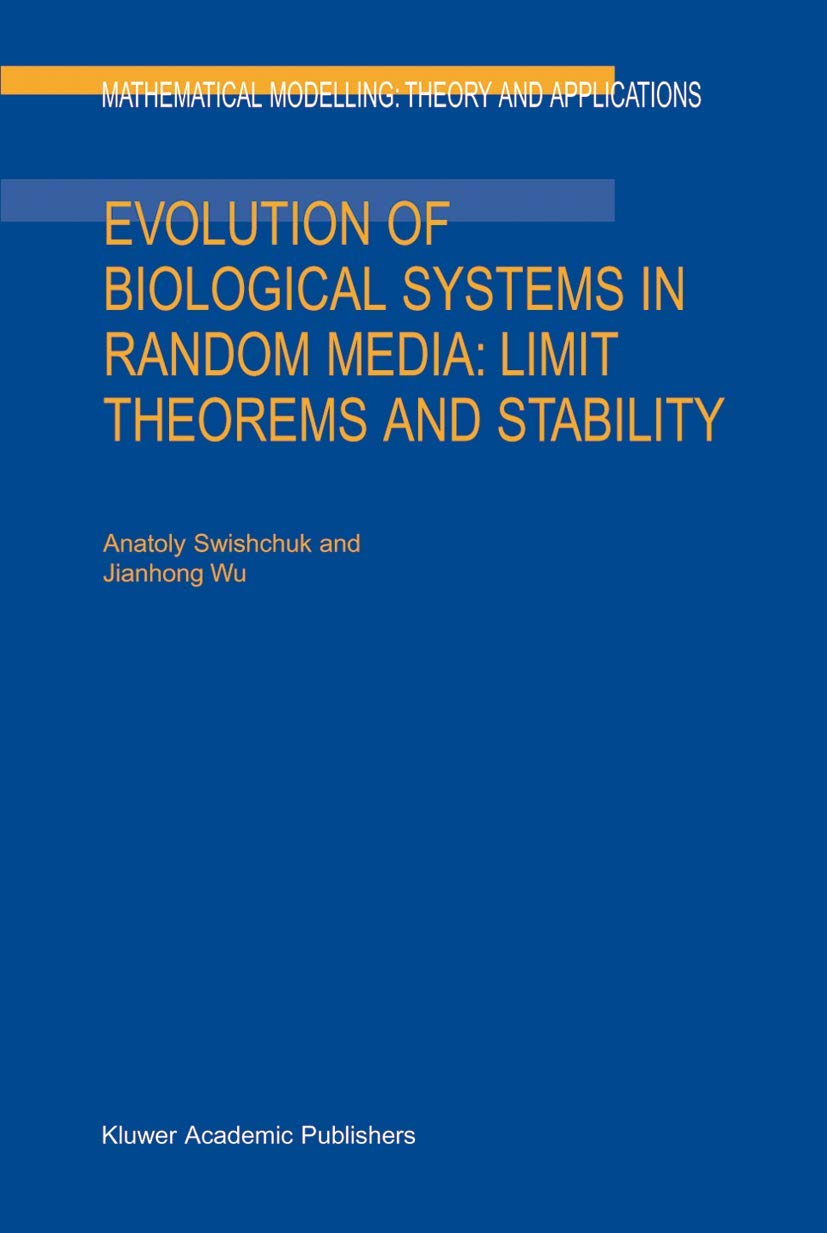
The book is devoted to the study of limit theorems and stability of evolving biologieal systems of "particles" in random environment. Here the term "particle" is used broadly to include moleculas in the infected individuals considered in epidemie models, species in logistie growth models, age classes of population in demographics models, to name a few. The evolution of these biological systems is usually described by difference or differential equations in a given space X of the following type and dxt/dt = g(Xt, y), here, the vector x describes the state of the considered system, 9 specifies how the system's states are evolved in time (discrete or continuous), and the parameter y describes the change ofthe environment. For example, in the discretetime logistic growth model or the continuoustime logistic growth model dNt/dt = r(y)Nt(lNt/K(y)), N or Nt is the population of the species at time n or t, r(y) is the per capita n birth rate, and K(y) is the carrying capacity of the environment, we naturally have X = R, X == Nn(X == Nt), g(x, y) = r(y)x(lxl K(y)), xE X. Note that n t for a predatorprey model and for some epidemie models, we will have that X = 2 3 R and X = R, respectively. In th case of logistic growth models, parameters r(y) and K(y) normaIly depend on some random variable y.
⚠️ WARNING (California Proposition 65):
This product may contain chemicals known to the State of California to cause cancer,
birth defects, or other reproductive harm.
For MAP (Minimum Advertised Price) violations and Intellectual Property (IP) or Trademark concerns, please contact:
support@ergodebooks.com
⚠️ California Proposition 65 Warning: Some products sold on this website may expose you to chemicals known to the State of California to cause cancer, birth defects, or other reproductive harm. For more information, visit www.P65Warnings.ca.gov.