
Title
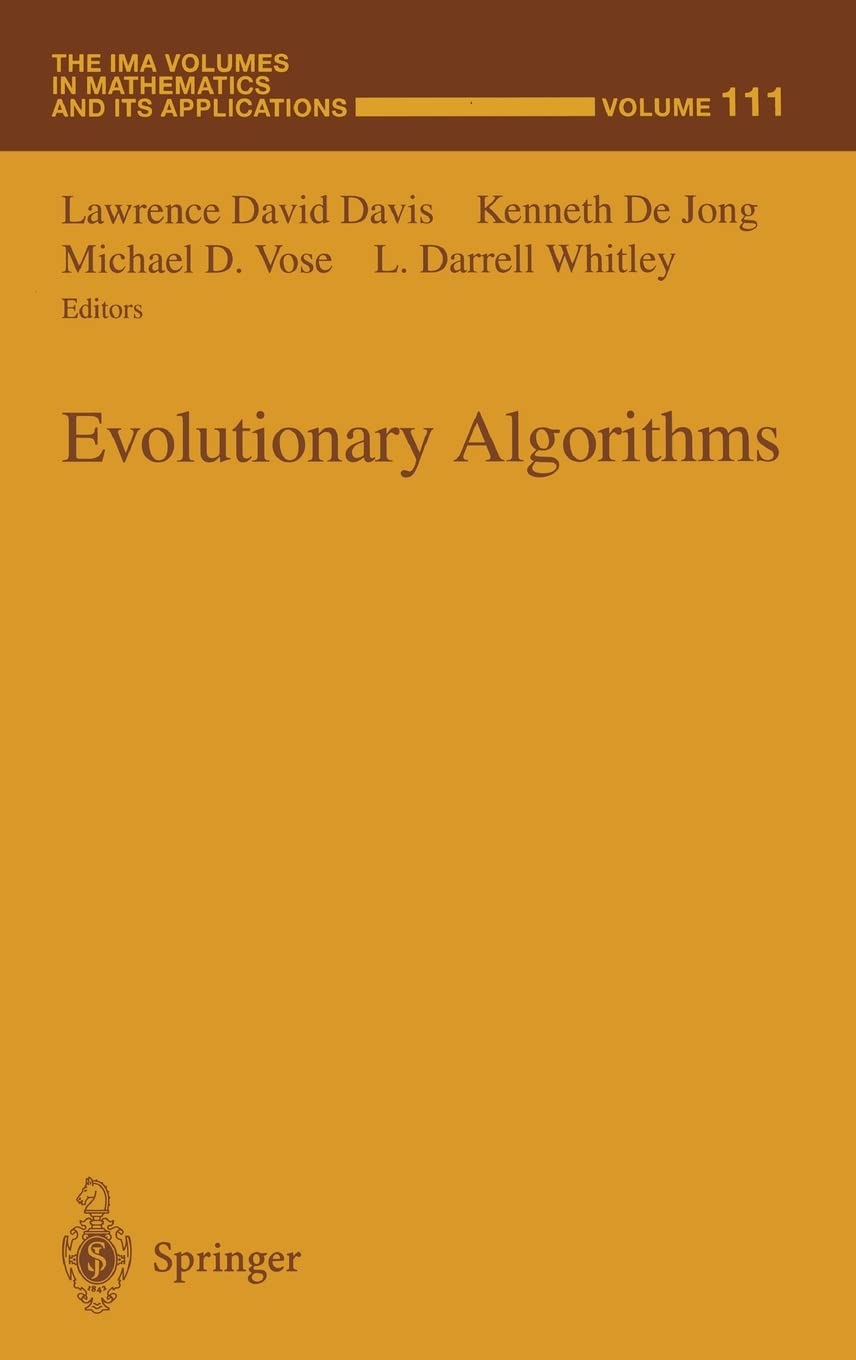
Evolutionary Algorithms (The IMA Volumes in Mathematics and its Applications),New
Sold by Ergodebooks, an authorized reseller.
Returns accepted within 30 days | support@ergodebooks.com
Shipping Information
- Free Standard Shipping — United States only
- Processing Time: 3–5 business days
- Estimated Delivery: 6–10 business days after dispatch
- Double-boxed, fully insured & discreetly packaged
- Tracking number sent via email once dispatched
Returns & Refund
Returns accepted within 30 days of delivery.
Damaged or Defective Item
Free return shipping + replacement or full refund
Wrong Item Received
Free return shipping + replacement or full refund
Change of Mind
Return shipping at customer's expense · 25% restocking fee applies
Payment Option

The IMA Workshop on Evolutionary Algorithms brought together many of the top researchers in the area of Evolutionary Computation for a week of intensive interaction. The field of Evolutionary Computation has developed significantly over the past 30 years and today consists of a variety of subfields such as genetic algorithms, evolution strategies, evolutionary programming, and genetic programming, each with its own algorithmic perspectives and goals. The workshop did a great deal to clarify the current state of the theory of Evolutionary Algorithms. The existing theory might be characterized as deriving from two principal approaches. There is a high level macrotheory that looks at the processing of 'building blocks' and 'schemata' that are shared by many good solutions when searching a problem space. There is also a low level microtheory that builds exact Markov models of the search process. It is sometimes hard for researchers working at such different levels of abstraction to interact. The IMA workshop allowed researchers working at these different levels to present their points of view and to move toward common ground. There was real progress in communication between theorists and practitioners in the evolutionary computation field. Speakers presented applications across a wide range of problem areas. In some of those cases, theoretically motivated methods work quite well. In other cases, practitioners used domainbased methods to obtain better performance than could be achieved by using a 'pure' evolutionary algorithm. Individuals on both sides went away with a better appreciation of the successes and failures of current theory.
⚠️ WARNING (California Proposition 65):
This product may contain chemicals known to the State of California to cause cancer, birth defects, or other reproductive harm.
For more information, please visit www.P65Warnings.ca.gov.