
Title
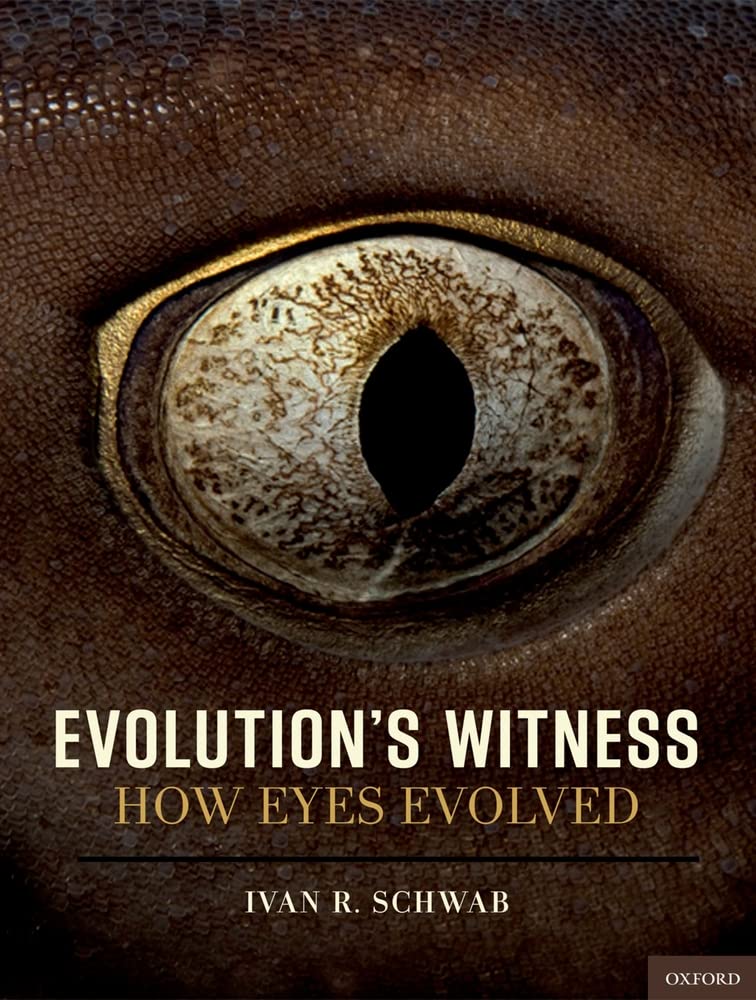
Evolution'S Witness: How Eyes Evolved,Used
Sold by Ergodebooks, an authorized reseller.
Returns accepted within 30 days | support@ergodebooks.com
Shipping Information
- Free Standard Shipping — United States only
- Processing Time: 3–5 business days
- Estimated Delivery: 6–10 business days after dispatch
- Double-boxed, fully insured & discreetly packaged
- Tracking number sent via email once dispatched
Returns & Refund
Returns accepted within 30 days of delivery.
Damaged or Defective Item
Free return shipping + replacement or full refund
Wrong Item Received
Free return shipping + replacement or full refund
Change of Mind
Return shipping at customer's expense · 25% restocking fee applies
Payment Option

With Predation And Carnivory As Catalysts, The First Known Eye Appeared In A Trilobite During The Cambrian Explosion Approximately 543 Million Years Ago. This Period Was A Crucible Of Evolution And Teemed With Anatomic Creativity Although The Journey To Formed Vision Actually Began Billions Of Years Before That.The Cambrian Period, However, Spawned Nearly All Morphologic Forms Of The Eye, Followed By Descent Over Hundreds Of Millions Of Years Providing An Unimaginable Variety Of Eyes With At Least Ten Different Designs. Some Eyes Display Spectacular Creativity With Mirror, Scanning Or Telephoto Optics. Some Of These Ocular Designs Are Merely Curiosities, While Others Offer The Finest Visual Potential Packed Into A Small Space, Limited Only By The Laws Of Diffraction Or Physiological Optics.For Example, Some Spiders Developed Tiny, Wellformed Eyes With Scanning Optics And Three Visual Pigments; Scallops Have 40100 Eyes Circling Their Mantle, Each Of Which Has Mirror Optics And Contains Two Separate Retinae Per Eye; Deep Ocean Fish Have Eyes Shaped Like Tubes Containing Yellow Lenses To Break Camouflage; And Some Birds Have Vision Five Times Better Than Ours; But This Is Only Part Of The Story. Each Animal Alive Today Has An Eye That Fits Is Niche Perfectly Demonstrating The Intimacy Of The Evolutionary Process As No Other Organ Could. The Evolution Of The Eye Is One Of The Best Examples Of Darwinian Principles.Although Few Eyes Fossilize In Any Significant Manner, Many Details Of This Evolution Are Known And Understood. From Initial Photoreception 3.75 Billion Years Ago To Early Spatial Recognition In The First Cupped Eyespot In Euglena To Fully Formed Camera Style Eyes The Size Of Beach Balls In Ichthyosaurs, Animals Have Processed Light To Compete And Survive In Their Respective Niches.It Is Evolution'S Greatest Gift And Its Greatest Triumph. This Is The Story Of The Evolution Of The Eye.
⚠️ WARNING (California Proposition 65):
This product may contain chemicals known to the State of California to cause cancer, birth defects, or other reproductive harm.
For more information, please visit www.P65Warnings.ca.gov.
- Q: How many pages are in the book? A: The book has three hundred twenty-eight pages. This length provides ample content to explore the evolution of eyes in detail.
- Q: What is the binding type of this book? A: The book is a hardcover edition. This makes it durable and suitable for long-term use.
- Q: What are the dimensions of this book? A: The book measures eleven point one inches in length, one inch in width, and eight point eight two inches in height. These dimensions make it a standard size for a hardcover book.
- Q: Who is the author of this book? A: The author of the book is Ivan R. Schwab. He is known for his expertise in evolutionary biology.
- Q: What is the genre of this book? A: The book falls under the genre of evolution. It specifically discusses the evolutionary history of eyes.
- Q: Is this book suitable for children? A: Yes, the book is suitable for children with an interest in science. However, parental guidance may be needed for younger readers due to the complex themes.
- Q: How can I use this book for research? A: You can use this book as a resource for studying the evolution of eyes. It provides detailed information suitable for academic and personal research.
- Q: Is this book appropriate for beginners in science? A: Yes, the book is appropriate for beginners. It explains complex concepts in a clear and engaging manner.
- Q: How should I store this book? A: You should store the book in a cool, dry place to prevent damage. Keeping it upright on a shelf can help maintain its shape.
- Q: Can I clean the book if it gets dirty? A: Yes, you can clean the book. Use a soft, dry cloth to gently wipe the cover and pages to remove dust.
- Q: What if the book arrives damaged? A: If the book arrives damaged, you should contact the seller for a return or exchange. Most sellers have policies in place for such situations.
- Q: Is this book part of a series? A: No, this book is not part of a series. It stands alone as a comprehensive study on the evolution of eyes.
- Q: What is the publisher of this book? A: The book is published by Oxford University Press. They are known for their reputable academic publications.
- Q: Does this book include illustrations? A: Yes, the book includes illustrations to help explain complex concepts. These visuals enhance the understanding of the evolutionary content.
- Q: Can I read this book on a digital device? A: No, this version is a hardcover book. However, it may be available in digital formats from other retailers.