
Title
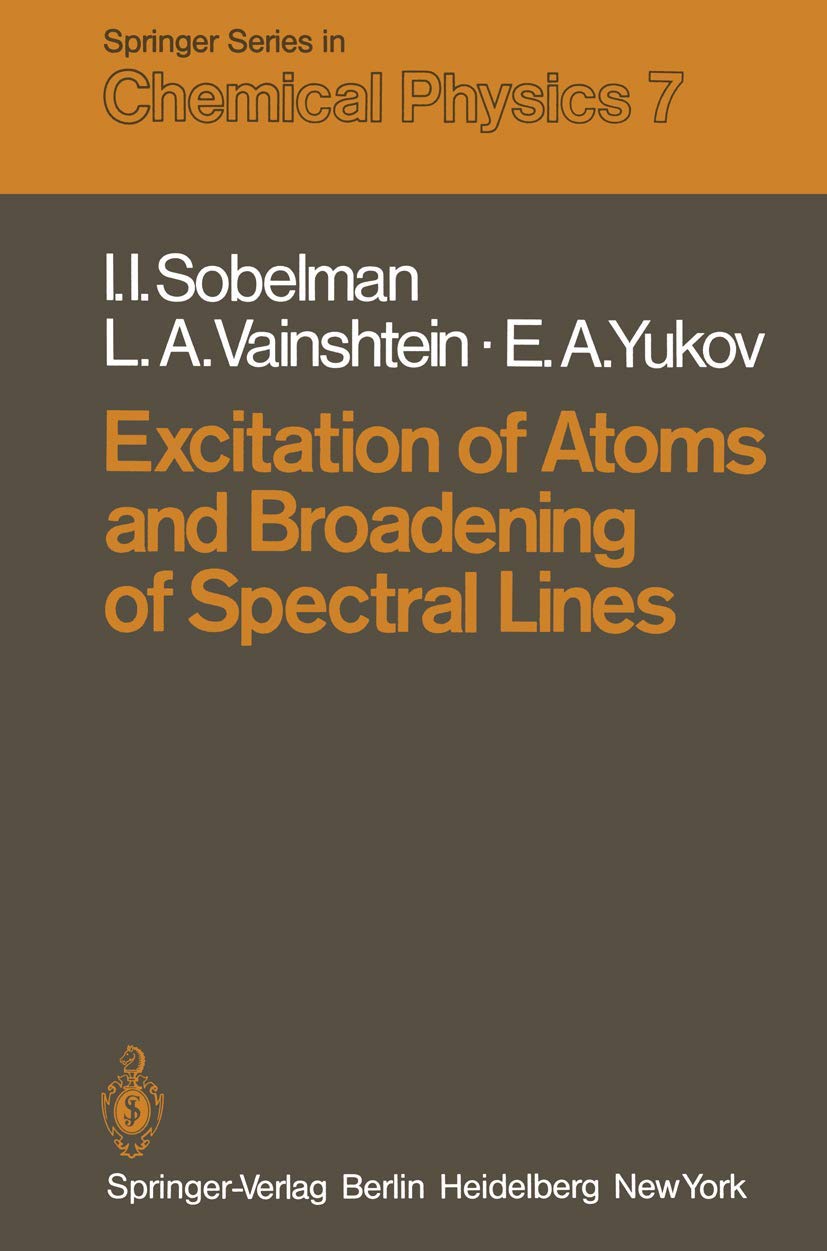
Excitation of Atoms and Broadening of Spectral Lines (Springer Series in Chemical Physics, 7),Used
Sold by Ergodebooks, an authorized reseller.
Returns accepted within 30 days | support@ergodebooks.com
Shipping Information
- Free Standard Shipping — United States only
- Processing Time: 3–5 business days
- Estimated Delivery: 6–10 business days after dispatch
- Double-boxed, fully insured & discreetly packaged
- Tracking number sent via email once dispatched
Returns & Refund
Returns accepted within 30 days of delivery.
Damaged or Defective Item
Free return shipping + replacement or full refund
Wrong Item Received
Free return shipping + replacement or full refund
Change of Mind
Return shipping at customer's expense · 25% restocking fee applies
Payment Option

New applications of atomic spectroscopy in laser physics, laser spectrosco py, laser frequency and wavelength measurements, plasma physics, astrophysics, and some other related problems have been developed very intensively in the last years. As a result, the approximate methods of calculation of the transition probabilities and cross sections necessary for all these applications have become of vastly increased importance. At the same time, some new problems have arisen in the theory of spectral line broadening such as the shape of nonlinear resonances in the spectra of gas lasers, interference effects, and some other problems connected with various spectroscopic methods of plasma diagnostics. This book is devoted to the systematic treatment of the theory of the elementary processes responsible for the excitation of atomic spectra and the theory of spectral line broadening. The choice of problems is significantly different from that traditional for books on the theory of atomic collisions. The main goal of the book is to present the most efficient and useful of comparatively simple approximate methods for the calcula tion and estimation of cross sections. Numerous tables containing the results of approximate cross section calculations for the most important elementary processes are included in the book. Comprehensive presenta tion of the theory of atomic collisions is out of the scope of this book and can be found elsewhere. However, the fundamentals of the general theory of collisions which are necessary for formulation of approximate methods are given in Chapter 2.
⚠️ WARNING (California Proposition 65):
This product may contain chemicals known to the State of California to cause cancer, birth defects, or other reproductive harm.
For more information, please visit www.P65Warnings.ca.gov.