
Title
Expanding Definitions of Giftedness (Educational Psychology Series),New
Sold by Ergodebooks, an authorized reseller.
Returns accepted within 30 days | support@ergodebooks.com
Shipping Information
- Free Standard Shipping — United States only
- Processing Time: 3–5 business days
- Estimated Delivery: 6–10 business days after dispatch
- Double-boxed, fully insured & discreetly packaged
- Tracking number sent via email once dispatched
Returns & Refund
Returns accepted within 30 days of delivery.
Damaged or Defective Item
Free return shipping + replacement or full refund
Wrong Item Received
Free return shipping + replacement or full refund
Change of Mind
Return shipping at customer's expense · 25% restocking fee applies
Payment Option

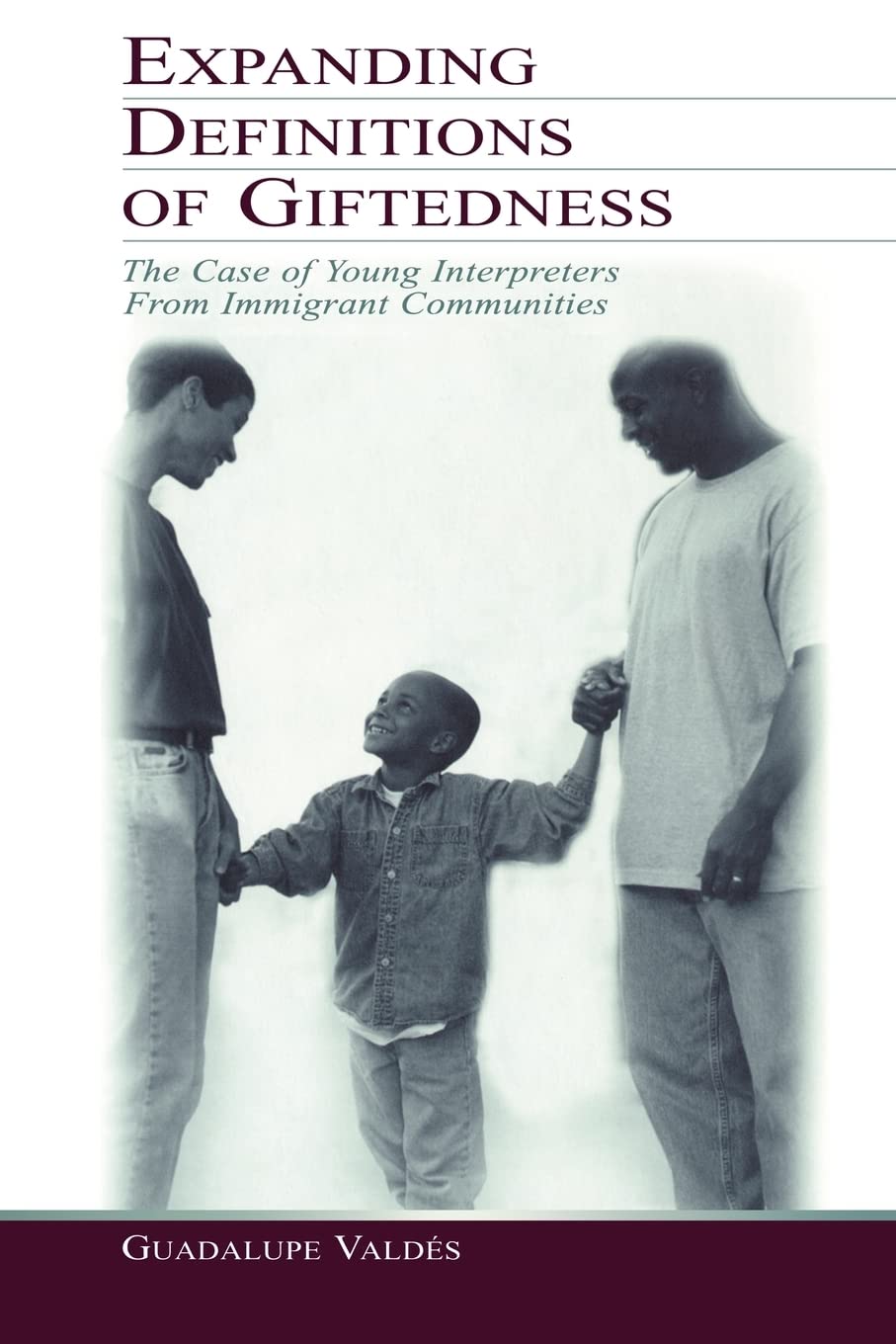
This book is about bilingual young people who have been selected by their families to carry out the hard work of interpreting and translating to mediate communication between themselves and the outside worldbetween minority and majority communities. It examines the experiences of these young interpreters and the skills they develop in order to fulfill this role.The authors' purpose in this volume is to contribute to extending current definitions of gifted and talented, by proposing and offering evidence that the young people who are selected to serve as family interpreters perform at remarkably high levels of accomplishment when compared with others of their age, experience, and environment, and should thus clearly be included in the 1993 U.S. federal definition of giftedness.They maintain that not only are these capabilities currently overlooked by existing assessment procedures, but also that there is little understanding of the ways in which the unique talents of young interpreters might be nurtured and developed in academic settings.A strong case is made that in order for such students to be identified as gifted on the basis of their bilingual abilities, the field of gifted and talented education must embrace the concept that bilingualism is a strength. The field must also make developing bilingualism a focus of programs designed to meet the needs of the increasingly multilingual student population in the United States.The research this book reportspart of a larger fiveyear study of giftedness through linguistic and cultural lenses, funded by OERI through the National Research Center on the Gifted and Talentedwas conducted by researchers whose background is very much outside the field of gifted education. Rather, their focus is on language, working within the traditions of qualitative sociolinguistics. Thus, this book offers a unique approach to the exploration of giftedness. It asks researchers and practitioners ordinarily accustomed to working with quantitative data to examine and make sense of detailed and rich analyses of students' linguistic performance, and argues that it is only by understanding the challenges of such bilingual interactions that the field of gifted and talented education can expand and reframe its vision of giftedness.
⚠️ WARNING (California Proposition 65):
This product may contain chemicals known to the State of California to cause cancer, birth defects, or other reproductive harm.
For more information, please visit www.P65Warnings.ca.gov.