
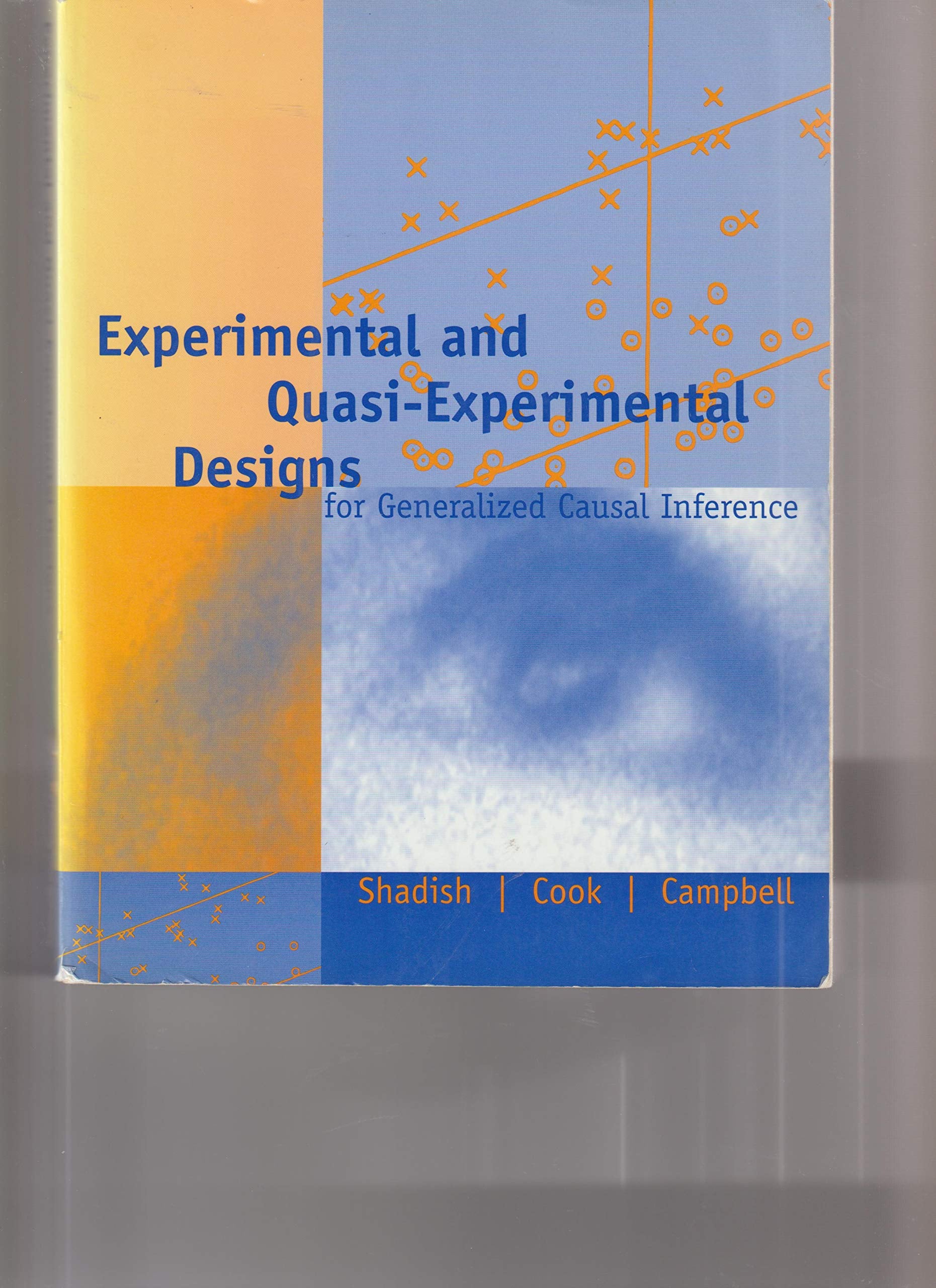
Title
Experimental And Quasiexperimental Designs For Generalized Causal Inference
Sold by Ergodebooks, an authorized reseller.
Returns accepted within 30 days | support@ergodebooks.com
Shipping Information
- Free Standard Shipping — United States only
- Processing Time: 3–5 business days
- Estimated Delivery: 6–10 business days after dispatch
- Double-boxed, fully insured & discreetly packaged
- Tracking number sent via email once dispatched
Returns & Refund
Returns accepted within 30 days of delivery.
Damaged or Defective Item
Free return shipping + replacement or full refund
Wrong Item Received
Free return shipping + replacement or full refund
Change of Mind
Return shipping at customer's expense · 25% restocking fee applies
Payment Option

This Long Awaited Successor Of The Original Cook/Campbell Quasiexperimentation: Design And Analysis Issues For Field Settings Represents Updates In The Field Over The Last Two Decades. The Book Covers Four Major Topics In Field Experimentation:
⚠️ WARNING (California Proposition 65):
This product may contain chemicals known to the State of California to cause cancer, birth defects, or other reproductive harm.
For more information, please visit www.P65Warnings.ca.gov.
- Q: What is the page count of this book? A: This book contains six hundred fifty-six pages. It provides in-depth coverage of experimental and quasi-experimental designs.
- Q: What are the dimensions of this book? A: The book measures seven point zero one inches in length, one inch in width, and eight point seven five inches in height.
- Q: What type of binding does this book have? A: This book is available in paperback binding. This makes it flexible and easy to handle.
- Q: Who is the author of this book? A: The author of this book is William R. Shadish. He is recognized for his contributions in experimental psychology.
- Q: What category does this book fall under? A: This book is categorized under Experimental Psychology. It focuses on causal inference in various settings.
- Q: How should I read this book for optimal understanding? A: To use this book effectively, read it chapter by chapter, as it builds on concepts sequentially. Take notes on key methodologies.
- Q: Is this book suitable for beginners in psychology? A: Yes, the content is accessible to beginners. It provides foundational concepts in experimental design while also covering advanced topics.
- Q: Can this book be used for academic coursework? A: Yes, this book is ideal for academic coursework. It is a comprehensive resource for students in psychology and related fields.
- Q: How should I store this book to keep it in good condition? A: Store this book upright in a cool, dry place. Avoid exposing it to direct sunlight to prevent fading and damage.
- Q: Is there a specific way to handle this book to avoid damage? A: Yes, handle the book with clean hands and avoid bending the spine. This helps maintain its structural integrity.
- Q: What if I receive a damaged copy of this book? A: If you receive a damaged copy, contact the seller for a return or replacement. Most sellers have a policy for such issues.
- Q: Does this book come with a warranty or guarantee? A: No, this book typically does not come with a warranty. However, check the seller's policy for returns and exchanges.
- Q: How can I ensure I’m choosing the right book on experimental methods? A: Look for books that match your level of expertise. This book is suitable for both new and experienced researchers in psychology.
- Q: What makes this book stand out compared to others in the field? A: This book is notable for its updates over two decades in the field. It offers a comprehensive analysis of field experimentation.
- Q: Is there additional support available for understanding the material in this book? A: Yes, supplementary resources may be available online or through academic institutions. Look for study guides or discussion groups.
- Q: Can this book be used for practical applications in research? A: Yes, it provides methodologies applicable to real-world research settings. It's designed to bridge theory and practice.