
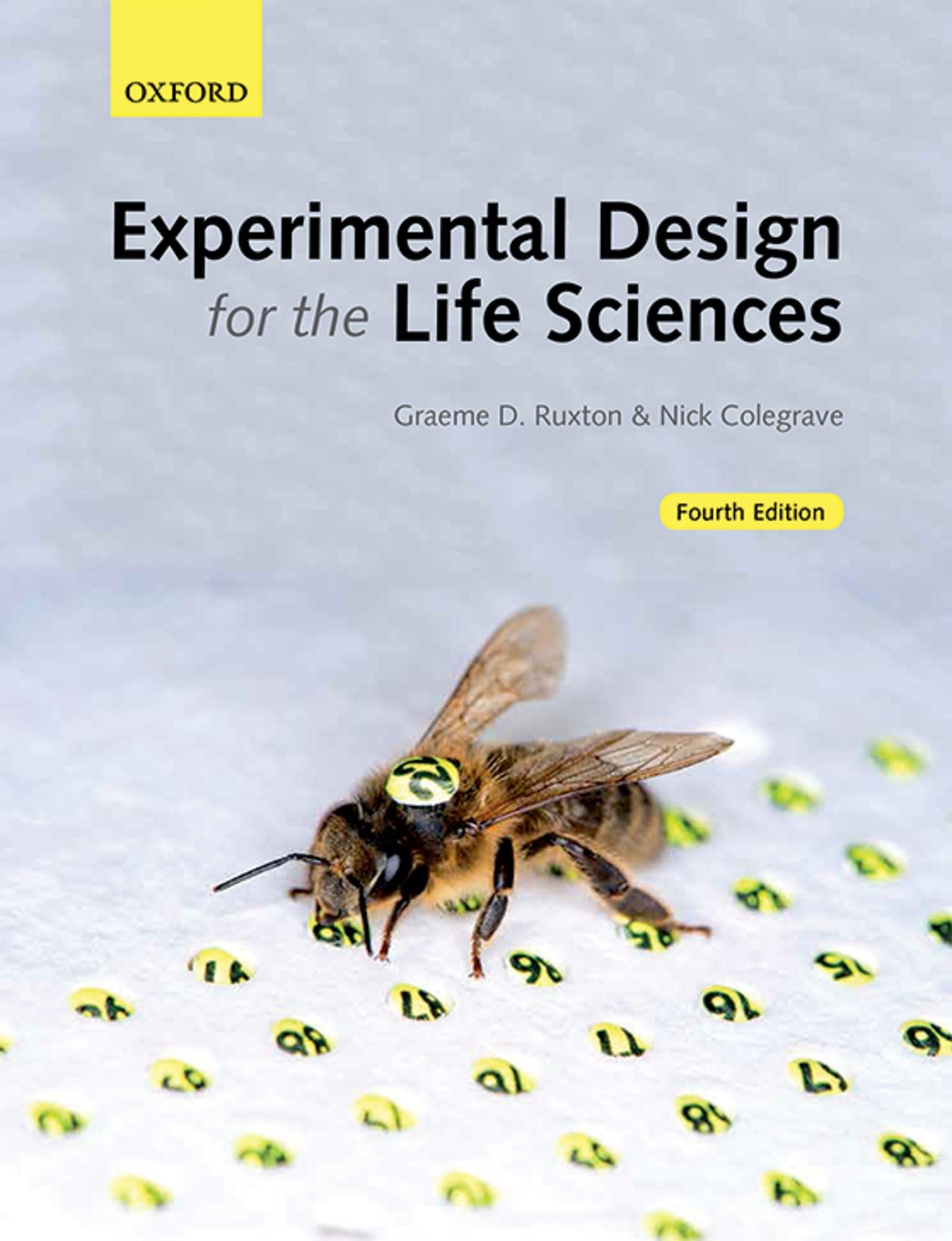
Title
Experimental Design For The Life Sciences,Used
Sold by Ergodebooks, an authorized reseller.
Returns accepted within 30 days | support@ergodebooks.com
Shipping Information
- Free Standard Shipping — United States only
- Processing Time: 3–5 business days
- Estimated Delivery: 6–10 business days after dispatch
- Double-boxed, fully insured & discreetly packaged
- Tracking number sent via email once dispatched
Returns & Refund
Returns accepted within 30 days of delivery.
Damaged or Defective Item
Free return shipping + replacement or full refund
Wrong Item Received
Free return shipping + replacement or full refund
Change of Mind
Return shipping at customer's expense · 25% restocking fee applies
Payment Option

The Careful Design Of Experiments Lies At The Core Of Good Research. Experimental Design For The Life Sciences Equips You With The Skills You Need To Effectively Design Experiments, Making This Essential Aspect Of The Research Process Readily Understandable. It Demonstrates How Good Experimental Design Relies On Clear Thinking And Biological Understanding, Not Mathematical Or Statistical Complexity.With A Refreshingly Approachable And Articulate Style, The Book Walks You Through The Considerations That Go Into Designing An Experiment In Clear, Practical Terms. Using Examples Drawn From Across The Life Sciences From Ecology, Biochemistry, Molecular Biology, Genetics, And Health Sciences The Authors Illustrate How These Concepts Are Applied Within The Broad Context Of Real Biological Research.Online Resource Centrethe Online Resource Centre To Accompany Experimental Design For The Life Sciences Features:For Students:Dt Selftest Questions And Answersdt Additional Examplesdt Supplementary Sections Discuss Complex Concepts And Statistical Issues In More Depthdt Links To Useful Websites And Free Softwarefor Lecturers:Dt Suggested Course Structures, Complete With Practical Exercisesdt Figures From The Book, Available To Download
⚠️ WARNING (California Proposition 65):
This product may contain chemicals known to the State of California to cause cancer, birth defects, or other reproductive harm.
For more information, please visit www.P65Warnings.ca.gov.
- Q: How many pages does the book have? A: This book has two hundred twenty-two pages. It provides a thorough exploration of experimental design principles in the life sciences.
- Q: What are the dimensions of the book? A: The book measures zero point five one inches in thickness, seven point four inches in width, and nine point six one inches in height. These dimensions make it easy to handle and store.
- Q: What type of binding does this book have? A: This book is available in paperback binding. This makes it lightweight and portable for students and researchers alike.
- Q: Who is the author of this book? A: The author of this book is Graeme D. Ruxton. He brings expertise in biology and experimental design to the content.
- Q: What is the main focus of this book? A: The main focus of the book is on experimental design in the life sciences. It emphasizes practical applications and clear explanations.
- Q: Is this book suitable for beginners? A: Yes, this book is suitable for beginners. It breaks down complex concepts into understandable terms, making it accessible for newcomers.
- Q: Can I find exercises in this book? A: Yes, the book includes practical exercises. These exercises help reinforce the concepts discussed throughout the text.
- Q: Does this book provide online resources? A: Yes, it comes with an Online Resource Centre. This includes self-test questions and additional examples for students.
- Q: Is this book applicable to various fields in biology? A: Yes, the book covers examples from ecology, biochemistry, molecular biology, genetics, and health sciences. It shows the versatility of experimental design.
- Q: How should I store this book? A: Store this book in a cool, dry place. Avoid exposure to direct sunlight to preserve the quality of the pages and binding.
- Q: What if the book arrives damaged? A: If the book arrives damaged, you can usually return it for a replacement or refund. Check the seller's return policy for specific instructions.
- Q: Are there any special features for lecturers? A: Yes, the book includes suggested course structures for lecturers. It also provides downloadable figures for teaching purposes.
- Q: How can I improve my understanding of experimental design? A: Reading this book and utilizing the Online Resource Centre can significantly improve your understanding. The self-test questions and additional examples are particularly helpful.
- Q: Is there a glossary of terms in this book? A: Yes, the book includes a glossary of key terms. This helps readers familiarize themselves with the vocabulary used in experimental design.
- Q: What complexity level does this book address? A: The book addresses a range of complexity levels, making it suitable for both novice and advanced readers. It balances depth with accessibility.
- Q: Can I use this book for self-study? A: Yes, this book is ideal for self-study. It provides comprehensive explanations and resources that support independent learning.