
Title
Experimental Duopoly Markets With Demand Inertia: Gameplaying Experiments And The Strategy Method (Lecture Notes In Economics A,Used
Sold by Ergodebooks, an authorized reseller.
Returns accepted within 30 days | support@ergodebooks.com
Shipping Information
- Free Standard Shipping — United States only
- Processing Time: 3–5 business days
- Estimated Delivery: 6–10 business days after dispatch
- Double-boxed, fully insured & discreetly packaged
- Tracking number sent via email once dispatched
Returns & Refund
Returns accepted within 30 days of delivery.
Damaged or Defective Item
Free return shipping + replacement or full refund
Wrong Item Received
Free return shipping + replacement or full refund
Change of Mind
Return shipping at customer's expense · 25% restocking fee applies
Payment Option

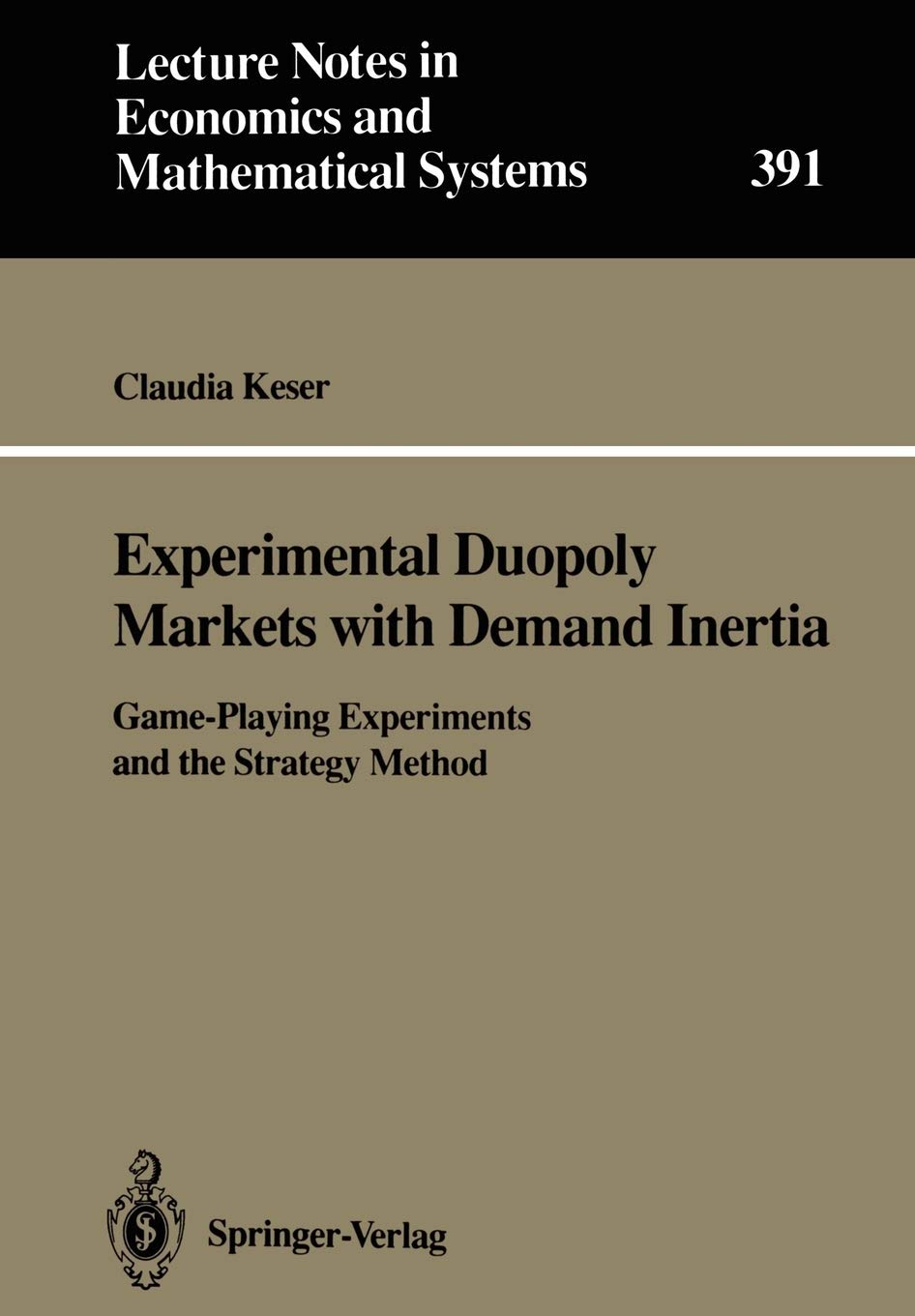
This report portrays the results of experimental research on dynamic duopoly markets with demand inertia. Two methods of experimentation are studied: gameplaying experiments where subjects interact spontaneously via computer terminals, and computer tournaments between strategies designed by subjects. The principal aim of this study is the understanding of boundedly rational decision making in the dynamic duopoly situation. 1. 1 Motivation The experiments examine a multistage duopoly game where prices in each period are the only decision variables. Sales depend on current prices and also on past sales (demand inertia). Applying the gametheoretic concept of subgame perfect equilibrium, the game is solved by backward induction. The result is a uniquely determined system of decision rules. However, we can hardly expect that human beings behave according to the equilibrium strategy of this game. It is unlikely that subjects are able to compute the equilibrium. And even if a subject is able to compute it, he might not make use of this knowledge. Only if he expects the others to behave according to the equilibrium, it is optimal for him to play the equilibrium strategy. We have evidence from several earlier experimental studies on oligopoly markets that, even in less complex oligopoly situations where the equilibrium solutions are very easy to compute, human behavior often is different from what is prescribed by normative theory. ! Normative theory is based on the concept of ideal rationality. However, human capabilities impose cognitive limits on rationality.
⚠️ WARNING (California Proposition 65):
This product may contain chemicals known to the State of California to cause cancer, birth defects, or other reproductive harm.
For more information, please visit www.P65Warnings.ca.gov.