
Title
Experimental Solid Mechanics,New
Sold by Ergodebooks, an authorized reseller.
Returns accepted within 30 days | support@ergodebooks.com
Shipping Information
- Free Standard Shipping — United States only
- Processing Time: 3–5 business days
- Estimated Delivery: 6–10 business days after dispatch
- Double-boxed, fully insured & discreetly packaged
- Tracking number sent via email once dispatched
Returns & Refund
Returns accepted within 30 days of delivery.
Damaged or Defective Item
Free return shipping + replacement or full refund
Wrong Item Received
Free return shipping + replacement or full refund
Change of Mind
Return shipping at customer's expense · 25% restocking fee applies
Payment Option

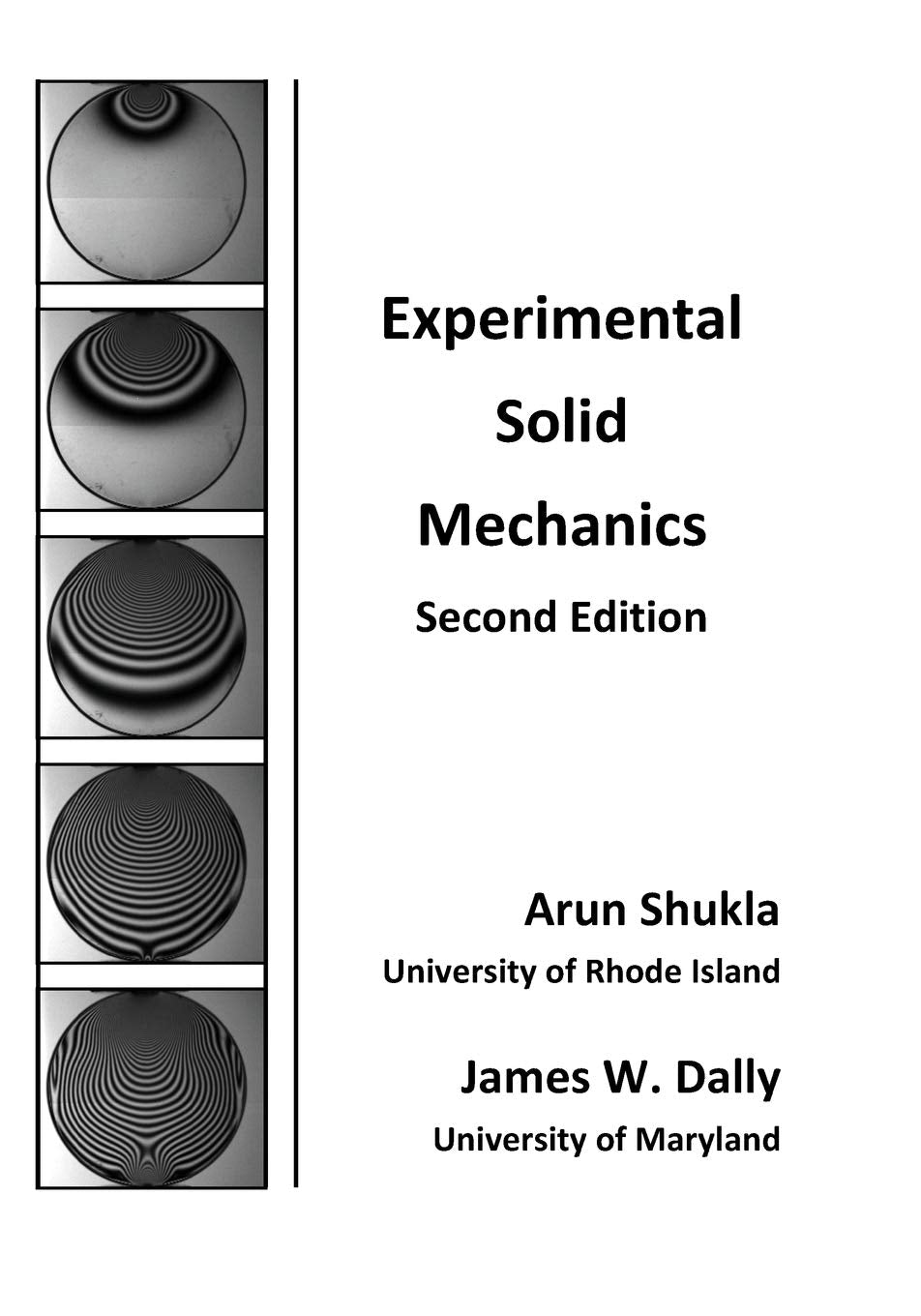
In this revised second edition of Experimental Solid Mechanics we have retained all the essential features of the first edition but have also modified and added several new sections to ensure coverage of the latest information. We have added information on elasticplastic fracture mechanics in Chapter 4. Chapters 10 and 11 have been condensed and some new sections have been added to emphasize salient aspects of photoelasticity. Chapter 15 has been completely rewritten to include the latest developments in the DIC technique. Chapter 17 now includes more discussion on split Hopkinson pressure bar techniques for soft materials. Chapter 18 has been considerably expanded to include new techniques for nanoscale measurements. The material in this book has evolved from the 4th edition of Experimental Stress Analysis. The title change reflects the fact that the field today is much broader than it was in 1965 when the first edition of Experimental Stress Analysis was published. Experimental Solid Mechanics describes methods used to measure forces, pressures, displacements, stresses, strains and fracture mechanics parameters. Measurements described include electrical and optical methods.
⚠️ WARNING (California Proposition 65):
This product may contain chemicals known to the State of California to cause cancer, birth defects, or other reproductive harm.
For more information, please visit www.P65Warnings.ca.gov.
- Q: What is the main focus of 'Experimental Solid Mechanics'? A: The book focuses on methods used to measure forces, pressures, displacements, stresses, strains, and fracture mechanics parameters. It covers both electrical and optical measurement techniques.
- Q: What are the key updates in the second edition of this book? A: The second edition includes new sections on elastic-plastic fracture mechanics, condensed chapters on photoelasticity, a complete rewrite of Chapter 15 covering the latest developments in the DIC technique, and expanded discussions on nanoscale measurements.
- Q: Is this book suitable for beginners in solid mechanics? A: While the book contains advanced topics suitable for professionals and students with some background in solid mechanics, it may require readers to have foundational knowledge to fully grasp the concepts presented.
- Q: What type of binding does 'Experimental Solid Mechanics' have? A: This book is bound with a hard cover, providing durability and longevity, contrary to some listings that may mistakenly indicate it is paperback.
- Q: Who is the author of 'Experimental Solid Mechanics'? A: The book is authored by Arun Shukla, a recognized expert in the field of solid mechanics.
- Q: How many pages does this book contain? A: The book consists of 690 pages, offering a comprehensive overview of experimental solid mechanics.
- Q: When was this book published? A: The second edition of 'Experimental Solid Mechanics' was published on February 13, 2017.
- Q: Does this book include information on photoelasticity? A: Yes, the book includes new sections that emphasize important aspects of photoelasticity, particularly in Chapters 10 and 11.
- Q: What materials are discussed in relation to soft materials? A: Chapter 17 of the book discusses techniques related to split Hopkinson pressure bar methods specifically for soft materials.
- Q: Is there information on nanoscale measurement techniques in the book? A: Yes, Chapter 18 has been expanded to include new techniques for nanoscale measurements, reflecting advancements in the field.