If you have any questions, you are always welcome to contact us. We'll get back to you as soon as possible, withing 24 hours on weekdays.
Customer service
All questions about your order, return and delivery must be sent to our customer service team by e-mail at yourstore@yourdomain.com
Sale & Press
If you are interested in selling our products, need more information about our brand or wish to make a collaboration, please contact us at press@yourdomain.com
Help
If you have any questions, you are always welcome to contact us. We'll get back to you as soon as possible, withing 24 hours on weekdays.
Customer service
All questions about your order, return and delivery must be sent to our customer service team by e-mail at yourstore@yourdomain.com
Sale & Press
If you are interested in selling our products, need more information about our brand or wish to make a collaboration, please contact us at press@yourdomain.com
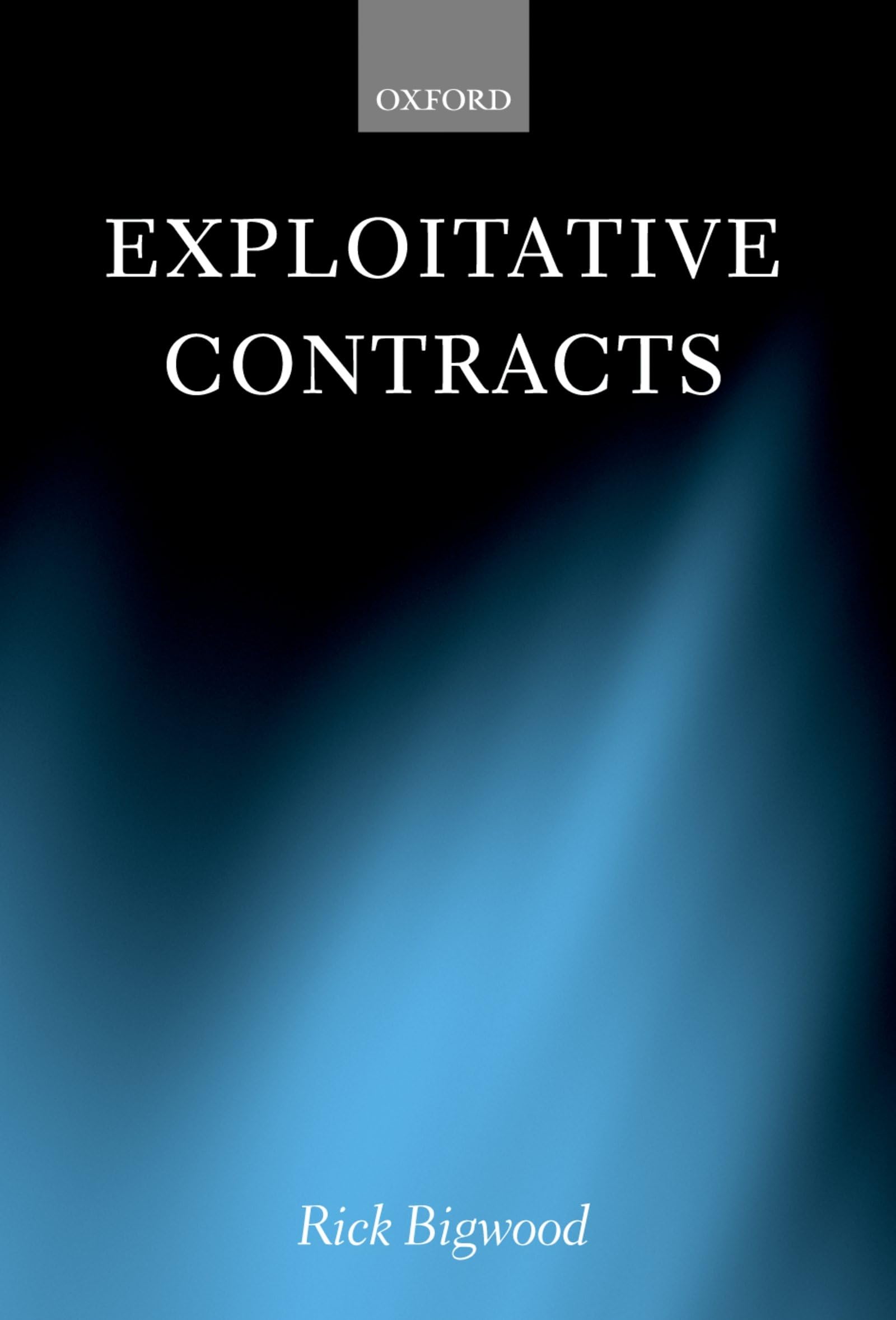
Judges and scholars routinely use concepts such as 'exploitation' in a justificatory way. In the field of contract law, a finding of exploitation may excuse a party from the normal consequences of his or her manifested contractual assent. However, the meaning of exploitation is usually assumed for this purpose, rather than elaborated. In fact, exploitation is a highly contested concept.Exploitative Contracts examines the 'essentially contestable' criteria of interpersonal exploitation claims. It puts forward a conception of exploitation: 'legal contractual exploitation', a form of wrongdoing that arises in connection with the formation of contracts. This notion is shown to underpin traditional heads of relief in contract law, including unconscionable dealing, undue influence, unilateral mistake in equity, and 'lawful act' duress.Importantly, this notion of legal contractual exploitation conforms to the intellectual and institutional forms of order presupposed by the classic liberal conception of the contract. The wrongfulness of an act of exploitation must reside in some characteristic of the processes of contract formation rather than in some quality of the impugned contract itself.The doctrines of unconscionable dealing, duress, and undue influence are examined in detail in the light of what they each reveal about the 'process' conception of legal contractual exploitation. In turn, the volume explains how an understanding of these contract law doctrines can be enhanced by a proper conception of exploitation.
⚠️ WARNING (California Proposition 65):
This product may contain chemicals known to the State of California to cause cancer,
birth defects, or other reproductive harm.
For MAP (Minimum Advertised Price) violations and Intellectual Property (IP) or Trademark concerns, please contact:
support@ergodebooks.com
⚠️ California Proposition 65 Warning: Some products sold on this website may expose you to chemicals known to the State of California to cause cancer, birth defects, or other reproductive harm. For more information, visit www.P65Warnings.ca.gov.