
Title
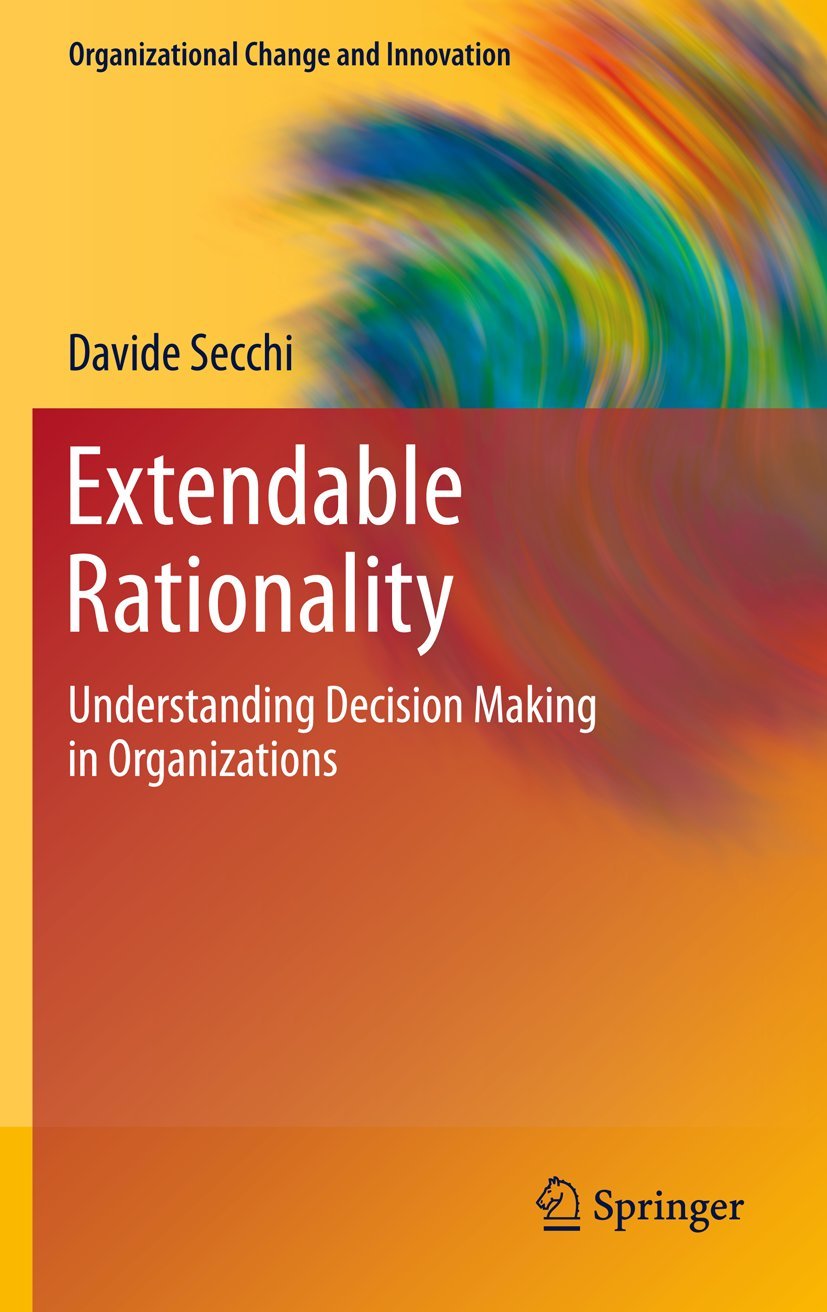
Extendable Rationality: Understanding Decision Making in Organizations (Organizational Change and Innovation, 1),Used
Sold by Ergodebooks, an authorized reseller.
Returns accepted within 30 days | support@ergodebooks.com
Shipping Information
- Free Standard Shipping — United States only
- Processing Time: 3–5 business days
- Estimated Delivery: 6–10 business days after dispatch
- Double-boxed, fully insured & discreetly packaged
- Tracking number sent via email once dispatched
Returns & Refund
Returns accepted within 30 days of delivery.
Damaged or Defective Item
Free return shipping + replacement or full refund
Wrong Item Received
Free return shipping + replacement or full refund
Change of Mind
Return shipping at customer's expense · 25% restocking fee applies
Payment Option

How do people make decisions in organizations? is the question at the core of this book. Do people act rationally? Under what conditions can information and knowledge be shared to improve decision making? Davide Secchi applies concepts and theories from cognitive science, organizational behavior, and social psychology to explore the dynamics of decision making. In particular, he integrates bounded rationality (people are only partly rational; they have (a) limited computational capabilities and (b) limited access to information) and distributed cognition (knowledge is not confined to an individual, but is distributed across the members of a group) to build upon the pioneering work of Herbert Simon (19162001) on rational decision making and contribute fresh insights. This book is divided into two parts. The first part (Chapters 2 to 5) explores how recent studies on biases, prospect theory, heuristics, and emotions provide the socalled map of bounded rationality. The second part (Chapter 6 to 8) presents the idea of extendable rationality. In this section, Secchi identifies the limitations of bounded rationality and focuses more heavily on sociallybased decision processes and the role of docility in teaching, managing, and executing decisions in organizations. The practical implications extend broadly to issues relating to change and innovation, as organizations adapt to evolving market conditions, implementing new systems, and effectively managing limited resources. The final chapter outlines an agenda for future research to help understand the decision making characteristics and capabilities of an organization.
⚠️ WARNING (California Proposition 65):
This product may contain chemicals known to the State of California to cause cancer, birth defects, or other reproductive harm.
For more information, please visit www.P65Warnings.ca.gov.