
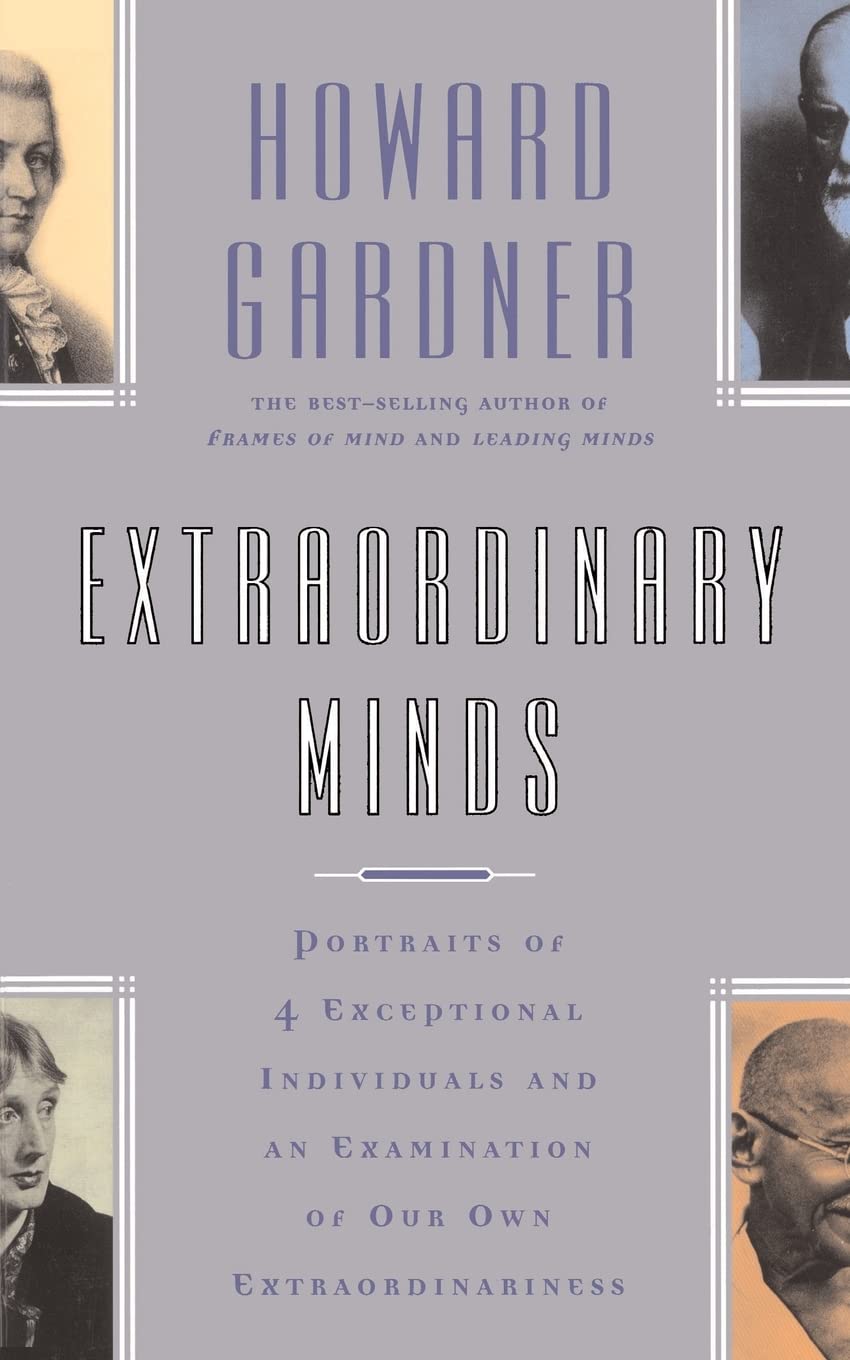
Title
Extraordinary Minds: Portraits Of 4 Exceptional Individuals And An Examination Of Our Own Extraordinariness (Masterminds (Paperb
Sold by Ergodebooks, an authorized reseller.
Returns accepted within 30 days | support@ergodebooks.com
Shipping Information
- Free Standard Shipping — United States only
- Processing Time: 3–5 business days
- Estimated Delivery: 6–10 business days after dispatch
- Double-boxed, fully insured & discreetly packaged
- Tracking number sent via email once dispatched
Returns & Refund
Returns accepted within 30 days of delivery.
Damaged or Defective Item
Free return shipping + replacement or full refund
Wrong Item Received
Free return shipping + replacement or full refund
Change of Mind
Return shipping at customer's expense · 25% restocking fee applies
Payment Option

Fifteen Years Ago, Psychologist And Educator Howard Gardner Introduced The Idea Of Multiple Intelligences, Challenging The Presumption That Intelligence Consists Of Verbal Or Analytic Abilities Only Those Intelligences That Schools Tend To Measure. He Argued For A Broader Understanding Of The Intelligent Mind, One That Embraces Creation In The Arts And Music, Spatial Reasoning, And The Ability To Understand Ourselves And Others. Today, Gardner'S Ideas Have Become Widely Accepted Indeed, They Have Changed How We Think About Intelligence, Genius, Creativity, And Even Leadership, And He Is Widely Regarded As One Of The Most Important Voices Writing On These Subjects. Now, In Extraordinary Minds , A Book As Riveting As It Is New, Gardner Poses An Important Question: Is There A Set Of Traits Shared By All Truly Great Achievers Those We Deem Extraordinary No Matter Their Field Or The Time Period Within Which They Did Their Important Work? In An Attempt To Answer This Question, Gardner First Examines How Most Of Us Mature Into More Or Less Competent Adults. He Then Examines Closely Four Persons Who Lived Unquestionably Extraordinary Lives Mozart, Freud, Woolf, And Gandhi Using Each As An Exemplar Of A Different Kind Of Extraordinariness: Mozart As The Master Of A Discipline, Freud As The Innovative Founder Of A New Discipline, Woolf As The Great Introspect Or, And Gandhi As The Influencer. What Can We Learn About Ourselves From The Experiences Of The Extraordinary? Interestingly, Gardner Finds That An Excess Of Raw Power Is Not The Most Impressive Characteristic Shared By Superachievers; Rather, These Extraordinary Individuals All Have Had A Special Talent For Identifying Their Own Strengths And Weaknesses, For Accurately Analyzing The Events Of Their Own Lives, And For Converting Into Future Successes Those Inevitable Setbacks That Mark Every Life. Gardner Provides Answers To A Number Of Provocative Questions, Among Them: How Do We Explain Extraordinary Times Athens In The Fifth Century B.C., The T'Ang Dynasty In The Eighth Century, Islamic Society In The Late Middle Ages, And New York At The Middle Of The Century? What Is The Relation Among Genius, Creativity, Fame, Success, And Moral Extraordinariness? Does Extraordinariness Make For A Happier, More Fulfilling Life, Or Does It Simply Create A Special Onus?
⚠️ WARNING (California Proposition 65):
This product may contain chemicals known to the State of California to cause cancer, birth defects, or other reproductive harm.
For more information, please visit www.P65Warnings.ca.gov.
- Q: How many pages does this book have? A: This book has one hundred ninety-two pages. It provides a deep exploration of the lives of exceptional individuals.
- Q: What is the binding type of this book? A: The binding type is paperback. This allows for flexibility and ease of handling while reading.
- Q: What are the dimensions of this book? A: The dimensions are five inches in length, eight inches in height, and zero point four four inches in width. These measurements make it portable and easy to fit in a bag.
- Q: Who is the author of this book? A: The author is Howard Gardner. He is a renowned psychologist and educator known for his work on multiple intelligences.
- Q: What genre does this book belong to? A: This book falls under the Psychology & Counseling genre. It delves into the nature of extraordinary achievement and intelligence.
- Q: What is the main theme of this book? A: The main theme explores the traits shared by extraordinary achievers across different fields. It examines how these traits contribute to their success.
- Q: Is this book suitable for all ages? A: Yes, this book is suitable for various age groups, particularly those interested in psychology and personal development.
- Q: Can this book be used as a textbook? A: Yes, it can serve as a textbook for courses in psychology or education. Its insights into intelligence and achievement are valuable for academic study.
- Q: How do I approach reading this book? A: You can approach this book by reflecting on the examples provided. Consider how the traits of extraordinary individuals relate to your own life.
- Q: What is the best way to care for this book? A: To care for this book, keep it in a dry place and avoid exposing it to direct sunlight. This will help maintain its condition.
- Q: Can this book be gifted? A: Yes, this book makes an excellent gift for anyone interested in psychology or personal growth. Its inspiring content appeals to a wide audience.
- Q: What if my book arrives damaged? A: If your book arrives damaged, contact the seller for a replacement or refund. Ensure to provide details about the damage for efficient processing.
- Q: Is there a money-back guarantee for this book? A: Yes, many sellers offer a money-back guarantee if you are not satisfied with the book. Check the seller's return policy for specifics.
- Q: What if I have questions about the content? A: If you have questions about the content, consider discussing it in a book club or seeking online forums. Engaging with others can enhance understanding.
- Q: What makes this book different from others in psychology? A: This book is unique as it combines the exploration of individual lives with broader insights into intelligence, making it both personal and theoretical.