
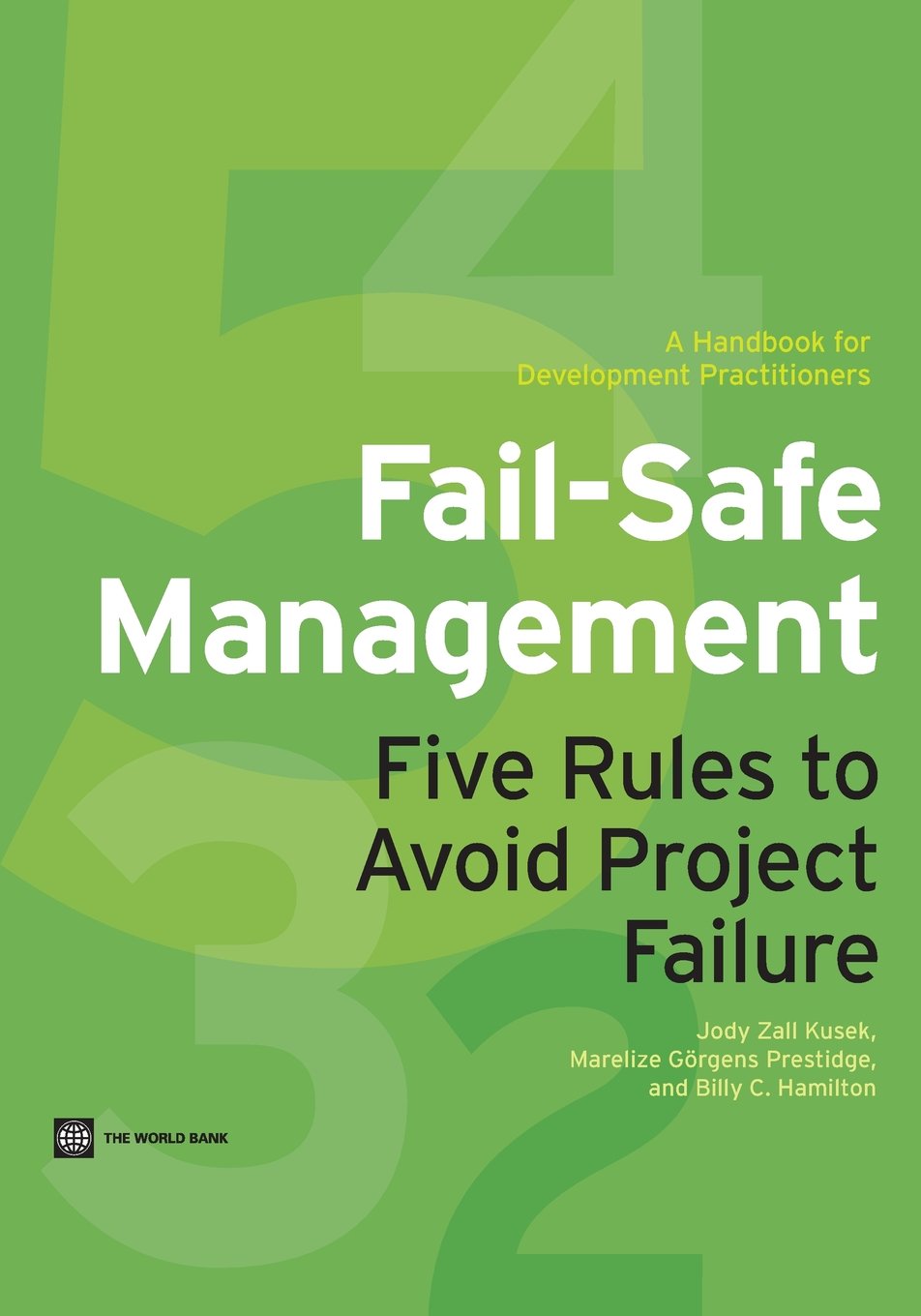
Title


FailSafe Management: Five Rules to Avoid Project Failure,Used
Sold by Ergodebooks, an authorized reseller.
Returns accepted within 30 days | support@ergodebooks.com
Shipping Information
- Free Standard Shipping — United States only
- Processing Time: 3–5 business days
- Estimated Delivery: 6–10 business days after dispatch
- Double-boxed, fully insured & discreetly packaged
- Tracking number sent via email once dispatched
Returns & Refund
Returns accepted within 30 days of delivery.
Damaged or Defective Item
Free return shipping + replacement or full refund
Wrong Item Received
Free return shipping + replacement or full refund
Change of Mind
Return shipping at customer's expense · 25% restocking fee applies
Payment Option

The decision to look at failures for answers is a bold one. Policy makers, planners and implementers have a tendency to look through prisms of success in framing working policies, programs and results when justifying them. Despite this, we still tend to address failures indirectly by looking at risk, critical success factors, unintended outcomes or consequences, and negative impacts to name a few. As the authors say, 'while success is desirable and we plan for it, failures are inevitable and we seldom plan to mitigate them.' The authors have clearly emphasized the need to look at failures in an integrated manner by building them into the planning and budget process while at the same time identifying monitoring points for early detection that will provide critical information for timely intervention. Failures are real, and we must plan to face them when they emerge. This book will offer the necessary insight to managers. Koshy Thomas, Head of the Outcomebased Budgeting Project Team, Ministry of Finance, Malaysia This book provides invaluable guidance on how to avoid the failure of interventions, whether for projects, programs, or policies. The authors note that although good design is essential, 'paying attention to details that only happen during implementation is essential in avoiding failure'. The five steps outlined are salutary, and point to the craft needed for good implementationthe range of issues which have continuously to be managed, the environment, stakeholders, resources, systems, and so on. As the authors point out, some elements are beyond the control of a project manager, but all too often it is the things that are controllable that are ignored at our peril. Good management is not sexy, but it usually makes the difference between failure and success. This book deserves careful study by public and private sector managers and implementers. Dr. Ian Goldman, Head of Evaluation and Research, Department of Performance Monitoring and Evaluation, The Presidency, South Africa FailSafe Management provides much needed guidance aimed at preventing failure in program implementation. Considerable resources and effort are traditionally invested in the development and scientific evaluation of program interventions. Despite the availability of efficacious interventions, populationlevel programmatic impact is difficult to achieve. The gap between the availability of scientifically developed efficacious interventions and the scarcity of populationlevel programmatic impact is often attributable to inadequate strategic planning and implementation failures. This book promises to be of great help to program managers in avoiding the latter. Dr Sevgi Aral, Associate Director for Science, Division of STD Prevention, U.S. Centers for Disease Control and Prevention (CDC) During the discussions on the Lagos Plan of Action, the late President of The United Republic of Tanzania, Mwalimu Julius Nyerere asked, 'why projects in Africa failed and what can be done to rescue the situation'. The answer was that projects failed because of corruption and greed, and the solution suggested was to set up anticorruption commissions to root out corrupt practices. Decades later the problem remains. What then is the problem? This book sheds light on why projects fail and provides a critical path on 'how to avoid failure' while addressing inevitable development problems. It outlines five simple stepsthat are not rocket sciencefor development practitioners to understand and apply. Perhaps this book should have written at the time of Mwalimu Julius Nyerere and the Lagos Plan of Action. He would have found the right answers in it. Dr. Simon Muchiru, Director, Oakwood and Associates Consultants, Gaborone, Botswana
⚠️ WARNING (California Proposition 65):
This product may contain chemicals known to the State of California to cause cancer, birth defects, or other reproductive harm.
For more information, please visit www.P65Warnings.ca.gov.