
Title

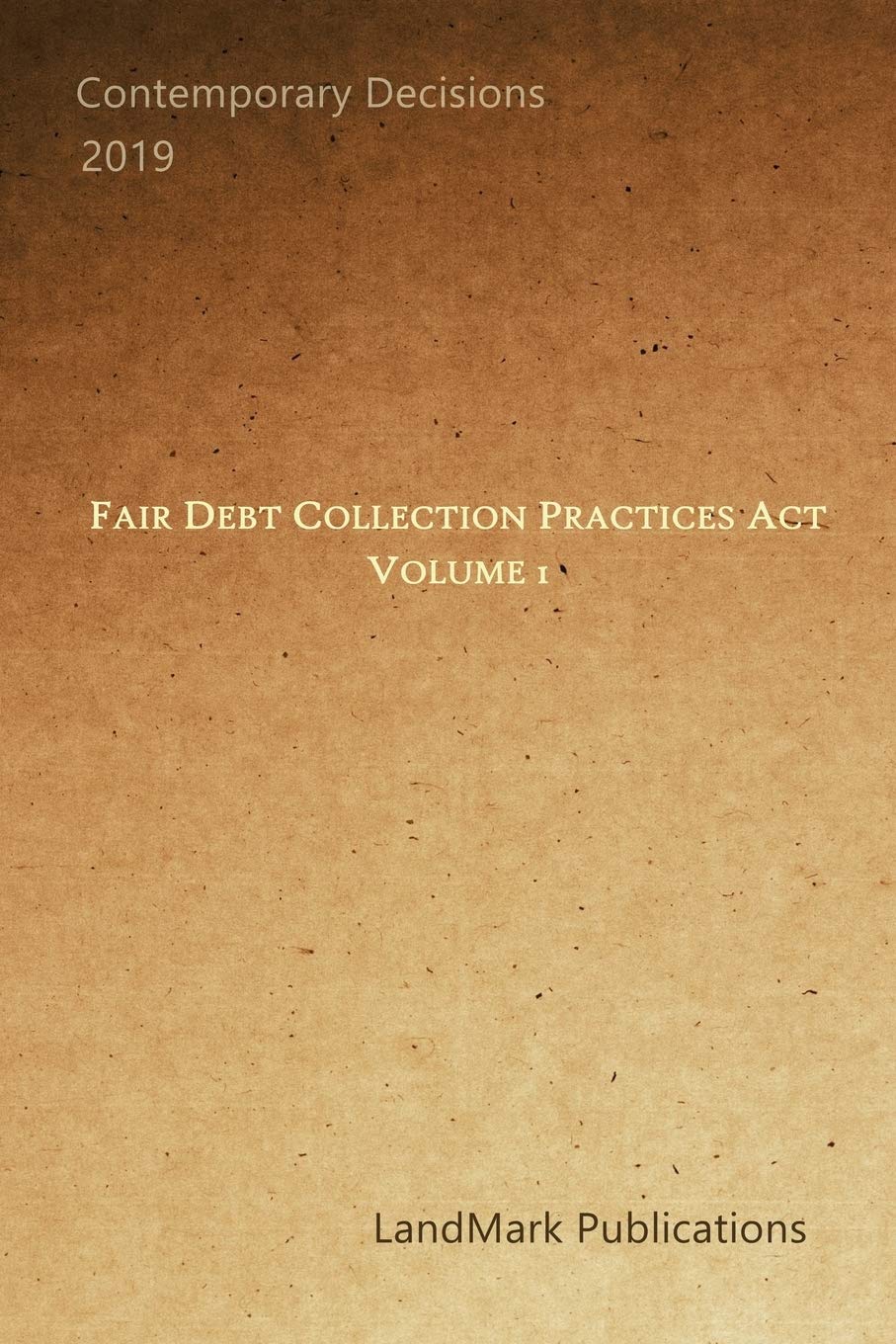
Fair Debt Collection Practices Act: Volume 1,Used
Sold by Ergodebooks, an authorized reseller.
Returns accepted within 30 days | support@ergodebooks.com
Shipping Information
- Free Standard Shipping — United States only
- Processing Time: 3–5 business days
- Estimated Delivery: 6–10 business days after dispatch
- Double-boxed, fully insured & discreetly packaged
- Tracking number sent via email once dispatched
Returns & Refund
Returns accepted within 30 days of delivery.
Damaged or Defective Item
Free return shipping + replacement or full refund
Wrong Item Received
Free return shipping + replacement or full refund
Change of Mind
Return shipping at customer's expense · 25% restocking fee applies
Payment Option

THIS CASEBOOK contains a selection of U. S. Court of Appeals decisions that analyze, interpret and apply provisions of the Fair Debt Collection Practices Act. Volume 1 covers the District of Columbia Circuit and the First through the Fifth Circuit Court of Appeals. * * * Congress enacted the FDCPA in 1977 "to eliminate abusive debt collection practices by debt collectors" and "to insure that those debt collectors who refrain from using abusive debt collection practices are not competitively disadvantaged." 15 U.S.C. 1692(e). It provides a private right of action against debt collectors who violate its provisions. 15 U.S.C. 1692k; see also Brown v. Card Serv. Ctr., 464 F.3d 450, 453 (3d Cir. 2006). "As remedial legislation, the FDCPA must be broadly construed in order to give full effect to these purposes." Caprio v. Healthcare Revenue Recovery Grp., LLC, 709 F.3d 142, 148 (3d Cir. 2013)."To prevail on an FDCPA claim, a plaintiff must prove that (1) she is a consumer, (2) the defendant is a debt collector, (3) the defendant's challenged practice involves an attempt to collect a 'debt' as the [FDCPA] defines it, and (4) the defendant has violated a provision of the FDCPA in attempting to collect the debt." St. Pierre v. RetrievalMasters Creditors Bureau, Inc., 898 F.3d 351, 358 (3d Cir. 2018) (quoting Douglass v. Convergent Outsourcing, 765 F.3d 299, 303 (3d Cir. 2014)). [. . .][T]he statute defines "debt collector" as any person (1) "who uses any instrumentality of interstate commerce or the mails in any business the principal purpose of which is the collection of any debts" (the "principal purpose" definition), or (2) "who regularly collects or attempts to collect, directly or indirectly, debts owed or due or asserted to be owed or due another" (the "regularly collects" definition). 15 U.S.C. 1692a(6). The statute thus provides two separate paths to establishing an entity's status as a "debt collector." See Henson, 137 S.Ct. at 1721.Barbato v. Greystone Alliance, LLC, 916 F. 3d 260 (3rd Cir. 2019)
⚠️ WARNING (California Proposition 65):
This product may contain chemicals known to the State of California to cause cancer, birth defects, or other reproductive harm.
For more information, please visit www.P65Warnings.ca.gov.