
Title
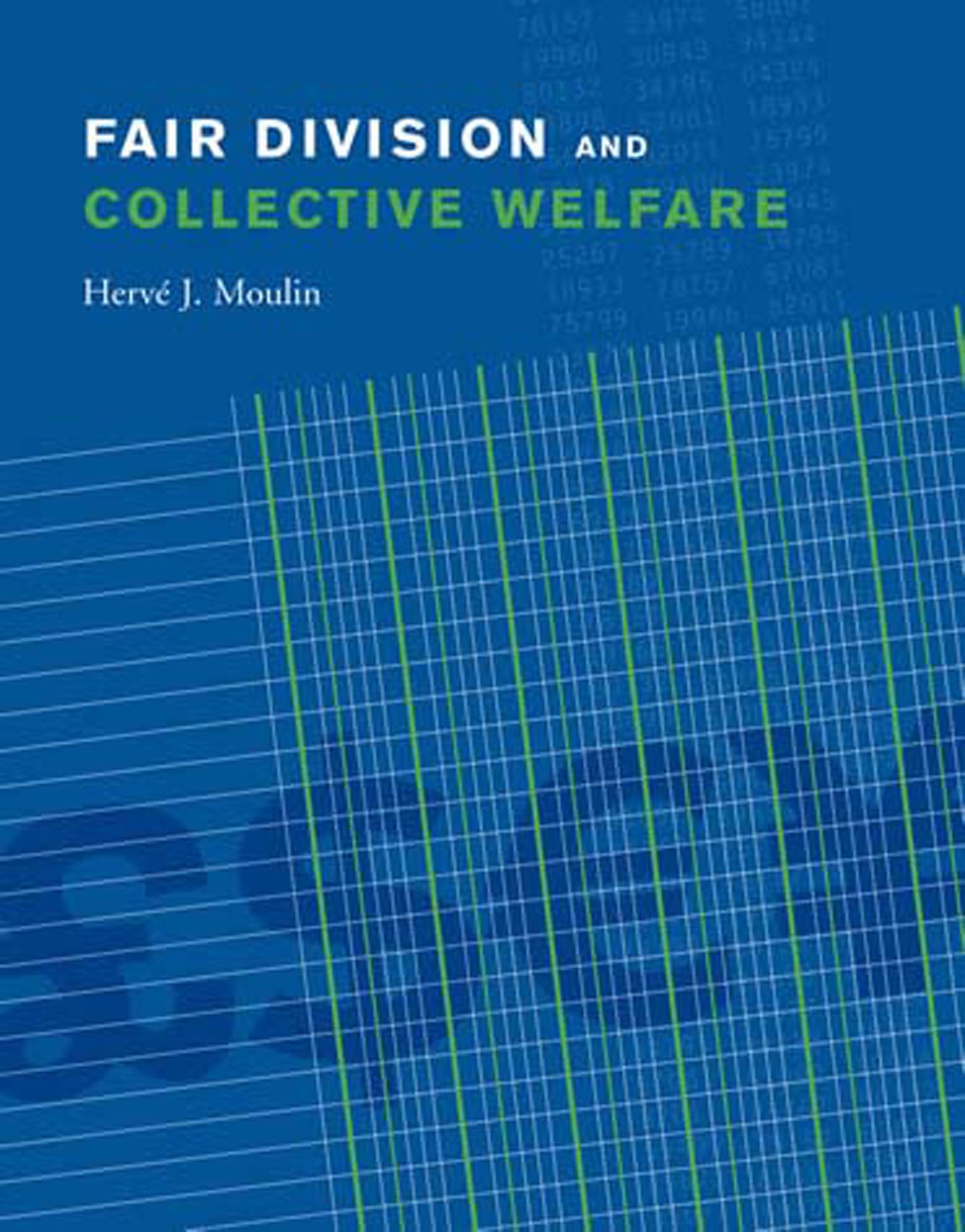
Fair Division and Collective Welfare,Used
Sold by Ergodebooks, an authorized reseller.
Returns accepted within 30 days | support@ergodebooks.com
Shipping Information
- Free Standard Shipping — United States only
- Processing Time: 3–5 business days
- Estimated Delivery: 6–10 business days after dispatch
- Double-boxed, fully insured & discreetly packaged
- Tracking number sent via email once dispatched
Returns & Refund
Returns accepted within 30 days of delivery.
Damaged or Defective Item
Free return shipping + replacement or full refund
Wrong Item Received
Free return shipping + replacement or full refund
Change of Mind
Return shipping at customer's expense · 25% restocking fee applies
Payment Option

The concept of fair division is as old as civil society itself. Aristotle's 'equal treatment of equals' was the first step toward a formal definition of distributive fairness. The concept of collective welfare, more than two centuries old, is a pillar of modern economic analysis. Reflecting fifty years of research, this book examines the contribution of modern microeconomic thinking to distributive justice. Taking the modern axiomatic approach, it compares normative arguments of distributive justice and their relation to efficiency and collective welfare.The book begins with the epistemological status of the axiomatic approach and the four classic principles of distributive justice: compensation, reward, exogenous rights, and fitness. It then presents the simple ideas of equal gains, equal losses, and proportional gains and losses. The book discusses three cardinal interpretations of collective welfare: Bentham's 'utilitarian' proposal to maximize the sum of individual utilities, the Nash product, and the egalitarian leximin ordering. It also discusses the two main ordinal definitions of collective welfare: the majority relation and the Borda scoring method.The Shapley value is the single most important contribution of game theory to distributive justice. A formula to divide jointly produced costs or benefits fairly, it is especially useful when the pattern of externalities renders useless the simple ideas of equality and proportionality. The book ends with two versatile methods for dividing commodities efficiently and fairly when only ordinal preferences matter: competitive equilibrium with equal incomes and egalitarian equivalence. The book contains a wealth of empirical examples and exercises.
⚠️ WARNING (California Proposition 65):
This product may contain chemicals known to the State of California to cause cancer, birth defects, or other reproductive harm.
For more information, please visit www.P65Warnings.ca.gov.
- Q: What is the main topic of 'Fair Division and Collective Welfare'? A: 'Fair Division and Collective Welfare' explores the concept of fair division and its relevance to distributive justice and collective welfare, drawing on modern microeconomic theories.
- Q: Who is the author of this book? A: The book is authored by Herve Moulin, a prominent figure in the field of microeconomics.
- Q: What are the key principles of distributive justice discussed in the book? A: The book discusses four classic principles of distributive justice: compensation, reward, exogenous rights, and fitness.
- Q: How does the book relate fairness to efficiency? A: It compares normative arguments of distributive justice with their implications for efficiency and collective welfare, illustrating how fairness can impact economic outcomes.
- Q: What is the Shapley value and its significance in the book? A: The Shapley value is highlighted as a crucial contribution of game theory to distributive justice, providing a fair method to allocate costs or benefits among participants.
- Q: What are some of the interpretations of collective welfare mentioned? A: The book discusses various interpretations of collective welfare, including Bentham's utilitarianism, the Nash product, and egalitarian leximin ordering.
- Q: Is this book suitable for beginners in economics? A: While the book provides a comprehensive overview, it may be more suitable for readers with some background in economics due to its analytical and theoretical depth.
- Q: How many pages does the book contain? A: The book contains a total of 296 pages, making it a relatively thorough exploration of its topics.
- Q: What type of binding does this book have? A: This book is available in paperback binding.
- Q: When was 'Fair Division and Collective Welfare' published? A: 'Fair Division and Collective Welfare' was published on August 20, 2004.