
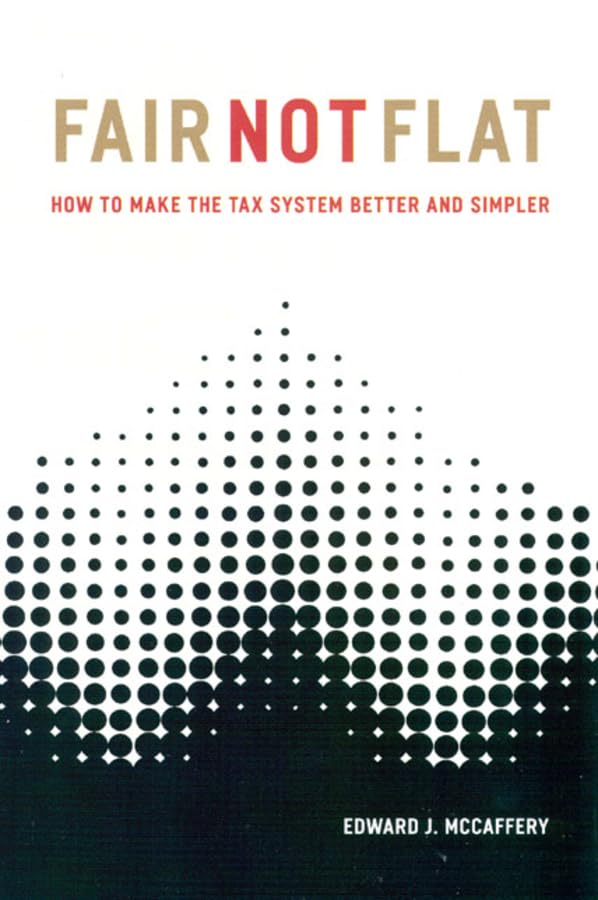
Title
Fair Not Flat: How to Make the Tax System Better and Simpler,New
Sold by Ergodebooks, an authorized reseller.
Returns accepted within 30 days | support@ergodebooks.com
Shipping Information
- Free Standard Shipping — United States only
- Processing Time: 3–5 business days
- Estimated Delivery: 6–10 business days after dispatch
- Double-boxed, fully insured & discreetly packaged
- Tracking number sent via email once dispatched
Returns & Refund
Returns accepted within 30 days of delivery.
Damaged or Defective Item
Free return shipping + replacement or full refund
Wrong Item Received
Free return shipping + replacement or full refund
Change of Mind
Return shipping at customer's expense · 25% restocking fee applies
Payment Option

Everyone knows that the current tax system is unfair. Some of the richest people in America pay no tax, while a huge share of the tax burden falls on the rest of us. A mere glance at the tax code confirms that it is far too complex, with volumes of rules that no ordinary person could possibly comprehend. What is to be done? Some conservatives have called for a socalled flat tax. But a flat tax is not necessarily a simple tax, and 'flat' means 'more' for most taxpayers: a rise in middleclass taxes to finance tax cuts for the rich. Is there another choice?In clear, easytounderstand language, Edward J. McCaffery proposes a straightforward and fair alternative. A 'fair not flat' tax that is consistent and progressive would tax spending, not income and savings. And if it were collected at its lower levels through a national sales tax, most people would not have to file a return. A supplemental tax on spending for the wealthiest individuals would make the national sales tax progressive. Under McCaffery's system, a family of four would pay no tax on their first $20,000 in spending, and 15 percent on the next $60,000. Only the few families who spend more than $80,000 a year would be subject to the supplemental tax. Necessities would be taxed less than ordinary and luxury items. No one would be taxed directly on savings. The estate and gift or socalled death tax would be abolished, for the simple reason that dead people don't spend. The 'fair not flat' tax would fall on heirs when and as they spend their good fortune. Perhaps best of all, most Americans would not have to fill out tax returns.Simpler, more efficient, fairer, and more reflective of America's current social values, McCaffery's 'fair not flat' tax could help get us out of the tax mess that politicians and special interests have gotten us into, improving the whole country in the process. Read Fair Not Flat to find out how.In Fair Not Flat, Mr. McCaffery lays out the case for a consumption tax. He does so in a readerfriendly way, presenting his argument with very few footnotes, equations or technical terms. The consumption of the book, so to speak, is not at all taxing. And its argument is well worth pondering.Bruce Bartlett, Wall Street Journal
⚠️ WARNING (California Proposition 65):
This product may contain chemicals known to the State of California to cause cancer, birth defects, or other reproductive harm.
For more information, please visit www.P65Warnings.ca.gov.