
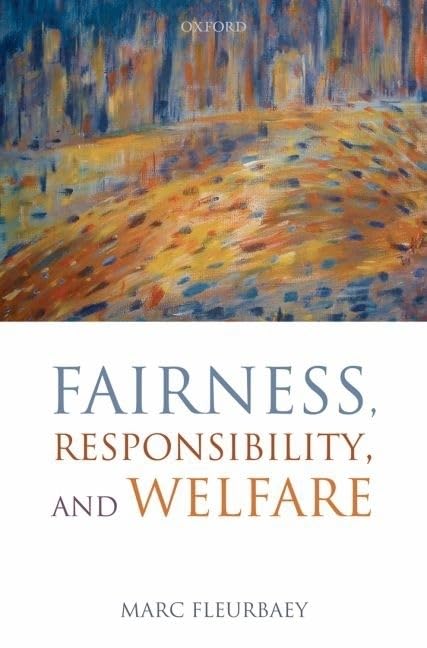
Title
Fairness, Responsibility, and Welfare,Used
Sold by Ergodebooks, an authorized reseller.
Returns accepted within 30 days | support@ergodebooks.com
Shipping Information
- Free Standard Shipping — United States only
- Processing Time: 3–5 business days
- Estimated Delivery: 6–10 business days after dispatch
- Double-boxed, fully insured & discreetly packaged
- Tracking number sent via email once dispatched
Returns & Refund
Returns accepted within 30 days of delivery.
Damaged or Defective Item
Free return shipping + replacement or full refund
Wrong Item Received
Free return shipping + replacement or full refund
Change of Mind
Return shipping at customer's expense · 25% restocking fee applies
Payment Option

What is a fair distribution of resources and other goods when individuals are partly responsible for their achievements? This book develops a theory of fairness incorporating a concern for personal responsibility, opportunities and freedom. With a critical perspective, it makes accessible the recent developments in economics and philosophy that define social justice in terms of equal opportunities. It also proposes new perspectives and original ideas. The book separates mathematical sections from the rest of the text, so that the main concepts and ideas are easily accessible to nontechnical readers.It is often thought that responsibility is a complex notion, but this monograph proposes a simple analytical framework that makes it possible to disentangle the different concepts of fairness that deal with neutralizing inequalities for which the individuals are not held responsible, rewarding their effort, respecting their choices, or staying neutral with respect to their responsibility sphere. It dwells on paradoxes and impossibilities only as a way to highlight important ethical options and always proposes solutions and reasonable compromises among the conflicting values surrounding equality and responsibility.The theory is able to incorporate disincentive problems and is illustrated in the examination of applied policy issues such as: income redistribution when individuals may be held responsible for their choices of labor supply or education; social and private insurance when individuals may be held responsible for their risky lifestyle; second chance policies; the measurement of inequality of opportunities and social mobility.
⚠️ WARNING (California Proposition 65):
This product may contain chemicals known to the State of California to cause cancer, birth defects, or other reproductive harm.
For more information, please visit www.P65Warnings.ca.gov.