
Title
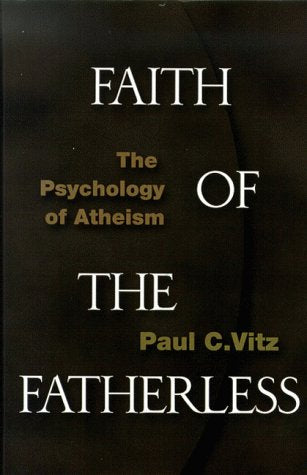
Faith of the Fatherless: The Psychology of Atheism,Used
Sold by Ergodebooks, an authorized reseller.
Returns accepted within 30 days | support@ergodebooks.com
Shipping Information
- Free Standard Shipping — United States only
- Processing Time: 3–5 business days
- Estimated Delivery: 6–10 business days after dispatch
- Double-boxed, fully insured & discreetly packaged
- Tracking number sent via email once dispatched
Returns & Refund
Returns accepted within 30 days of delivery.
Damaged or Defective Item
Free return shipping + replacement or full refund
Wrong Item Received
Free return shipping + replacement or full refund
Change of Mind
Return shipping at customer's expense · 25% restocking fee applies
Payment Option

Starting with Freud's "projection theory" of religionthat belief in God is merely a product of man's desire for securityProfessor Vitz argues that psychoanalysis actually provides a more satisfying explanation for atheism. Disappointment in one's earthly father, whether through death, absence, or mistreatment, frequently leads to a rejection of God. A biographical survey of influential atheists of the past four centuries shows that this "defective father hypothesis" provides a consistent explanation of the "intense atheism" of these thinkers. A survey of the leading intellectual defenders of Christianity over the same period confirms the hypothesis, finding few defective fathers. Professor Vitz concludes with an intriguing comparison of male and female atheists and a consideration of other psychological factors that can contribute to atheism.Professor Vitz does not argue that atheism is psychologically determined. Each man, whatever his experiences, ultimately chooses to accept God or reject him. Yet the cavalier attribution of religious faith to irrational, psychological needs is so prevalent that an exposition of the psychological factors predisposing one to atheism is necessary.
⚠️ WARNING (California Proposition 65):
This product may contain chemicals known to the State of California to cause cancer, birth defects, or other reproductive harm.
For more information, please visit www.P65Warnings.ca.gov.
- Q: How many pages does the book have? A: This book has two hundred pages. It provides an in-depth exploration of atheism and psychological factors influencing belief.
- Q: What is the book's binding type? A: The book is hardcover. This makes it durable and suitable for long-term use.
- Q: What are the dimensions of the book? A: The book measures five point five one inches in length, zero point seven five inches in width, and eight point five inches in height. These dimensions make it portable and easy to handle.
- Q: Who is the author of the book? A: The author of the book is Paul C. Vitz. He is a noted psychologist and scholar who explores the intersection of psychology and belief.
- Q: What is the book about? A: The book examines the psychology of atheism. It discusses how personal experiences, particularly with fathers, can influence one's belief in God.
- Q: Is this book suitable for all ages? A: The book is aimed at adults due to its complex themes. It addresses deep psychological and philosophical topics that may not be suitable for younger readers.
- Q: What should I do if I want to return the book? A: If you want to return the book, check the retailer's return policy. Most retailers allow returns within a certain period if the book is in good condition.
- Q: Can I read this book if I am new to psychology? A: Yes, you can read this book as a beginner. While it covers complex ideas, the author presents them in an accessible manner.
- Q: How should I store this book? A: Store the book upright on a shelf or in a bookcase. Keeping it in a dry place away from direct sunlight will help maintain its condition.
- Q: Does this book include any illustrations or photos? A: No, the book does not include illustrations or photos. It focuses on text and analysis of psychological theories.
- Q: What themes are explored in the book? A: The book explores themes of atheism, father figures, and psychological theories. It links personal experiences with broader philosophical questions.
- Q: Is the book available in other formats? A: Yes, the book may be available in digital formats. Check with specific retailers for eBook options.
- Q: What are the unique features of this book? A: The book is a used copy in good condition. It provides unique insights into the psychology behind atheism and influential thinkers.
- Q: How does the author support his claims? A: The author supports his claims through biographical surveys of influential atheists and comparisons with Christian thinkers. He uses psychological analysis to back his arguments.
- Q: What is the general reception of the book? A: The book has been well-received for its thought-provoking analysis. Readers appreciate its insights into the relationship between psychology and belief.