
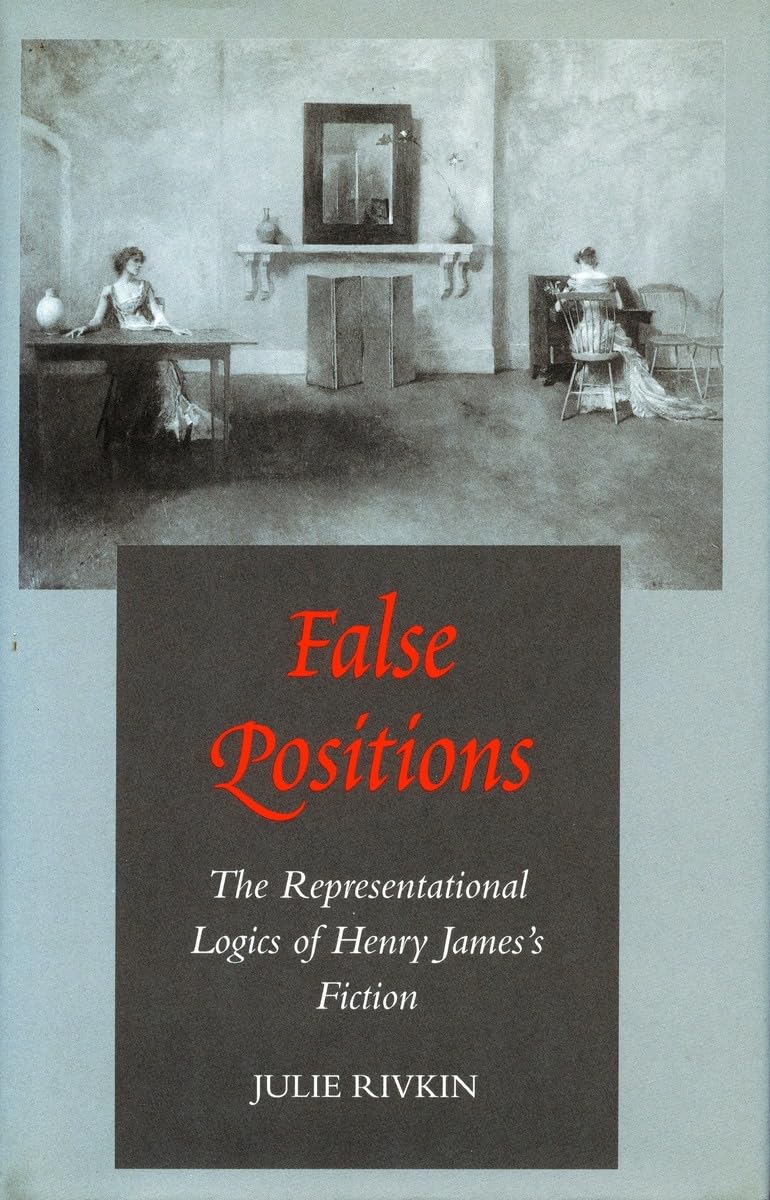
Title
False Positions: The Representational Logics Of Henry Jamess Fiction,Used
Sold by Ergodebooks, an authorized reseller.
Returns accepted within 30 days | support@ergodebooks.com
Shipping Information
- Free Standard Shipping — United States only
- Processing Time: 3–5 business days
- Estimated Delivery: 6–10 business days after dispatch
- Double-boxed, fully insured & discreetly packaged
- Tracking number sent via email once dispatched
Returns & Refund
Returns accepted within 30 days of delivery.
Damaged or Defective Item
Free return shipping + replacement or full refund
Wrong Item Received
Free return shipping + replacement or full refund
Change of Mind
Return shipping at customer's expense · 25% restocking fee applies
Payment Option

Product DescriptionRepresentation is the subject of this book, representation taken in a series of senses, from the formal and linguistic to the social and political. Representation poses a theoretical problem that can be located in the inconsistency between two vocabularies for compositional method: one positing a centre of consciousness (Jamess term), the other being a story of displaced agency and intermediaries, of deputies, delegates, and substitutes. What the center promisesthat consciousness can be fully incarnated in a given character who will then constitute a foundation for meaning and truth in the novelis exactly what the delegate acknowledges as an impossibility.Drawing largely on the theory of representation of Jacques Derrida, this book examines the interplay between the two contradictory positions in detailed readings of Jamess stories of writers and artists and his novels The Ambassadors, The Wings of the Dove, What Maisie Knew, and The Awkward Age. Throughout, the readings are organized by the supplementary logic of representationa logic that understands that a thing standing for another thing both completes it and suggests a lack or limitation in that which it completes, and hence ultimately in itself.ReviewThis exciting new book addresses the crucial topic of tragedys prominence in classical French literature. . . . Supporting the books central thesis are sensitive and compelling analyses of five plays by Corneille.Thomas Pavel, Princeton UniversityFrom the Inside FlapRepresentation is the subject of this book, representation taken in a series of senses, from the formal and linguistic to the social and political. Representation poses a theoretical problem that can be located in the inconsistency between two vocabularies for compositional method: one positing a centre of consciousness (Jamess term), the other being a story of displaced agency and intermediaries, of deputies, delegates, and substitutes. What the center promisesthat consciousness can be fully incarnated in a given character who will then constitute a foundation for meaning and truth in the novelis exactly what the delegate acknowledges as an impossibility.Drawing largely on the theory of representation of Jacques Derrida, this book examines the interplay between the two contradictory positions in detailed readings of Jamess stories of writers and artists and his novels The Ambassadors, The Wings of the Dove, What Maisie Knew, and The Awkward Age. Throughout, the readings are organized by the supplementary logic of representationa logic that understands that a thing standing for another thing both completes it and suggests a lack or limitation in that which it completes, and hence ultimately in itself.From the Back CoverThis exciting new book addresses the crucial topic of tragedys prominence in classical French literature. . . . Supporting the books central thesis are sensitive and compelling analyses of five plays by Corneille.Thomas Pavel, Princeton UniversityAbout the AuthorJulie Rivkin is Associate Professor of English at Connecticut College.
⚠️ WARNING (California Proposition 65):
This product may contain chemicals known to the State of California to cause cancer, birth defects, or other reproductive harm.
For more information, please visit www.P65Warnings.ca.gov.