
Title
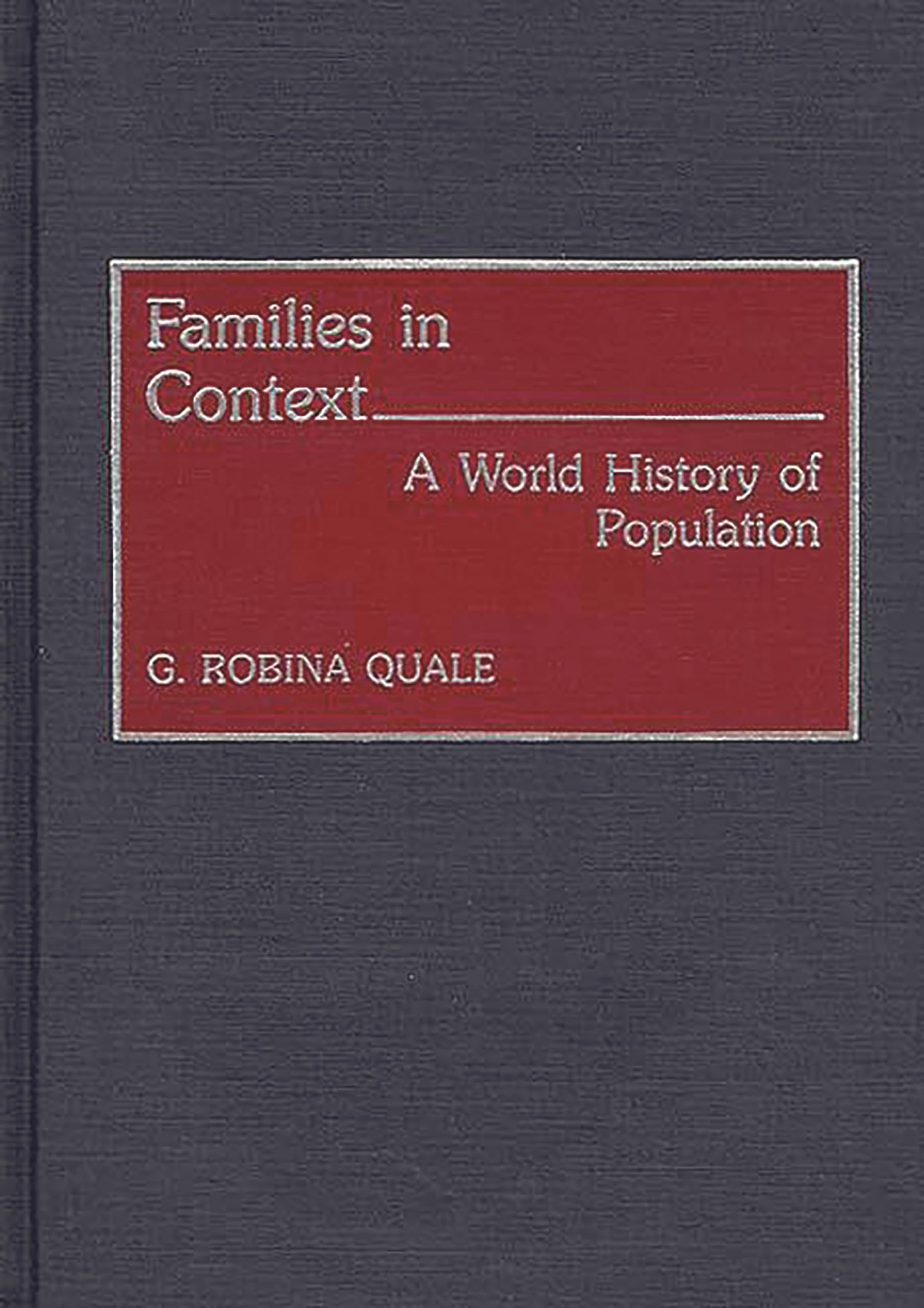
Families in Context: A World History of Population (Contributions to the Study of World History),Used
Sold by Ergodebooks, an authorized reseller.
Returns accepted within 30 days | support@ergodebooks.com
Shipping Information
- Free Standard Shipping — United States only
- Processing Time: 3–5 business days
- Estimated Delivery: 6–10 business days after dispatch
- Double-boxed, fully insured & discreetly packaged
- Tracking number sent via email once dispatched
Returns & Refund
Returns accepted within 30 days of delivery.
Damaged or Defective Item
Free return shipping + replacement or full refund
Wrong Item Received
Free return shipping + replacement or full refund
Change of Mind
Return shipping at customer's expense · 25% restocking fee applies
Payment Option

About the Author G. ROBINA QUALE is Professor of History at Albion College. She is the author of A History of Marriage Systems (Greenwood Press, 1988) and Eastern Civilizations (1966 d ed. 1975). Product Description Continuing a series of explorations of aspects of family life begun in A History of Marriage Systems (GP, 1988), G. Robina Quale provides a comprehensive overview of the basic forms of interaction between the family and the societal macrocosm, as both interact with disease, available resources, and current technologies. Since the beginning of human society, Quale says, forager bands and, later, family households have striven to meet the group's basic needs by maintaining a ratio of 3 active members to 2 members who need care because of immaturity, a handicap, or frailty. The book describes the way in which households have tried to reach the favorable 3:2 ratio in different areas and periods of history, factoring in the technological and environmental constraints and health hazards inherent in those areas and periods.The broad periods considered include forager and preurban agricultural life, the period of regional cities and peasantry from about 3500 B.C. to A.D. 1500, and, since 1500, the age of world cities, which grew out of the increasing commercialization and demographic expansion of regional cities. Quale describes how in recent times economic diversification, fertility reduction, education, social welfare services, and pension plans have joined bilaterality, equally divided inheritance, nuclear households, midtwenties marriage, and partner selfselection in modern life in Europe and its overseas offshoots. These patterns are being adapted by other societies as they also diversify economically. Yet economic diversification, with all its benefits, also presents problems such as the overuse of environmental resources and the incidence of pollutioncaused disease. This volume will be of interest to those concerned with family studies and family history, global environmental history, and the history of disease, as well as those concerned with demographic history.
⚠️ WARNING (California Proposition 65):
This product may contain chemicals known to the State of California to cause cancer, birth defects, or other reproductive harm.
For more information, please visit www.P65Warnings.ca.gov.