
Title
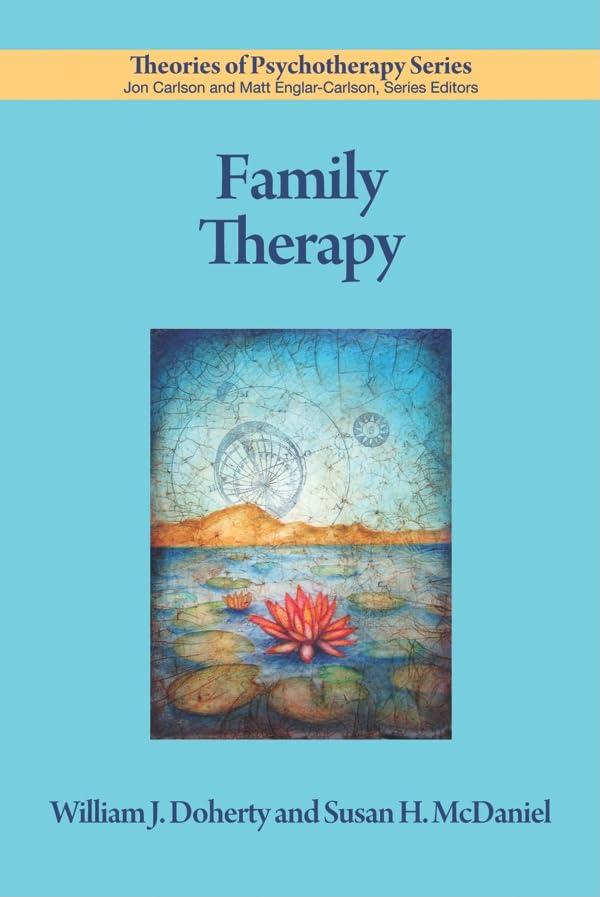
Family Therapy (Theories of Psychotherapy Series),Used
Sold by Ergodebooks, an authorized reseller.
Returns accepted within 30 days | support@ergodebooks.com
Shipping Information
- Free Standard Shipping — United States only
- Processing Time: 3–5 business days
- Estimated Delivery: 6–10 business days after dispatch
- Double-boxed, fully insured & discreetly packaged
- Tracking number sent via email once dispatched
Returns & Refund
Returns accepted within 30 days of delivery.
Damaged or Defective Item
Free return shipping + replacement or full refund
Wrong Item Received
Free return shipping + replacement or full refund
Change of Mind
Return shipping at customer's expense · 25% restocking fee applies
Payment Option

In Family Therapy, William J. Doherty and Susan H. McDaniel discuss the history, theory, and practice of this systemsoriented therapy.There are many different types of family therapy, but at the heart of each is systems theory, a model that arose from the fields of biology, physics, chemistry, and cybernetics. The main clinical precept of family systems theory is that individual problems must be understood within their larger family and environmental systems, which often provide the key to successful treatment. Family therapy provides a way of thinking in systemic, relational terms, and a set of strategies for intervening with individuals, couples, families, and other systems. Whether the client is a large family or a single person, family therapy focuses on changing relational interactions.In addition to this relationship focus, family therapy considers biological, environmental, and cultural influences on the client. Ultimately, this systemic way of thinkingessentially a model for understanding the complex relations that make up the worldcan help therapists of all orientations in their practice.In this book, Dr. Doherty and Dr. McDaniel present and explore this approach, its theory, history, the therapy process, primary change mechanisms, empirical basis, and future developments. This essential primer to family therapy, amply illustrated with case examples, is perfect for graduate students studying theories of therapy and counseling as well as for seasoned practitioners interested in understanding this approach.
⚠️ WARNING (California Proposition 65):
This product may contain chemicals known to the State of California to cause cancer, birth defects, or other reproductive harm.
For more information, please visit www.P65Warnings.ca.gov.
- Q: What is the main focus of Family Therapy? A: Family Therapy primarily focuses on understanding individual problems within the context of larger family and environmental systems, emphasizing relational interactions.
- Q: Who are the authors of Family Therapy? A: The book is authored by Dr. William J. Doherty and Dr. Susan H. McDaniel, both of whom are experienced professionals in the field of psychology and counseling.
- Q: What is the publication date of Family Therapy? A: Family Therapy was published on October 15, 2009.
- Q: What edition is available for Family Therapy? A: The available edition of Family Therapy is the first edition.
- Q: What is the condition of the book? A: The book is listed as a used book in good condition.
- Q: How many pages does Family Therapy have? A: Family Therapy contains a total of 125 pages.
- Q: What type of binding does the book have? A: Family Therapy is available in paperback binding.
- Q: Is Family Therapy suitable for graduate students? A: Yes, Family Therapy is an essential primer for graduate students studying theories of therapy and counseling.
- Q: What key topics are covered in the book? A: The book covers the theory, history, therapy process, primary change mechanisms, empirical basis, and future developments of family therapy.
- Q: How does Family Therapy address cultural influences? A: Family Therapy considers biological, environmental, and cultural influences on the client, providing a comprehensive approach to therapy.