
Title
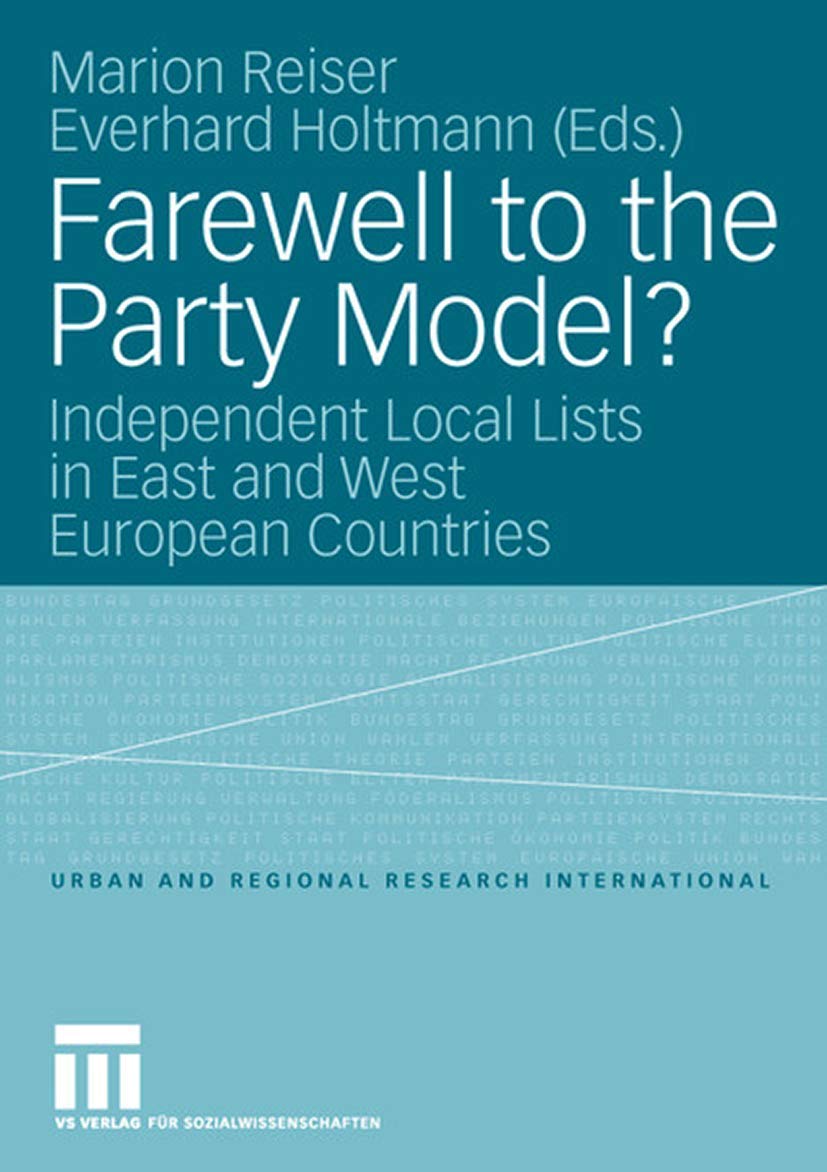
Farewell to the Party Model?: Independent Local Lists in East and West European Countries (Urban and Regional Research Internati,Used
Sold by Ergodebooks, an authorized reseller.
Returns accepted within 30 days | support@ergodebooks.com
Shipping Information
- Free Standard Shipping — United States only
- Processing Time: 3–5 business days
- Estimated Delivery: 6–10 business days after dispatch
- Double-boxed, fully insured & discreetly packaged
- Tracking number sent via email once dispatched
Returns & Refund
Returns accepted within 30 days of delivery.
Damaged or Defective Item
Free return shipping + replacement or full refund
Wrong Item Received
Free return shipping + replacement or full refund
Change of Mind
Return shipping at customer's expense · 25% restocking fee applies
Payment Option

Product Description Marion Reiser, Everhard Holtmann Local independent lists as political actors are a common phenomenon on the local level in many European countries in established Western democracies as well as in the new democracies in Central and Eastern Europe. In some West European countries, these nonpartisan groups have been an established and stable element in the local political system for decades. Ty cally, they understand themselves as protectors of a harmonious factual political style. In their opinion, good local politics is not compatible with party politics so they consequently perceive themselves as nonparties. During the last two d ades, presence and success of local lists have steadily increased in these co tries. Furthermore, during the last years local lists emerged also in countries which had been formerly fully partypoliticised on the local level. Explanations offered for these developments are often based on the observation of a general decline of trust in established parties and politicians. Hence, it has been argued that the disenchantment with political parties is a fertile ground for local lists. For the Central and East European countries, this argument can be ployed only to a certain extent. Local lists established themselves in the early 1990s as important actors on the local level especially due to a lack of party organisation in the process of democratic consolidation. Book Description A Comparative View of Croatia, Hungary, Poland, Portugal, Netherlands and Belgium From the Back Cover Local independent lists are a general phenomenon on the local level in many European countries in established Western countries as well as in new democracies in Middle and Eastern Europe. The research is linked to the muchdiscussed phenomenon of the growing disenchantment with political parties and the sceptical evaluation of political parties on the local level. Typically, these lists understand themselves as nonparties or antiparties and therefore assume a contra position in the local party system. The edited book aims first at developing a theoretical and conceptual framework for these nonpartisan lists. Second, the contributions describe and analyse for the first time comparatively presence, success, organisational structure, behaviour and performance of these local actors in twelve West and East European countries. About the Author Reiser, Marion, Dr., is Senior Research Fellow at the Institute of Political Science at the MartinLutherUniversity of HalleWittenberg. Holtmann, Everhard, Dr., is Professor of Political Science at the MartinLutherUniversity of HalleWittenberg.
⚠️ WARNING (California Proposition 65):
This product may contain chemicals known to the State of California to cause cancer, birth defects, or other reproductive harm.
For more information, please visit www.P65Warnings.ca.gov.