
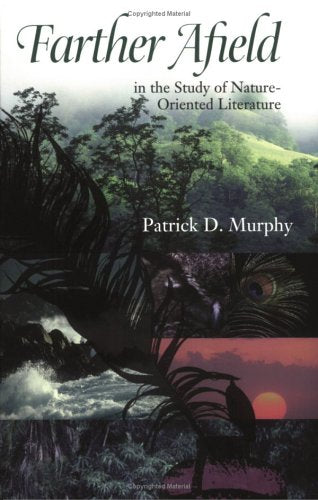
Title
Farther Afield In The Study Of Natureoriented Literature (Under The Sign Of Nature: Explorations In Environmental Humanities),New
Sold by Ergodebooks, an authorized reseller.
Returns accepted within 30 days | support@ergodebooks.com
Shipping Information
- Free Standard Shipping — United States only
- Processing Time: 3–5 business days
- Estimated Delivery: 6–10 business days after dispatch
- Double-boxed, fully insured & discreetly packaged
- Tracking number sent via email once dispatched
Returns & Refund
Returns accepted within 30 days of delivery.
Damaged or Defective Item
Free return shipping + replacement or full refund
Wrong Item Received
Free return shipping + replacement or full refund
Change of Mind
Return shipping at customer's expense · 25% restocking fee applies
Payment Option

From Library Journal In his third book on nature and literature, Murphy (Indiana Univ. of Pennsylvania) establishes a taxonomy of natureoriented literature'nature writing, nature literature, ecofiction, environmental literature, and whatever other terms critics use to label literary attention to the relationship of humanity to the rest of nature.' He does this through discussions of bias, ecofeminism, and postmodernism and through an examination of genre, mode, and critical orientation in specific literary works. In the book's final chapters, he expands his literary discussion to the subjects of pedagogy and language. A good bibliography provides a supplementary reading list. This informative though densely written text is recommended for academic collections or large public libraries.Sue Samson, Univ. of Montana Lib., Missoula Copyright 1999 Reed Business Information, Inc. Product Description In the 1990s, the emerging field of ecocriticismnaturesensitive literary studiesbegan to establish and define itself. Arguing that the field has matured to the point where it requires a thorough critique and new theoretical underpinnings, Patrick D. Murphy suggests a variety of ways ecocriticism can become more inclusive in its objects of study and more sophisticated in its methodologies.According to Murphy, ecocriticism in the United States has been too narrowly associated with the study of nonfiction. To broaden the field's purview, he proposes a new taxonomy that draws an important distinction between nature writinga nonfiction essay form descended from Henry David Thoreaunature literature, which includes fiction and poetry, and environmental literature, which is inspired by and concerned with a threatened natural world. He also urges ecocritics to expand their study to international literature, and he proceeds to survey natureoriented prose from Central America, the Caribbean, southern Africa, Spain, and Japan.On a theoretical level, Murphy addresses the relationship of ecofeminism to postmodernism and provides interpretations of contemporary American multicultural and women's literature, including works by Gary Snyder, Simon Ortiz, Jane Brox, Pat Mora, Lori Anderson, Nora NaranjoMorse, Sallie Tisdale, and Terry Tempest Williams. Applying his theories of ecocritical analysis to underappreciated or unknown literature, especially fiction and poetry by American women writers of color, Murphy introduces his fellow critics to authors ripe for ecocritical analysis.Murphy's wideranging book will no doubt serve as a watershed in the development of ecocriticism. Review A wonderful contribution to ecocriticism, advancing the field in many exciting ways. This is a book that will stimulate others to read new books, teach new kinds of classes, conceive of ecocriticism differently. It will contribute to a transformation of our thinking. Cheryll Glotfelty, University of Nevada, Reno Review A wonderful contribution to ecocriticism, advancing the field in many exciting ways. This is a book that will stimulate others to read new books, teach new kinds of classes, conceive of ecocriticism differently. It will contribute to a transformation of our thinking. (Cheryll Glotfelty, University of Nevada, Reno) Review 'A wonderful contribution to ecocriticism, advancing the field in many exciting ways. This is a book that will stimulate others to read new books, teach new kinds of classes, conceive of ecocriticism differently. It will contribute to a transformation of our thinking. 'Cheryll Glotfelty, University of Nevada, Reno Book Description A wonderful contribution to ecocriticism, advancing the field in many exciting ways. This is a book that will stimulate others to read new books, teach new kinds of classes, conceive of ecocriticism differently. It will contribute to a transformation of our thinking. About the Author Patrick D. Murphy, the founding editor of ISLE: Interdisci
⚠️ WARNING (California Proposition 65):
This product may contain chemicals known to the State of California to cause cancer, birth defects, or other reproductive harm.
For more information, please visit www.P65Warnings.ca.gov.