
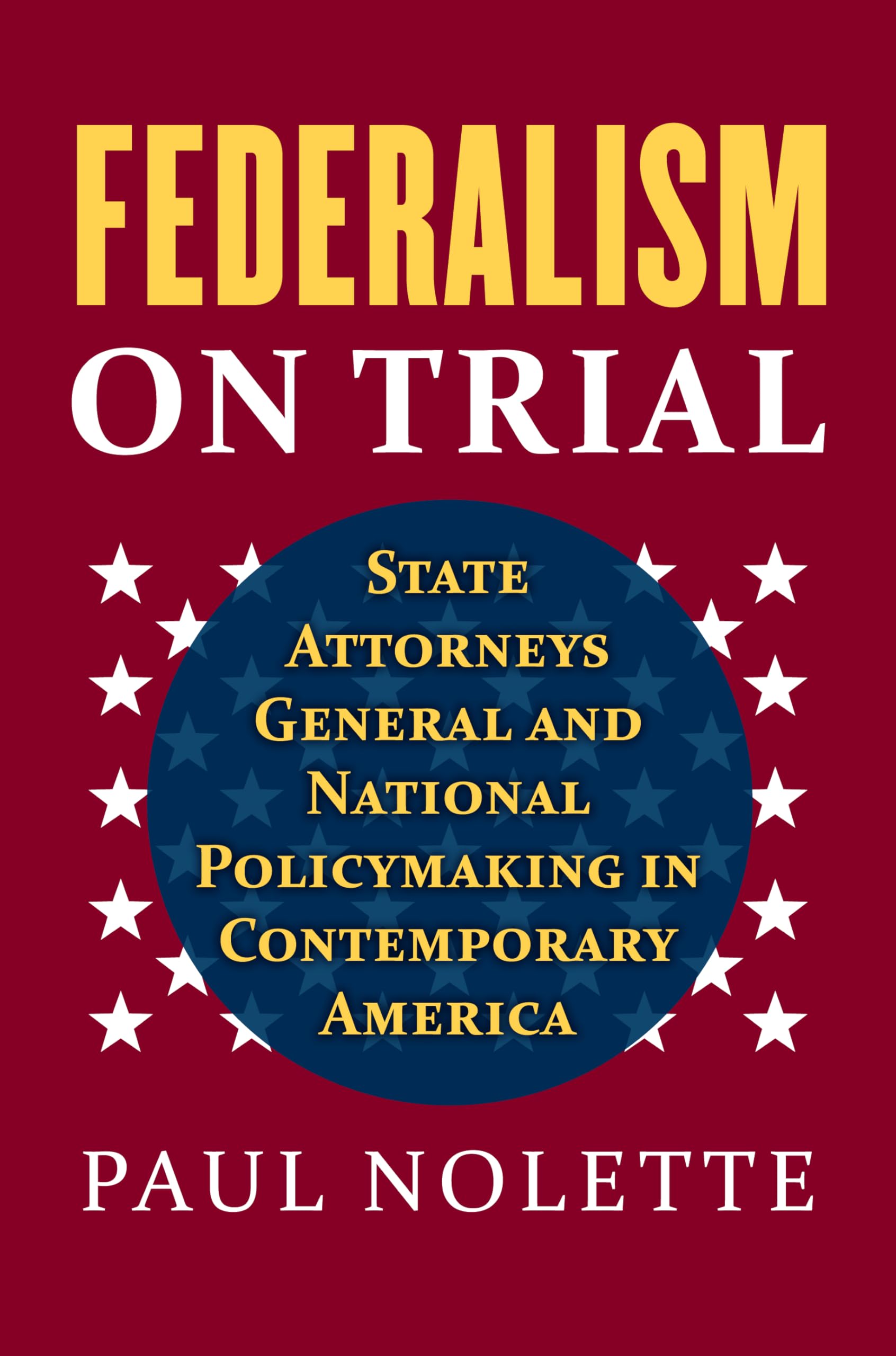
Title
Federalism On Trial: State Attorneys General And National Policymaking In Contemporary America
Sold by Ergodebooks, an authorized reseller.
Returns accepted within 30 days | support@ergodebooks.com
Shipping Information
- Free Standard Shipping — United States only
- Processing Time: 3–5 business days
- Estimated Delivery: 6–10 business days after dispatch
- Double-boxed, fully insured & discreetly packaged
- Tracking number sent via email once dispatched
Returns & Refund
Returns accepted within 30 days of delivery.
Damaged or Defective Item
Free return shipping + replacement or full refund
Wrong Item Received
Free return shipping + replacement or full refund
Change of Mind
Return shipping at customer's expense · 25% restocking fee applies
Payment Option

It Is One Of The Happy Incidents Of The Federal System, Justice Louis Brandeis Wrote In 1932, That A Single Courageous State May, If Its Citizens Choose, Serve As A Laboratory, And Try Novel Social And Economic Experiments Without Risk To The Rest Of The Country. It Is One Of The Features Of Federalism In Our Day, Paul Nolette Counters, That These Laboratories Of Democracy, Under The Guidance Of State Attorneys General, Are More Apt To Be Dictating National Policy Than Conducting Contained Experiments. In Federalism On Trial, Nolette Presents The First Broadscale Examination Of The Increasingly Nationalized Political Activism Of State Attorneys General. Focusing On Coordinated State Litigation As A Form Of National Policymaking, His Book Challenges Common Assumptions About The Contemporary Nature Of American Federalism.In The Tobacco Litigation Of The 1990S, A Number Of State Attorneys General Managed To Reshape One Of America'S Largest Industriesall Without The Involvement Of Congress Or The Executive Branch. This Instance Of Prosecution As A Form Of Regulation Is Just One Case Among Many In The Larger Story Of American State Development. Federalism On Trial Shows How New Social Policy Regimes Of The 1960S And 1970Sadopting National Objectives Such As Cleaner Air, Wider Access To Health Care, And Greater Consumer Protectionspromoted Both Adversarial Legalism And New Forms Of Cooperative Federalism That Enhanced The Powers And Possibilities Open To State Attorneys General. Nolette Traces This Trendas Ags Took Advantage Of These New Circumstances And Opportunitiesthrough Case Studies Involving Drug Pricing, Environmental Policy, And Health Care Reform.The Result Is The First Full Accountfarreaching And Finely Detailedof How, Rather Than Checking National Power Or Creating Productive Dialogue Between Federal And State Policymakers, The Federalism Exercised By State Attorneys General Frequently Complicates National Regulatory Regimes And Seeks Both Greater Policy Centralization And A More Extensive Reach Of The American Regulatory State.
⚠️ WARNING (California Proposition 65):
This product may contain chemicals known to the State of California to cause cancer, birth defects, or other reproductive harm.
For more information, please visit www.P65Warnings.ca.gov.
- Q: What is the page count of 'Federalism on Trial'? A: The book 'Federalism on Trial' has two hundred ninety-six pages. This length provides a comprehensive exploration of state attorneys general and their role in national policymaking.
- Q: What are the dimensions of this book? A: The dimensions of 'Federalism on Trial' are six and a half inches in length, one inch in width, and nine and a half inches in height. These dimensions make it a suitable size for both reading and display.
- Q: What type of binding does this book have? A: This book is bound in hardcover. Hardcover binding enhances durability and provides a more premium feel compared to paperback options.
- Q: Who is the author of 'Federalism on Trial'? A: The author of 'Federalism on Trial' is Paul Nolette. He provides insights into the political activism of state attorneys general in this comprehensive examination.
- Q: Which publishing company released this book? A: The book was published by the University Press of Kansas. This publisher is known for its academic and scholarly works.
- Q: How does 'Federalism on Trial' explore its themes? A: The book uses case studies to illustrate how state attorneys general influence national policy. It highlights significant legal battles and their implications for American federalism.
- Q: Is 'Federalism on Trial' suitable for general readers? A: Yes, 'Federalism on Trial' is suitable for general readers interested in politics and law. However, it may also appeal to scholars and students studying federalism.
- Q: What themes does 'Federalism on Trial' cover? A: The book covers themes like state activism, national policy, and legal regulation. It delves into the role of state attorneys general in shaping contemporary issues.
- Q: Can this book be used in academic settings? A: Yes, this book is appropriate for academic use. It provides valuable insights and case studies that can be useful for students and educators in political science.
- Q: How can I incorporate 'Federalism on Trial' into a study program? A: You can incorporate 'Federalism on Trial' into a study program by using its case studies as discussion points. They can help illustrate practical applications of federalism in contemporary America.
- Q: What is the main focus of 'Federalism on Trial'? A: The main focus of 'Federalism on Trial' is the political activism of state attorneys general. It examines how they function as key players in national policymaking.
- Q: What can readers expect to learn from this book? A: Readers can expect to learn about the evolving role of state attorneys general in the American political system. The book challenges conventional views of federalism.
- Q: Are there any notable case studies included in the book? A: Yes, the book includes notable case studies on drug pricing, environmental policy, and healthcare reform. These examples illustrate the impact of state-level legal actions.
- Q: Is there a specific audience for this book? A: The book targets audiences interested in political science, law, and public policy. It is especially relevant for those studying federalism and state governance.
- Q: How does this book challenge common assumptions about federalism? A: The book challenges the assumption that state attorneys general primarily check national power. Instead, it argues they often complicate and centralize national regulation.
- Q: What is the significance of the title 'Federalism on Trial'? A: The title 'Federalism on Trial' signifies the examination of state attorneys general's roles in shaping national policy. It reflects the ongoing debate about the nature of American federalism.